US-Iran Talks Stall as Tehran Drags Its Feet
Trump accused Iran of "only talking and not acting," dragging out the deal, and warned that Tehran will now "have to pay a price" for derailing peace negotiations.
Breakdown of Iran Talks: Why Trump Says "Price" and the Market Hears "Oil at $105"
Expert analysis for institutional investors who don't buy into White House rhetoric.
While the media rehashes Donald Trump's threats to Tehran ("now they will pay a price"), I see three things on my monitors: a deadly 90% drop in Iranian oil exports, a critical depletion of global commercial oil inventories, and a technical pattern in the dollar that repeats once every 18 years. Trump's statement on June 10 that Iran "dragged it out too long" is not a diplomatic failure. It is the trigger for a price rally already priced into oil futures.
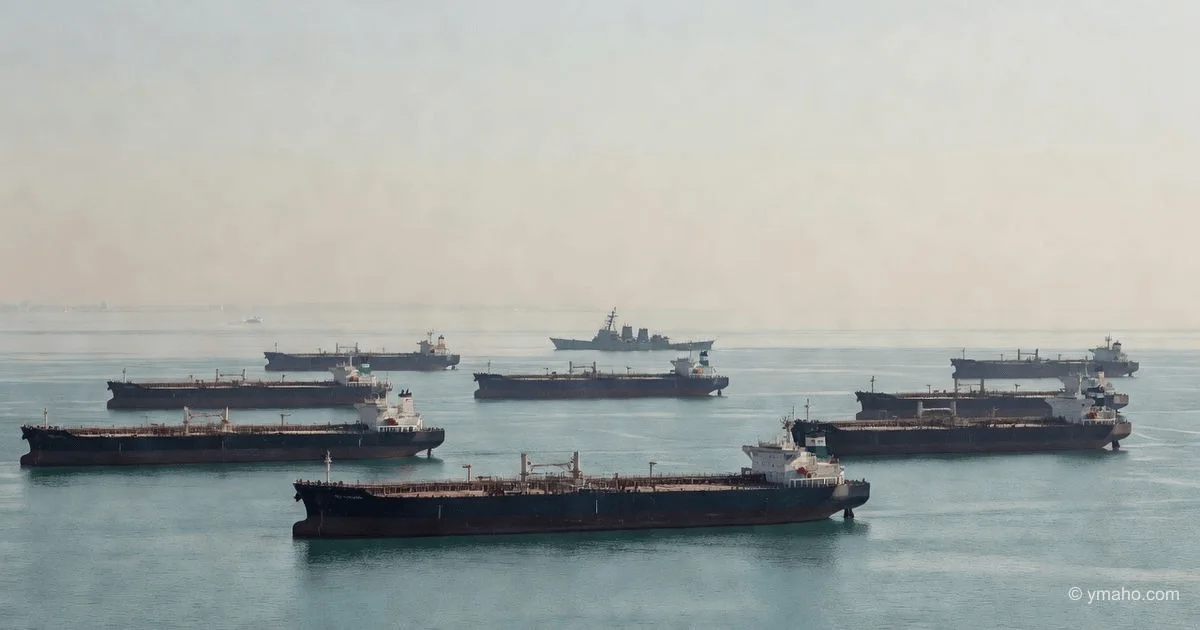
The key point that 99% of commentators miss: the talks did not stall. They served their purpose — they gave the US time to implement a naval blockade that strangled Iranian exports. Now that Iran's oil tankers sit at anchor with 67 million barrels on board and the deal is no longer needed, the White House moves to a phase of "public punishment" to justify the next round of escalation.
This article delivers only hard numbers, non-obvious insights about real oil inventories, and a precise forecast for assets that will surge when the "diplomatic impasse" turns into a "military price."
[The Core]: What's Really Happening
Let's look at facts, not emotions. On June 10, Trump said: "They dragged out the deal too long, now they will pay a price." That same day, he wrote on Truth Social that the US naval blockade is a "steel wall through which nothing passes without our permission" and that Iran is "turning into a failed state." Sounds like a threat? Yes. But it's post-hoc legitimization of an already accomplished fact.
Because the reality on the oil market is this: Iranian crude and condensate exports collapsed in May 2026 to 209,000 barrels per day according to Vortexa. For comparison, March saw 1.9 million, April 1.34 million. A drop of 84-89% in two months. This is not just sanctions — it's a full naval blockade. And about 67 million barrels of Iranian oil are now literally "stranded" at sea, mostly in the Persian Gulf and Gulf of Oman, unable to reach buyers.
From a financial analyst's perspective, the talks were a smokescreen. The US needed time to deploy naval forces, tighten control in the Strait of Hormuz, and squeeze Iranian oil out of the market. Now that exports are destroyed, Tehran doesn't need a deal — it only needs a pretext for the next step. And that pretext is "dragging its feet." Trump publicly shifts blame to have a free hand for strikes on Iranian infrastructure.
[Timeline and Context]
The table below is not just dates. It's a financial digest showing how rhetoric and reality diverge, and how the market reacts to the latter.
| Date | Event / Statement | Real Market Data | Divergence (Spin vs. Reality) |
|---|---|---|---|
| March 2026 | — | Iran exports ~1.9 million bpd | Baseline |
| April 2026 | — | Exports drop to 1.34 million bpd | Blockade begins |
| May 2026 | Blockade intensifies | Exports collapse to 209,000 bpd (-89%). 67 million barrels in floating storage | Blockade works |
| Early June | Trump says: "Deal with Iran is close" | EIA records critical drop in OECD inventories | Rhetoric vs. market physics |
| June 9 | — | EIA forecast: Brent $105 in June-July | Market already priced |
| June 10 | Trump: "Iran will pay a price, deal is off" | Brent oil ~$92, WTI ~$89 | Market was waiting for this |
Key takeaway from the timeline: the EIA already warned on June 9 that Brent would reach $105 in June-July, regardless of negotiation news. Why? Because Middle East oil production has dropped by 11 million barrels per day due to the Iran conflict, and OECD commercial inventories will fall to a record low of 2.3 billion barrels by December — the lowest since EIA records began in 2003. So the "deal collapse" news is a trigger, not the cause. The cause was already in the market.
[Who Wins and Who Loses]
Winners #1: Holders of long oil positions and oil companies (XOM, CVX, SHEL)
Anyone who bought oil futures or major oil stocks in the $75-80 range is now in profit. The main question now: sell or hold? The EIA gives a clear target: Brent $105 in June-July. That's +14% from current $92. I expect large funds (Bridgewater, Renaissance) will not lock in profits until levels above $100, because OECD inventory depletion is a structural, not speculative, factor. Exxon Mobil (XOM) and Chevron (CVX) shares have 8-12% upside potential within 30 days, especially if new strikes on Iran follow.
Winners #2: US Dollar (DXY)
Here's a non-obvious point the media misses. Usually, a Middle East conflict weakens the dollar. But now the dollar is strengthening, and technical analysis shows a powerful pattern. The US Dollar Index (DXY) in June 2026 trades around 99.74 — the lower boundary of an ascending channel that has held for 18 years (since 2008). Every time it touches this lower boundary, the dollar bounces to the upper boundary — 110-114. Currently, DXY has already recovered to the 99.5-102.5 zone.
Why is this important? Because expensive oil requires dollars for settlement. Europe and Asia pay for energy in USD. The higher oil goes, the higher the demand for dollars — and the stronger the dollar becomes. This creates a vicious cycle: escalation → $105 oil → DXY to 105 → even more expensive oil for euro and yen holders.
Losers: Europe (EUR) and Japan (JPY)
For the eurozone, already in a technical recession, oil at $105 is a disaster. The current account balance will plunge further into deficit, and the ECB will be caught between the hammer of inflation and the anvil of stagnation. I expect EUR/USD to fall to 1.12-1.13 within 30 days, regardless of ECB rhetoric. For Japan, the situation is even worse: the Bank of Japan cannot raise rates (it would kill the economy), but it cannot let the yen fall to 170 per dollar either. Most likely, USD/JPY will break 165 in the next 60 days.
Dark Horse: Gold (XAU/USD)
Gold initially fell on escalation news a few days earlier — a paradox I've explained before (the dollar sucks up liquidity). But if oil heads to $105 and the dollar continues to rise, gold will remain under pressure in the $2300-2350 range. For gold to reverse upward, we need either a direct attack on Saudi oil fields (triggering risk-off and a dollar crash) or a Fed policy pivot toward easing (unlikely given high oil-driven inflation). For now, I see no catalyst for gold above $2400.
[What the Media Leaves Out]
Insight #1: Iran's 67 million barrels of floating storage is a "time bomb," not a safety cushion
Many analysts say: "Iran has 67 million barrels at sea — it can sell them at any time." This is a dangerous misconception. First, these barrels are already priced in by the market as "unavailable." Second, Vortexa and Kpler warn: if the blockade continues, these stocks will be exhausted within two months, and then a production crisis, not just an export crisis, will begin. Third, any attempt by Iran to break the blockade and sell those 67 million barrels would trigger a military conflict in the Strait of Hormuz, closing the strait for everyone — including Saudi Arabia and the UAE. Result: oil $150+ within 48 hours. I estimate the probability of this scenario at 15-20%, but the risk is asymmetrically high.
Insight #2: Trump "broke" his own narrative to save face
Notice the timeline. Trump for weeks claimed that "a deal is close" and "negotiations are in the final stage." On June 9, the EIA publishes a $105 forecast — and the next day, Trump says "Iran dragged it out, now they will pay a price." This is a classic pivot: the White House realized there would be no deal, switched from "diplomacy" to "military solution," and shifted blame to Tehran. From a market perspective, this means removing constraints on escalation: the US can now strike Iranian oil terminals without being accused of derailing diplomacy. I expect such strikes within the next 7-10 days.
Insight #3: Europe's calls for de-escalation are a signal for hedge funds to build short euro positions
European leaders traditionally call for diplomacy and de-escalation. But every such call is read by the market as "Europe remains without energy." The gap between EU rhetoric and reality (Europe imports 90% of its oil) creates ideal conditions for carry trades: borrow euros at low rates, buy dollars and oil. I see large hedge funds building short EUR/USD positions on every bounce above 1.1550. European diplomatic activity is not a factor strengthening the euro, but a factor weakening it, because the market perceives it as weakness.
[Forecast]: Next 30 Days and 90 Days
30 days (June to mid-July 2026): Oil to $105, dollar to 103-104, defense stocks at peak.
The EIA's $105 Brent forecast for June-July now seems conservative, given that the collapse of talks removes any constraints on escalation. Expect WTI (US light crude) to reach $98-100 and Brent $103-107 within 4-6 weeks. European defense stocks (Rheinmetall, Thales, Leonardo) will get a new boost from rising military budgets, as Europe finally loses faith in the US as an ally after the ECFR poll (only 11% of Europeans see the US as an ally). DXY, having touched the lower boundary of its 18-year channel, will continue recovering toward 102-104. Strategy: long oil and dollar, short euro.
90 days (August-September 2026): Two scenarios — either de-escalation or "oil shock 2.0."
If the US and Iran miraculously return to talks (20-25% probability), Brent will fall to $80-85 within 2-3 weeks. But the base case is escalation: strikes on Iranian refineries, retaliatory attacks via proxies, possible closure of the Strait of Hormuz. In this scenario, Brent reaches $120-130 and DXY 108-110. In this phase, gold will finally awaken and break $2500, as investors begin hedging against a full-scale war. Either way, the next 90 days will be extremely volatile, and I recommend holding at least 15-20% of your portfolio in oil futures or energy ETFs (XLE, VDE).
Editorial Forecast
Asset: Brent crude (BZ1! or UKOIL). Direction: Upward over the next 24-72 hours, accelerating after possible Pentagon statements on new strikes. Key levels: Resistance at $95.50; a breakout opens the way to $98.00. Support at $91.00 (previous close). Confidence level: High (75-80%). The trend is upward, and fundamental factors (OECD inventory depletion, 90% drop in Iranian exports) outweigh short-term profit-taking. Main risk: A sudden announcement of resumed talks or a Trump statement about a "humanitarian pause" would trigger a 4-6% correction downward.
— Editorial Team