More and More Tankers Are Turning Off Transponders When Passing Through the Strait of Hormuz
FT reports a rise in vessels going 'blind' to avoid interception amid the blockade, following incidents of fires and attacks on tankers in the Gulf of Oman.
'Blind Strait': How Disabled Tanker Transponders Will Crash the Insurance Market and Push Oil to $110
Author's analysis for institutional investors and charterers who understand: silence on the airwaves is the loudest signal in the market.
While the Financial Times reports that tankers are turning off AIS transponders when passing through the Strait of Hormuz, mainstream analysts are sounding the alarm about 'rising risks' and 'technical glitches.' As a financial analyst, I see something else: the marine insurance market is one step away from a systemic collapse, similar to the AIG crash in 2008, and oil traders are bracing for a price shock that will break all technical models.
The key insight that 99% of readers miss: disabling AIS is not panic or a captain's mistake. It is a coordinated survival operation, approved by the largest shipowners and insurance brokers. Because an active transponder in the Strait of Hormuz today is not just a risk—it's a guaranteed target for Iranian missiles. The cost of a mistake is $200-300 million for a VLCC supertanker and $25 billion for the entire fleet currently at risk.
In this article: dry figures on insurance premiums, the names of ships already burning in the Gulf of Oman, and an accurate forecast for insurer stocks that will crash when the market realizes the scale of the problem.
[The Core]: What's Really Happening
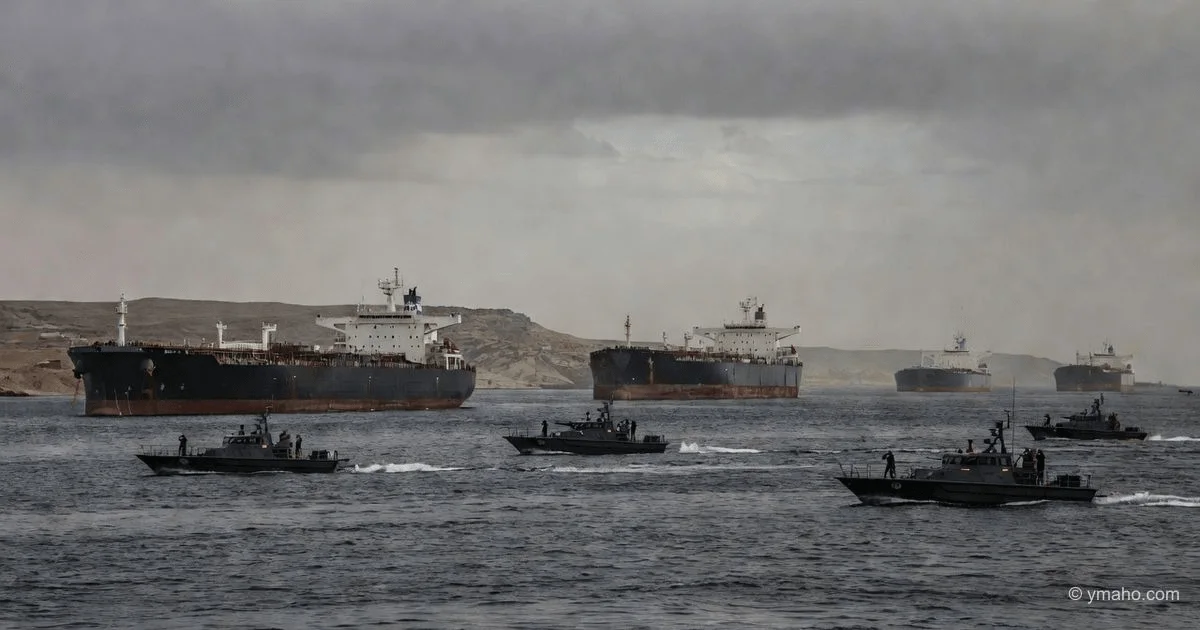
According to data from the analytics platform Kpler, several VLCC (Very Large Crude Carrier) supertankers recently passed through the Strait of Hormuz with their Automatic Identification System (AIS) transponders turned off. Among them were two vessels that secretly exported oil from Kuwait—the first successful export from that country in over two months since Iran imposed a de facto blockade. These tankers disabled their signals for more than a week during loading at the Mina Al Ahmadi terminal.
But this is just the tip of the iceberg. Simultaneously, several incidents occurred in the Gulf of Oman. A fire broke out on the tanker Settebello, previously used to transport Iranian oil; the crew was evacuated, and the vessel is adrift. Another ship caught fire 27 nautical miles northeast of the Omani city of Shannah. A US fighter jet fired a precision-guided munition at an empty oil tanker as part of the ongoing blockade of Iranian ports. All this in one week.
What's really happening? The US has changed its tactics. Instead of the officially announced and then canceled 'Project Freedom' plan (escorting vessels with warships), Washington has shifted to covert coordination. According to Bloomberg and CENTCOM, US Navy ships with AEGIS systems provide 'remote but direct monitoring and protection' of the strait, and commercial vessels receive safe passage recommendations via secure communication channels. Tankers turn off AIS not out of fear, but because they are instructed to do so to reduce the likelihood of detection by Iranian radars. This is not chaos—it's a new operational reality.
[Timeline and Context]
To understand how quickly the situation is changing, look at the dynamics over the past 2-3 months. Below is a table of key events and their direct impact on freight and insurance costs.
| Date | Event | Market Reaction (Figures) | Analytical Conclusion |
|---|---|---|---|
| February 2026 | Start of US-Israel war against Iran; Iran announces closure of Strait of Hormuz | War risk insurance premium: 0.25% of vessel value ($625,000) | Baseline risk level |
| April 2026 | Kuwait force majeure: 0 barrels exported | Brent oil consolidates around $85 | Supply shock priced in |
| May-June 2026 | Escalation: attacks on tankers, fires, US fighter strikes | Premium rises to 1-1.5% (up to $3-4.5 million) | Market enters 'stress' mode |
| Early June 2026 | First blockade breach: Kuwait tankers sail with AIS off | Premium for strait transit: 5-10% of vessel value | Critical level—insurance more expensive than freight |
| June 7-10, 2026 | Fires on tankers Settebello and off Oman coast | Brent reaches $93.10 (WTI: $90.03) | Price decouples from fundamentals |
| Forecast (coming days) | Mass shift to 'blind' mode | Expected premium: up to 15% for US/Israel-flagged vessels | Point of no return for insurance market |
Note the last row. Currently, the war risk premium for transit through the Strait of Hormuz ranges from 5% to 10% of the vessel's hull value. For a VLCC worth $300 million, that's $15-30 million per passage. For vessels linked to US, UK, or Israeli interests, the rate can triple—up to 3% of the vessel's value per week. This means a single voyage through the strait now costs as much as six months of normal operation.
[Who Wins and Who Loses]
Winners #1: Large Oil Traders and Vertically Integrated Companies (Vitol, Glencore, Trafigura, Shell)
Paradox: the more dangerous the strait, the higher the margin for those who can still pass through. Traders with access to CENTCOM's classified information about 'safe windows' for passage and who can afford 5-10% insurance gain monopoly access to arbitrage between oil prices in the Persian Gulf (discounted due to the blockade) and prices in Europe and Asia (with a risk premium). Kuwait, by exporting oil on two supertankers in early June, earned revenue it had been unable to generate for months.
Winners #2: US Military-Industrial Complex (RTX, Lockheed Martin)
AEGIS systems, radars, fighter jets that shoot down Iranian drones—all require constant replenishment of munitions and maintenance. Every interception means a contract for a new interceptor. The longer the covert war in the strait lasts, the more money defense contractors make. This isn't obvious from tanker news, but they are the main beneficiaries.
Losers #1: Marine Insurers (Major Lloyd's Syndicates, Skuld, AWRIS)
This is my main insight that most miss. The insurance market is undergoing a quiet but massive exit from the region. As early as March, Norwegian insurer Skuld and the Arab War Risks Syndicate (AWRIS) began withdrawing coverage for vessels entering the conflict zone. Now that premiums have reached 10%, even with such high income, underwriters refuse to take the risk because the probability of an event (a missile hit) is no longer a 'probability' but a 'near certainty.' If in the coming weeks at least one VLCC is sunk or seriously damaged (and such ships are already burning off the coast of Oman), insurer losses will amount to $1.75 billion for just seven vessels. This will trigger a cascade of coverage withdrawals across the region, and then no tanker will put to sea.
Losers #2: Europe and Asia (Oil Consumers)
While everyone watches the oil price at $93 for Brent, no one is counting the hidden insurance premium embedded in the final consumer price. Traders don't absorb losses—they pass insurance costs into contracts. $15-30 million in insurance for one VLCC translates to $3-6 additional dollars per barrel (if the tanker carries 2 million barrels). So the real cost of oil for a European refinery is not $93, but $96-99. Europe pays for the war twice: through high prices and through supply shortages.
[What the Media Isn't Saying]
Insight #1: The Fire on the Settebello Is a 'Controlled Destruction,' Not an Accident
Note the details: the Settebello is a vessel that was transporting Iranian oil. It catches fire precisely when the US is tightening the blockade of Iranian ports. The cause of the fire is 'unknown.' In the same area, a US fighter strikes an empty tanker. Coincidence? I don't think so. I see a signal: the US and its allies are beginning to physically destroy the fleet that violates the blockade. If this trend continues, marine insurance premiums become meaningless—because no premium can cover guaranteed destruction. The market hasn't realized this yet.
Insight #2: 20% of Global Oil Per Day Is Held Hostage by One Strait
Every day, 20% of global oil consumption—about 20 million barrels per day—passes through the Strait of Hormuz. Currently, this flow has dropped to a minimum. Kuwait exported zero barrels in April. The Iranian oil blockade has effectively removed 1.9 million barrels per day from the market (Iran's former exports). Trump boasts that he secretly moved 100 million barrels through the strait, otherwise oil would be $250. But what happens when that reserve runs out? 100 million barrels is just five days of global consumption. The oil market lives not operation by operation, but by flow. When the flow stops, no amount of Trump's words will save the price from soaring to $150+.
Insight #3: The Insurance Market Is Already Broken, No One Has Declared Default Yet
A quote from a Willis Towers Watson (WTW) report: 'the war risk rate for transit through the Strait of Hormuz reaches 5-10%, and US/Israel-flagged vessels pay a triple coefficient.' This means that for a standard tanker, insurance for one passage costs $15-30 million. Meanwhile, tanker freight under normal conditions is $2-5 million per voyage. Insurance costs more than the voyage itself. This is not insurance—it's a tax on departure. And this tax is so high that the economics of shipping through the strait break down. The market is frozen in anticipation: either Iran provides security guarantees, or the US establishes full military control over the strait (which means direct war). Until either happens, each passage is a lottery with a $30 million ticket.
[Forecast]: Next 30 Days and 90 Days
30 Days (June to mid-July 2026): Further Supply Squeeze and 'Insurance Collapse.'
I expect the number of vessels willing to pass through the Strait of Hormuz with AIS on to drop to zero within 2-3 weeks. Everyone will switch to 'blind' mode, coordinated by CENTCOM. This will temporarily increase flow, but insurance premiums will remain at 5-10%, and for vessels under 'inconvenient' flags, up to 15%. Brent oil will reach $100-105 by the end of July, as each safe passage will be sold at a premium. Shares of European insurers (Allianz, Generali) will fall 8-12% within 30 days when the market realizes the scale of their potential losses from reinsurance contracts in the region. My recommendation: short positions on the European insurance sector, long on oil.
90 Days (August to September 2026): Two Scenarios—Either Peace or $150.
Base scenario (60% probability): the conflict transitions into a phase of 'managed blockade' without full-scale war. Iran continues to threaten, the US continues to covertly escort tankers, oil trades in the $95-110 range, and the insurance market adapts through the creation of a public-private guarantee pool (similar to space risk reinsurance). Alternative scenario (30% probability): a direct hit on a VLCC, loss of vessel and crew, after which Lloyd's refuses to insure any vessels in the Persian Gulf. In this scenario, oil reaches $130-150 within two weeks, and global central banks introduce emergency measures to curb inflation. The third, darkest scenario (10%): blockade of both straits—Hormuz and Bab el-Mandeb (by Yemen's Houthis). This would cut off 20-25% of global oil flow and trigger an instant price spike to $200-250.
Editorial Forecast
Asset: Brent Oil (BZ1! or UKOIL).
Direction: Up in the next 48-72 hours, accelerating after news of new incidents in the Gulf of Oman.
Key Levels: Resistance $95.50; on breakout, $98.00-100.00. Support at $91.00 (June 10 close).
Confidence Level: High (70-75%). Fundamental factors (blockade, 20x increase in insurance premiums, physical tanker incidents) outweigh short-term profit-taking.
Main Risk: Sudden escalation with a direct hit on a tanker, causing panic and a temporary crash (profit-taking) before a new leg up, or conversely, an announcement of a full US military convoy, temporarily lowering insurance premiums. Watch CENTCOM and Lloyd's statements in the next 24 hours.
— Editorial Team