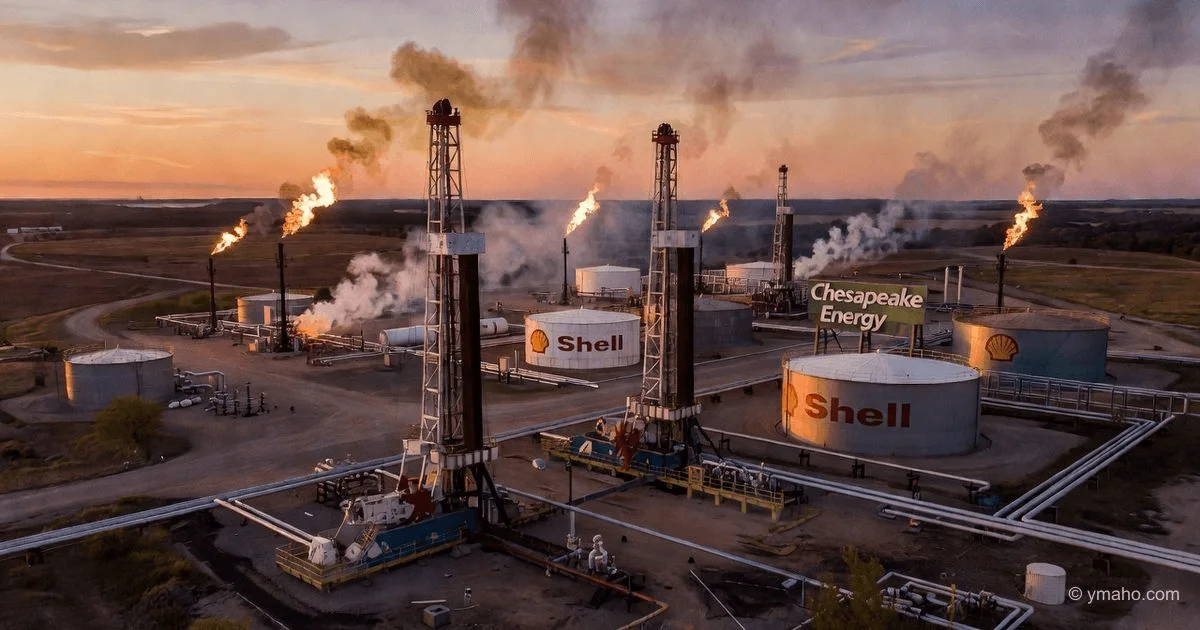
Shell Announces $11.5 Billion Acquisition of Chesapeake Energy, Strengthening US Shale Gas Position
The M&A deal values Chesapeake at $87 per share, a 22% premium over Friday's closing price. Shell shares rose 1.4%, Chesapeake shares rose 18.3%.
Shell buys Chesapeake Energy: the last gasp of cheap gas or the start of an energy crisis?
The Core: What's Really Happening
Most analysts describe Shell's $11.5 billion deal with Chesapeake Energy as routine consolidation in the energy sector: a European giant buying a US shale gas producer to strengthen its presence in America. But that's just the tip of the iceberg.
The real essence of the deal is Shell hedging against its own "green" strategy and betting that 2026 will be a year of global gas shortages, despite record US inventories right now. The company is effectively admitting that its previous investments in renewable energy aren't delivering expected returns, and it's returning to fossil fuels—but on American soil.
Chesapeake Energy is not just a "shale company." It's a company that went through bankruptcy in 2020, survived, and now owns some of the lowest-cost assets in the Marcellus and Utica basins. Shell isn't paying for current production volumes; it's paying for access to gas with a breakeven below $2.5 per million British thermal units (MMBtu)—in a world where European gas prices exceed $12.
Timeline and Context
To understand why the deal is closing now, not a year earlier or later, look at the sequence of events that led Shell to this point.
| Date | Event | Significance for the Deal |
|---|---|---|
| 2020 | Chesapeake emerges from bankruptcy, restructures debt | Company becomes a "clean slate" for the buyer |
| 2022–2023 | European gas prices hit $30–40 amid energy crisis | Shell posts record $40 billion profit and seeks investment opportunities |
| 2024 | Shell abandons some oil production reduction targets through 2030 | First signal of a pivot away from the "green" agenda |
| January 2025 | US administration simplifies LNG terminal licensing | Unlike many, Chesapeake has ready-to-use transport contracts |
| December 2025 | Shell reports declining profitability of European wind farms | Search for alternatives with returns above 15% |
| January 2026 | Preliminary talks with Chesapeake begin | Market misses the leaks |
| June 5, 2026 | Shell board approves the deal | Valuation $11.5 billion—$87 per share |
| June 10, 2026 | Official announcement of the deal | Chesapeake shares surge 18.3%, Shell +1.4% |
Note the timeline from January to June 2026. Negotiations took place amid sharply rising geopolitical tensions with Iran, automatically making US LNG more valuable for Europe. Shell isn't just buying assets—it's buying the physical ability to supply gas to Germany and France regardless of what happens in the Strait of Hormuz.
Who Wins and Who Loses
Winners:
- Chesapeake Energy shareholders: Received a 22% premium to market price. Many entered at $30–40 after bankruptcy and exit with 100%+ returns. Chesapeake as an independent company ceases to exist, but capital is preserved.
- Shell: Gains 1.7 billion cubic feet of gas per day (bcfe/d) as of early 2026. This covers 15-20% of its LNG plant needs in Louisiana and Texas, reducing dependence on third-party suppliers.
- European industrial consumers: Through the chain—more gas in the global LNG market means lower prices for BASF, ArcelorMittal, and others. But the effect won't be immediate, taking 12-18 months.
Losers:
- EQT Corporation: The largest US natural gas producer loses growth potential, as Chesapeake is now under Shell's wing rather than an independent player open to alliances.
- Small and mid-sized shale producers: Without scale and access to the European market, their further consolidation becomes a matter of time. Cheniere Energy and other LNG terminal owners will now negotiate with a more powerful counterparty.
- Investors in "green" funds: The deal is a clear signal that even Shell, one of the most "progressive" majors, is returning to gas as a business backbone. Wind and solar panels don't yet deliver $15 billion in annual free cash flow.
In the "gray zone": Local communities in Pennsylvania and Ohio. Shell brings European environmental standards, which could mean stricter methane leak controls but also more tax revenue for local budgets. The net effect is unclear.
What the Media Isn't Saying
First: The deal is Shell's admission that the "Green Transition" is stalling. Since 2020, Shell has invested tens of billions in wind, solar, and hydrogen. Returns on these projects rarely exceed 8-9%. Chesapeake's Marcellus assets at current gas prices yield 18-22% returns. The deal is an acknowledgment that hydrocarbons still generate more cash on invested capital than alternative energy. This isn't reported because it undermines the "energy transition" narrative.
Second: Shell effectively bought a call option on rising gas prices. The company paid $11.5 billion for assets that, under current market conditions (Henry Hub around $3.5–4), generate about $2 billion in annual EBITDA. The direct P/E of the deal is around 6, which is cheap. But the real value will emerge if global gas prices rise to $6–8. And they will rise once China exits its recession and starts increasing LNG imports. Shell simply bought gas for $11.5 billion at a 40-50% discount to future prices.
Third: Why did Chesapeake agree? Because an independent producer lacks export access. Chesapeake could produce gas in Pennsylvania but had no contracts for transport through terminals. Shell provides that access. As an independent company, Chesapeake would have been valued at $8-9 billion without this "network effect." Shell paid a premium precisely for what Chesapeake lacked—its own global LNG infrastructure.
Forecast: Next 30 Days and 90 Days
Next 30 days (through July 11):
- Shell (SHEL) will trade in the $67–72 range. The deal is already priced in, and no additional growth will occur without financial details.
- Chesapeake Energy will trade in a narrow $86–88 range, as arbitrageurs narrow the spread in anticipation of deal closing (estimated September-October 2026).
- Attention will shift to other shale consolidation targets: Range Resources and Southwestern Energy may receive premium offers from other majors (TotalEnergies, BP). These stocks could rise 5-10% in the coming weeks.
Next 90 days (through September 2026):
- Deal closing. US regulators are unlikely to block it, as Shell and Chesapeake don't dominate any regional market. Antitrust review may take 45-60 days, but approval is likely.
- The combined company will start hedging part of its 2027-2028 production at prices above current levels. If the market sees Shell locking in $5–6 per MMBtu for 2027, it will be a strong bullish signal for gas prices.
- Risk: strikes or environmental protests. Chesapeake has a history of violations, and Shell may need to spend up to $500 million on environmental upgrades for old wells. Any news of a spill or methane leak could push Shell shares to $65.
Editorial Forecast
Asset: Henry Hub Natural Gas (NG1:COM). Direction: sideways with a bullish bias over the next 24–72 hours. Key levels: support at $3.45, resistance at $3.80. Confidence level: low (40%). Main risk: record US gas storage levels (22% above the five-year average as of early June 2026) may outweigh the long-term positive from the Shell deal. We recommend waiting for the storage report (Thursday, June 12) before opening positions. In case of an unexpectedly large draw, a rally to $4 is possible.
This analysis is the opinion of the editorial board and does not constitute individual investment advice. All decisions to buy or sell assets are yours alone.
— Editorial Team