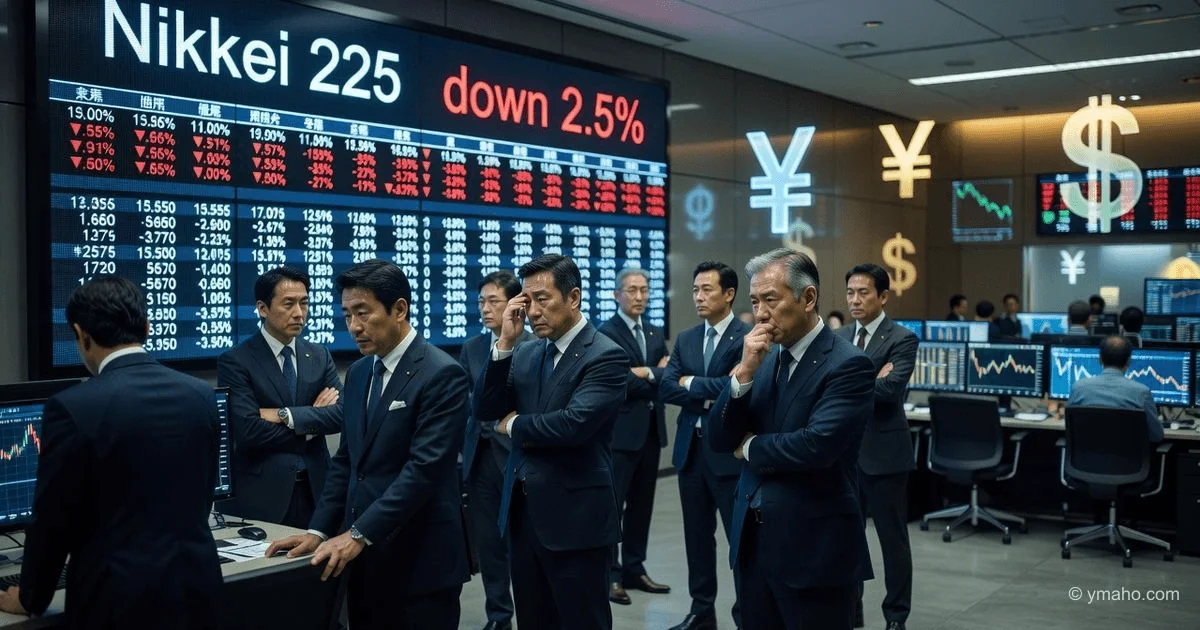
Japan's Nikkei 225 Plunges 2.5% on Fears of BOJ Intervention
The yen's strengthening to 138 per dollar hit exporters: Toyota lost 3.8%, Sony 2.9%. Hong Kong's Hang Seng, on the other hand, rose 1.1% on hopes of Chinese stimulus.
Nikkei Crashed 2.5%, Hang Seng Rose: Anatomy of an Asian Reversal That Headlines Ignore
[The Core]: What's Really Happening
Most analysts explain the Nikkei's 2.5% drop by fears of Bank of Japan intervention and the yen strengthening to 138 per dollar. Toyota shares lost 3.8%, Sony 2.9%. Meanwhile, Hong Kong's Hang Seng rose 1.1% on hopes of Chinese stimulus. It seems like just a divergent move of two Asian markets. But the reality is far more complex and alarming.
The real essence of what's happening is a tectonic rift between the "Japanese" and "Chinese" models of survival amid global turbulence. Japan, an export-oriented country with massive external debt, suffers from any yen strengthening because its corporations earn abroad but incur costs in yen. China, on the contrary, is a manufacturing country with a controlled exchange rate and powerful fiscal leverage, ready to print yuan to support its markets.
My insider view: The Nikkei's 2.5% drop is not just a reaction to the yen. It's an acknowledgment that the Japanese economy is caught between the hammer of geopolitics (Iran, US) and the anvil of its own debt burden. Japan's government debt exceeds 250% of GDP. Even a 0.25% rate hike by the Bank of Japan would increase debt service costs by tens of billions of dollars. So the BOJ cannot raise rates as the market wants. Without a rate hike, the yen will weaken, and interventions will only be a temporary measure.
At the same time, China, having announced a PSL program of 1.5 trillion yuan (about $230 billion) and preparing to increase quotas for local debt replacement, demonstrates a willingness to do what Japan cannot. Markets see this. The Hang Seng is rising despite weak macroeconomic data. Investors are voting with their money for the "Chinese case" and against the "Japanese dead end."
Timeline and Context
The table below maps how over the past two weeks, the Japanese and Chinese markets have diverged despite a common external backdrop.
| Date | Event | Impact on Nikkei / JPY | Impact on Hang Seng / CNY |
|---|---|---|---|
| Feb 28 – May 2026 | Operation "Epic Fury" — US-Iran conflict, oil above $90 | Pressure on yen (Japan imports energy) | Neutral-positive (China is a net importer but has reserves) |
| June 1, 2026 | Morgan Stanley raises Hang Seng target to 28,400 points | No change | +1.5% in a day, start of rally |
| June 3, 2026 | Reports of 1.5 trillion yuan PSL plan and increased debt replacement quotas | Negative (capital flows to China) | +0.8%, Hang Seng holds above 27,500 |
| June 9, 2026 | Japan PPI data: acceleration to 6.3% YoY — highest since March 2023 | Initially positive for yen, but market realizes inflation is from oil, not demand | No direct impact |
| June 10, 2026 | Nikkei falls 2.5% to 63,772, yen at 160.35 | Panic among exporters | Contrast: Hang Seng holds |
| June 10-11, 2026 | US rate rise (inflation data, hawkish Fed expectations) | Pressure on yen via rate differential | Pressure on yuan, but China can resist better |
| June 11, 2026 | Asian trading: Nikkei at 63,800, Honda -1%, SoftBank -7% in previous days | Panic among exporters | Hang Seng at 27,500, awaiting new stimulus |
The main takeaway from the timeline: The Japanese market reacts to every external event (Iran, Fed, oil) with an immediate drop because the BOJ's hands are tied. The Chinese market, on the other hand, receives government support and thus shows resilience.
Who Wins and Who Loses
Winners:
Chinese market overall (Hang Seng, CSI 300): Morgan Stanley gave a Hang Seng target of 28,400 points, 10-12% above current levels. Investors who entered Chinese assets in late May to early June are already seeing profits.
Investors in Chinese bonds and PSL instruments: The 1.5 trillion yuan PSL program is "China's version of QE." Money will go into infrastructure, supporting construction companies and banks.
Toyota and Sony shareholders (if they hedged currency risks): The 3.8% and 2.9% drops are painful, but companies with currency hedging suffer less. However, retail investors without hedging lose directly.
Traders betting on USD/JPY upside: USD/JPY holds above 160. XS.com analysts expect a move to 162 in the coming weeks. The rate differential (US > 270 bps above Japan) remains the main driver.
Losers:
Japanese export companies (Toyota, Sony, Honda, Nissan): Every yen strengthening means billions of yen in losses from foreign revenue revaluation. Toyota lost 3.8% in one day. Honda about 1%. And it's not over if the yen continues to strengthen.
Japanese pension funds and insurers: They hold huge portfolios of foreign bonds (mostly US Treasuries). Yen strengthening means their assets depreciate when converted back to yen.
Retail investors in Japan who bought Nikkei at highs: The index fell 2.5% in a day, and over the past week more than 6.5%. Those who bought at 66,000-67,000 see losses.
Short sellers of Hang Seng: Those betting on a continued fall of the Chinese market are caught in a trap. The 1.1% rise and Morgan Stanley's 28,400 target force them to close positions at a loss.
Who is in the "gray zone": The Bank of Japan. If it raises rates to support the yen, it increases debt service costs (250% of GDP!). If it doesn't, the yen continues to weaken, import inflation accelerates, and the population becomes poorer. The BOJ has no good options.
What the Media Isn't Saying
First. BOJ intervention is not a panacea, and everyone knows it. Finance Minister Katayama repeats that authorities are "ready to take decisive measures." But the market has already seen interventions in April-May 2026: USD/JPY fell 2-3%, then returned to 160. Why? Because the fundamental driver — the interest rate differential between the US (about 4.5%) and Japan (about 0.1%) — exceeds 400 basis points. As long as the Fed keeps rates high and the BOJ cannot raise, any USD/JPY pullback will be seen as a buying opportunity.
Second. Chinese stimulus is not a "maybe," it's "already here." The 1.5 trillion yuan PSL is already being discussed at the government level. This is not rumors. It's preparation for a new cycle of "Chinese QE." Doubling quotas for local debt replacement is saving provinces from default. The Hang Seng is not rising on thin air, but on concrete promises of monetary injection.
Third, and most important. The divergence of Nikkei and Hang Seng is not an anomaly, but the start of a long-term trend. Japan is aging, its debt is unmanageable, and the BOJ cannot normalize policy without a government bond market crash. China, on the other hand, has a relatively young population, huge foreign exchange reserves ($3.2 trillion), and the political will to stimulate. Morgan Stanley calls the current period "the strongest investment cycle in 20 years" for China. And this is not rhetoric — it's billions of dollars already flowing into Chinese assets.
Fourth. The yen could strengthen not because of the BOJ, but due to a global recession. If the conflict with Iran escalates into a full-scale war, oil prices could soar to $120, the US economy could enter a recession, and the Fed would be forced to cut rates. Then the dollar would fall, and the yen, as a safe-haven currency, would rise to 130-140 per dollar. This would kill Japanese exporters once and for all. This "black swan" scenario is not discussed in the news, but professional hedge funds are already hedging Japanese stocks against such an outcome.
Forecast: Next 30 Days and 90 Days
Next 30 days (until July 11):
Nikkei 225 will trade in the range of 62,000–65,000. The lower bound may be tested if the yen strengthens to 135-138 per dollar. The upper bound is achievable only if the yen weakens to 165+ (which would require a new escalation with Iran).
USD/JPY will remain near 160-162, with short-term dips to 158 on interventions. XS.com expects 162 in the coming weeks. The rate differential remains the main driver.
Hang Seng will aim for 28,000–28,400, according to Morgan Stanley's forecast. Key drivers: announcement of PSL details and increased debt replacement quotas. If these measures are officially confirmed, Hang Seng could rise 5-7% in a week.
Next 90 days (until September 2026):
BOJ rate decision (July-August 2026). If the BOJ raises rates by 0.10-0.25%, the yen will strengthen to 150-155, and the Nikkei will fall another 5-8%. If rates remain unchanged, the yen will weaken to 165-170, temporarily supporting exporters but worsening inflation.
US elections (November 2026) will begin to influence markets as early as September. If the frontrunner is a candidate with a protectionist agenda, Chinese stocks may suffer despite stimulus.
Escalation with Iran remains the main risk. If oil exceeds $100, the Japanese economy (energy importer) will enter a recession. The Nikkei could fall to 55,000–58,000. China, with long-term contracts with Iran and Russia, will suffer less.
Editorial Forecast
Asset: USD/JPY. Direction: up (yen weakening) in the next 24–72 hours to the 161.50–162.00 zone. Key levels: support — 160.00 (psychological level and possible intervention zone), resistance — 161.20 (current high) and 162.00. Confidence level: medium (60%). Main risk: unexpected BOJ intervention (selling dollars, buying yen), which could crash USD/JPY to 157-158 within hours. However, given that the fundamental rate differential remains on the dollar's side and the BOJ cannot raise rates without risking a debt market crash, any pullbacks will be seen as buying opportunities. We recommend buying USD/JPY pullbacks to the 158-159 area with a target of 162-163.
This analysis is the opinion of the editorial board and does not constitute individual investment advice. All decisions to buy or sell assets are made by you independently.
— Editorial Team