Tesla Quarterly Report: EPS $0.92 vs. Estimate $0.88, but Margins Decline
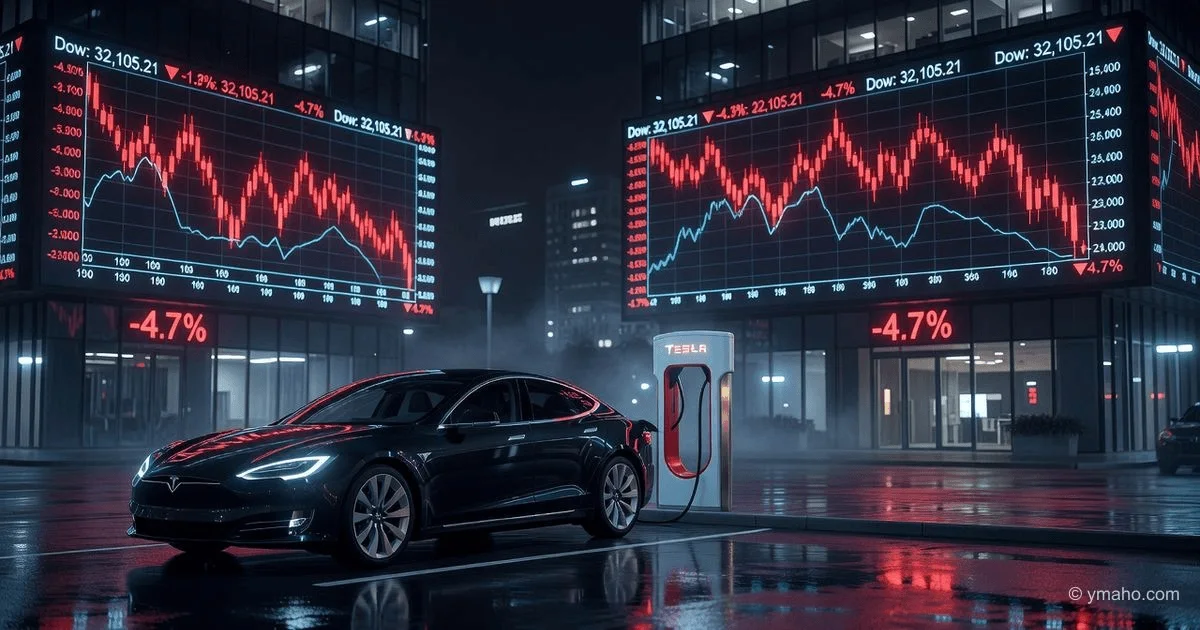
TSLA shares initially rose 4% but then turned negative by 1.5% due to concerns over price wars in China. The company confirmed the launch of a budget model in 2027.
Tesla beat estimates but collapsed: anatomy of the 'perfect nightmare' you might miss
[The Gist]: What's Really Happening
You see the numbers: EPS of $0.92 vs. estimate of $0.88 — a 4.5% beat. Revenue of $25.5 billion vs. expected $24.54 billion — also above consensus. Shares initially jumped 4%, then turned negative by 1.5%. Seems contradictory. But institutional money wasn't looking at EPS, which is easily manipulated through one-time items, but at gross margin.
Here's what's really happening: Tesla's gross margin fell to 18% compared to 18.2% a year ago. Back in Q1 2022, it was 29.1%. A drop of more than 11 percentage points over four years is not 'fluctuation' — it's structural degradation of the business model. Tesla is transforming from a premium EV manufacturer with huge margins into a mass-market automaker forced to compete on price.
My insider take: the real drama isn't even the margin. It's that Tesla is losing its key advantage — technological leadership. BYD just announced a €2 billion investment in a charging station network with 1.5 megawatt capacity, delivering 400 km of range in 5 minutes — six times more powerful than Tesla's Supercharger. Elon Musk, in turn, announced the discontinuation of the Model S and Model X to repurpose the Fremont plant for production of Optimus humanoid robots.
The market doesn't know what's scarier: that Tesla is losing the tech race to BYD in 'hardware,' or that Elon Musk seems to genuinely believe the company's future is not cars but robots handing out popcorn at Christmas fairs.
Timeline and Context
The table below maps how Tesla went from 'tech leader' to 'company being chased from all sides' over the past 12 months.
| Date | Event | Stock Reaction | What's Hidden |
|---|---|---|---|
| 2024–2025 | Tesla repeatedly delays launch of budget 'Model 2' | Shares lose 40% over the year | Company shifts resources to robotaxi and Optimus |
| Full year 2025 | Tesla sales drop a record 9% | Market cap shrinks | First annual sales decline in company history |
| Feb-Mar 2026 | Operation 'Epic Fury' — US conflict with Iran | Oil prices rise, Tesla grows 67% in Europe | War paradoxically helps EV market — gas gets expensive |
| April 2026 | Tesla lays off over 10% of employees, restructuring costs $622M | Shares fall another 5% | Company prepares for 'winter' |
| April 2026 | BYD emerges from prolonged slump, May sales at 383,453 vehicles | BYD +0.3%, Tesla stable | Chinese giant seizes initiative |
| May 20, 2026 | Tesla unveils Optimus handing out popcorn | Skepticism, shares flat | Musk talks about $10 trillion revenue from robots |
| June 9, 2026 | BYD announces €2B for charging stations in Europe | Tesla loses 3% next day | Direct attack on Tesla's ecosystem |
| June 10, 2026 | Tesla Q2 2026 report: EPS $0.92, revenue $25.5B | +4% immediately after report, then -1.5% | Market digests margin drop to 18% |
| June 11, 2026 | Post-report trading | Shares test support at $34 on TSX (CAD) | Volatility persists |
| 2027 (forecast) | Launch of budget Model 2 priced at $25,000–30,000 | ? | But Evercore believes mass production won't start until 2027 |
Note the chronology of recent weeks. BYD strikes blow after blow: first emerging from a sales crisis with 80% growth in overseas markets, then announcing charging technology that makes Tesla's Supercharger obsolete. And Tesla's response... shows a robot handing out popcorn.
Winners and Losers
Winners:
BYD: The Chinese manufacturer sold 160,644 vehicles in overseas markets in May — up 80.4% year-over-year. The €2 billion investment in European charging infrastructure is a strategic move that will make BYD more attractive to Europeans than Tesla. BYD has already built over 4,000 'Flash Charging' stations in China. By end of 2026, there will be 3,000 in Europe.
Consumers waiting for a cheap Tesla: The Model 2 is finally approaching. Target price is $25,000–30,000, though Musk originally promised $25,000 back in 2020. Production will be set up in Monterrey (Mexico) and Shanghai. The new 'unboxing' technology reduces assembly time by 40% and production costs by 30-40%.
Tesla (in Europe, paradoxically): The war with Iran and rising gas prices boosted EV demand. Tesla sales in France surged 655% in May to 5,446 vehicles, in Denmark by 136%, in Spain by 113%.
Losers:
Tesla shareholders who bought at highs: The stock is down 45% from a year ago. Some recoveries occurred, but the overall trend is bearish. Forward P/E is still high by some estimates, and if margins continue to fall, multiples will compress further.
Tesla (structurally): The company is losing technological leadership. BYD offers charging six times more powerful. Chinese competitors (Nio, Xpeng, Li Auto) are also not standing still. Tesla is no longer the 'obvious choice' for EV buyers.
Model S and Model X: These models will be discontinued. Fremont production capacity will be repurposed for Optimus. Musk announced this on the earnings call, putting an end to two flagship models.
Investors who believed in 'robotaxi': Musk talked about Cybercab back in 2024, promising a launch in 2026. In the latest report, the company said it started production of a 'more affordable vehicle' and plans to start Cybercab production in 2026. But no concrete numbers or timelines. Inaction in this area allows Waymo and other competitors to widen the gap.
Who's in the 'gray zone': Buyers of used Model 3 and Model Y. On one hand, new Model 2 will be cheaper, which could lower used car prices. On the other, Tesla may limit Model 2 production to protect margins, keeping used car values stable.
What the Media Isn't Saying
First. The margin drop to 18% is not temporary. It's the new reality. Look at the numbers: in Q1 2022, margin was 29.1%. Now it's 18%. And that's with Tesla earning $890 million in a quarter from selling 'green' credits to other automakers. Without those credits, margin would be even lower. Credits are a one-time story that will end when competitors themselves switch to EVs. When that happens, margin will collapse to 15% or below.
Second. BYD isn't just catching up — it has already surpassed Tesla in some metrics. BYD sold 383,453 vehicles in May 2026. Tesla sold 443,956 for the entire second quarter. That means BYD nearly matched Tesla's monthly sales, while having a much wider model lineup (from cheap hatchbacks to luxury Denza) and its own battery production. Tesla, in contrast, relies on external battery suppliers (Panasonic, LG, CATL) and has only 4 models in mass production (soon to be 2 after discontinuing S and X).
Third, most importantly. Musk is betting the company on the Optimus gamble. Look at the numbers: Musk received shareholder approval for a compensation package worth nearly $1 trillion — conditional on Tesla delivering 1 million Optimus robots within 10 years. On the latest earnings call, he announced the discontinuation of Model S and Model X to free up space for Optimus production. He talks about $10 trillion in revenue from robots. But reality: Optimus currently can sort objects, hand out popcorn, throw away trash, and dance. There's no trace of the 'surgical operations' Musk mentioned last year. Mass production will start 'by the end of 2027.' An optimistic forecast from Evercore points to 2027 as the start of mass production for Model 2. Robots will come even later.
Fourth. The Chinese price war isn't over, and Tesla can't win it. BYD's domestic market continues to face issues: the Chinese government is investigating BYD owner complaints about battery degradation and increased charging time after over-the-air updates. But that doesn't help Tesla — Chinese manufacturers (BYD, Nio, Xpeng, Li Auto) compete with each other by slashing prices. Tesla is forced to cut prices in China to avoid losing market share. This directly hits margins.
Forecast: Next 30 Days and 90 Days
Next 30 days (until July 11):
- Tesla (TSLA) shares will trade in the range of $32–38 (CAD) or $160–190 (USD, after conversion). The upper bound is achievable only with positive news about Model 2 production start.
- Key trigger: any news from China about price wars. If BYD announces another round of price cuts, Tesla will follow, and shares will fall another 5-10%.
- Watch for June sales reports. If Tesla shows sales growth in Europe (data due mid-July), it could support shares. However, the effect from the Iran war (which helped Tesla in April-May) may begin to fade.
Next 90 days (until September 2026):
- The Q3 2026 report (expected in October) will be a moment of truth. If margin falls below 17%, prepare for a drop to $140–150 (USD).
- BYD will continue expanding in Europe. By September, several hundred 'Flash Charging' stations will be operational in Germany and the UK. This directly attacks Tesla's 'ecosystem' advantage. European consumers will see that BYD offers faster charging for less money.
- Optimus: if no concrete news about contracts with industrial clients (e.g., Amazon or FedEx ordering robots for warehouses) emerges by September, the market will finally stop believing in Tesla's 'robotic future.' This will lead to further multiple compression.
Editorial Forecast
Asset: Tesla (TSLA) shares. Direction: further moderate decline in the next 24–72 hours to the zone of $160–$170 (USD) / $32–$34 (CAD). Key levels: resistance — $185 (pre-report level), support — $160 (psychological low of April 2026). Confidence level: medium (55%). Main risk: a sudden announcement by Elon Musk of a major Optimus supply contract (e.g., with Amazon or Walmart) could trigger a 10-15% rally. However, given that Optimus is not yet ready for industrial use, margins continue to fall, and BYD is increasing pressure, the probability of further decline in the coming days is higher. We recommend refraining from buying until the margin situation clears in Q3.
This analysis is the opinion of the editorial board and does not constitute individual investment advice. All decisions to buy or sell assets are made by you independently.
— Editorial Team