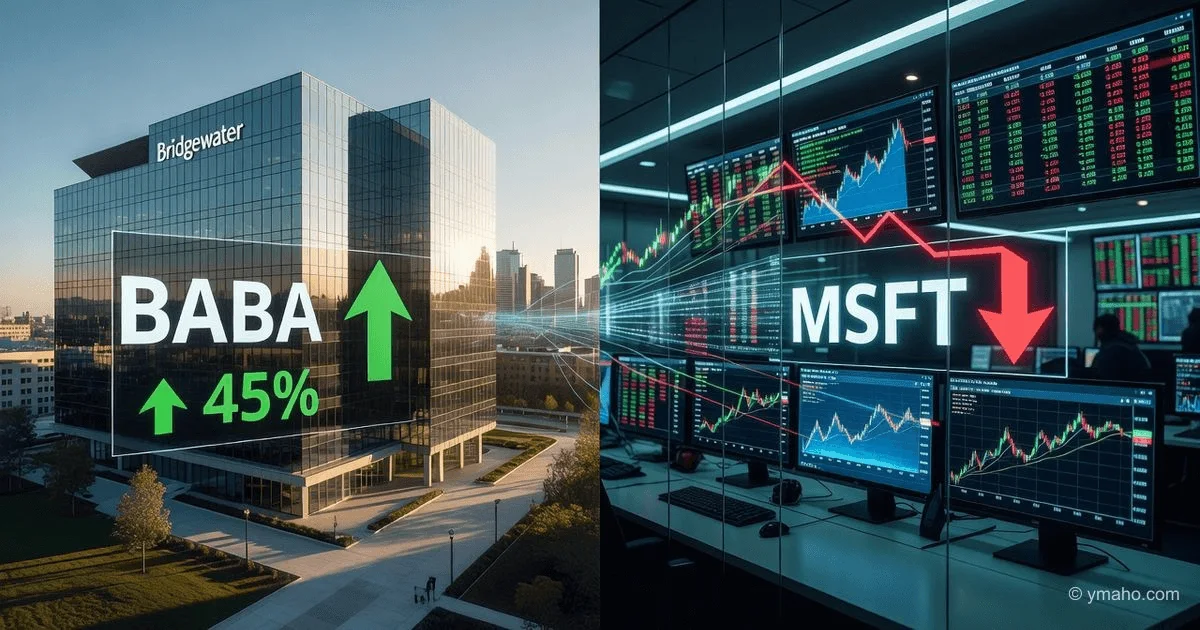
Ray Dalio's Bridgewater Hedge Fund Discloses 13F: Increased Alibaba Stake by 45%, Reduced Microsoft Position
The first-quarter report showed a massive influx into Chinese tech stocks. BABA rose 3.1% after hours, MSFT lost 0.7%.
Ray Dalio's Bridgewater Hedge Fund Discloses 13F: Anatomy of a 'Quiet' Reversal You Won't Notice
[The Gist]: What's Really Happening
Most analysts write about Bridgewater's 13F as a single event: the fund increased its Alibaba stake by 45%, reduced its Microsoft position, BABA shares rose 3.1% after hours, MSFT lost 0.7%. But that's just the tip of the iceberg. The real story is much deeper and more troubling for those who blindly copy the trades of the 'great Ray Dalio.'
According to data filed with the SEC on May 15, 2026, Bridgewater's total portfolio value at the end of Q1 2026 was $22.4 billion, down 18% from $27.4 billion in the previous quarter. But the decline isn't solely due to market drops. Bridgewater actively reduced positions: it cut 487 stocks, completely exited 261 positions, and added only 214 new ones. This is a massive sell-off, not a rebalancing.
My insider take: Bridgewater isn't just 'shifting from Microsoft to Alibaba.' The fund is making a tectonic shift from the software sector to hardware AI and manufacturing, while simultaneously reducing overall risk ahead of an impending recession. And increasing the Alibaba stake amid a Chinese market downturn is not a 'bullish signal' but a classic 'value trap' for retail investors, which large funds use to exit larger, more liquid positions.
Timeline and Context
To understand the scale of what's happening, you need to look not just at Alibaba but at the entire capital flow within Bridgewater's portfolio. The table below is a hidden map of the war between the 'old' and 'new' AI worlds.
| Sector/Action | Key Bridgewater Trades in Q1 2026 | Value / Change | What It Means |
|---|---|---|---|
| Aggressive AI Chip Buying | New position in TSMC ($364M), increased NVDA (+82.8K shares to $818M), AVGO (+66.9K), MU (+58.6K) | $364M (TSMC), $818M (NVDA — 4.84% of portfolio) | Bet on 'physical' AI — chips and hardware, not software |
| Complete Software Exit | Full liquidation of Salesforce (CRM), Workday (WDAY), ServiceNow (NOW), and GoDaddy | $511M (CRM alone) — largest sale | Bearish signal for enterprise SaaS |
| Increased Alibaba (BABA) | Increased stake by 45% | Shares rose 3.1% after hours | But the fund is reducing overall China risk? No, it's a selective bet |
| Reduced Microsoft (MSFT) | Small reduction, but in context — MSFT no longer in top holdings | MSFT shares fell 0.7% | Signal that even 'safe' AI software is no longer favored |
| Overall Portfolio Reduction | AUM fell from $27.4B to $22.4B (-18.3%) | Active selling, not just market decline | Fund moving to cash or other assets (not reflected in 13F) |
Note the key discrepancy: Bridgewater increases its Alibaba stake (Chinese tech) while exiting Salesforce (US SaaS). This isn't just a 'rotation into China.' It's an acknowledgment that US enterprise software is overvalued, while Chinese is undervalued. But there's a nuance that goes unmentioned: Alibaba trades at a P/E of about 10, while Salesforce is around 30. Dalio is simply buying cheap and selling expensive in an environment where the Fed is likely to keep rates high.
Who Wins and Who Loses
Winners (according to Bridgewater):
Taiwan Semiconductor Manufacturing (TSMC): The fund's largest new position — $364M. Bridgewater is betting TSMC will remain a monopoly in advanced chip manufacturing for AI, despite geopolitical risks around Taiwan. This signals that 'real' AI (chips) matters more than 'virtual' AI (software).
Google AdInline article slotAmazon (AMZN): The largest portfolio position — 5.41%, or $914M. Bridgewater increased its stake by 125%. Amazon combines cloud infrastructure (AWS, which buys chips) and a consumer business resilient to recession. It's a defensive bet in the tech sector.
NVIDIA (NVDA): The fourth-largest position — $818M, or 4.84% of the portfolio. Despite a recent correction, Bridgewater increased its stake by 21%. The fund believes NVDA's drop is a correction, not a trend reversal.
Alibaba (BABA): Those who bought shares on news of Bridgewater's 45% stake increase already gained +3.1% after hours. But this is a short-term effect, not a long-term trend.
Losers (according to Bridgewater):
Salesforce (CRM), ServiceNow (NOW), Adobe (ADBE), Workday (WDAY), GoDaddy: All these companies were either fully liquidated or significantly reduced. Bridgewater exited CRM at $511M — the quarter's largest sale. The fund believes enterprise SaaS is overheated and vulnerable to an economic downturn as companies cut IT budgets.
Microsoft (MSFT): Although the reduction wasn't dramatic (MSFT remains in the portfolio), the fact that the fund is selling the 'safest' tech stock is troubling. Retail investors who blindly follow 'smart money' may start selling, exacerbating the decline.
Investors in S&P 500 ETFs (SPY, IVV): Bridgewater reduced its position in the iShares Core S&P 500 ETF (IVV) by $1.117B — the second-largest sale. The fund is reducing passive exposure in favor of active sector bets. This is a bearish signal for the broad market.
What the Media Isn't Saying
First. Bridgewater didn't 'increase its Alibaba stake by 45%' in the way you think. The tables show changes in shares, but they don't reveal that Alibaba was a tiny position. A 45% increase from a very small base is not a 'major bet.' Alibaba's actual weight in Bridgewater's portfolio is still no more than 0.5-1%. The fund isn't 'entering China'; it's making a selective, very cautious bet on one company trading at a huge discount to US peers.
Second. The fund is reducing overall risk, not 'rotating.' Look at the totals: $27.4B in December 2025 vs. $22.4B in March 2026. The $5B difference isn't just market decline. Bridgewater actively sold stocks and moved into cash or other assets (e.g., bonds not reflected in 13F). If the world's largest hedge fund is reducing risk, retail investors should ask why.
Third. The fund is betting on 'Hard AI' vs. 'Soft AI.' Look at the buys: TSMC, NVDA, AVGO, MU — all chip and hardware manufacturers. The sells: CRM, NOW, ADBE, MSFT (partially) — companies selling software and cloud services. Bridgewater believes the first wave of the AI boom (software, models) is over, and the second wave — infrastructure ('picks and shovels' for the gold rush) — is beginning. This is a very subtle and important signal completely missed by headlines about Alibaba.
Fourth. This is a report FOR THE FIRST QUARTER of 2026, which ended March 31. We are now in June. Many events have occurred since then: escalation with Iran, the Fed meeting, an AI market correction. Bridgewater may have already changed its positions. 13F is a 'rearview mirror,' not a 'roadmap.' Copying trades from two months ago is a sure way to buy high and sell low.
Forecast: Next 30 Days and 90 Days
Next 30 Days (through July 11):
- Alibaba (BABA) shares will continue to trade with elevated volatility, but in the $75–85 range. The short-term momentum from Bridgewater news will fade in 2-3 days. Attention will shift to China's macroeconomics — if GDP data disappoints, BABA could fall below $70.
- Microsoft (MSFT) will be under pressure from the Bridgewater signal, but the company is fundamentally strong. Expected range: $480–500. Key risk: the Azure cloud segment earnings report. If it shows a slowdown, shares could drop to $460.
- Semiconductor sector (SMH, NVDA, AVGO, TSMC) will get support from capital rotation from software to hardware. NVDA could test $900–950 in the coming weeks if no new negative news about Blackwell emerges.
Next 90 Days (through September 2026):
- Rotation from software to chips will continue, but not linearly. TSMC and NVIDIA Q2 earnings will be catalysts. If TSMC confirms high demand for AI chips, shares could rise 15-20%.
- The Chinese sector (BABA, JD, BIDU) remains under pressure from geopolitics and a weak economy. Bridgewater's bet is a 'contrarian' position that could pay off only if China announces large-scale stimulus. Without stimulus, Chinese tech stocks could fall another 10-15%.
- The broad market (S&P 500) is at risk. The fact that Bridgewater cut its S&P 500 ETF positions by $1.1B suggests smart money is preparing for a correction. If the Fed doesn't deliver dovish signals in June, the S&P 500 could fall to 5,200-5,400.
Editorial Forecast
Asset: S&P 500 Index (SPY). Direction: decline over the next 24–72 hours following Bridgewater's signal (reduction in IVV position by $1.1B). Key levels: resistance — 5,450 (current level), support — 5,300 (April low), if broken — 5,200. Confidence level: medium (55%). Main risk: an unexpectedly dovish signal from the Fed at the June 17 meeting, which could force Bridgewater and others to quickly reverse and buy. However, given that the fund itself is moving to cash, not just rotating between stocks, the probability of a correction in the coming weeks is higher. We recommend reducing long positions in the broad market and increasing cash holdings.
This analysis is the opinion of the editorial board and does not constitute individual investment advice. All decisions to buy or sell assets are yours alone.
— Editorial Team