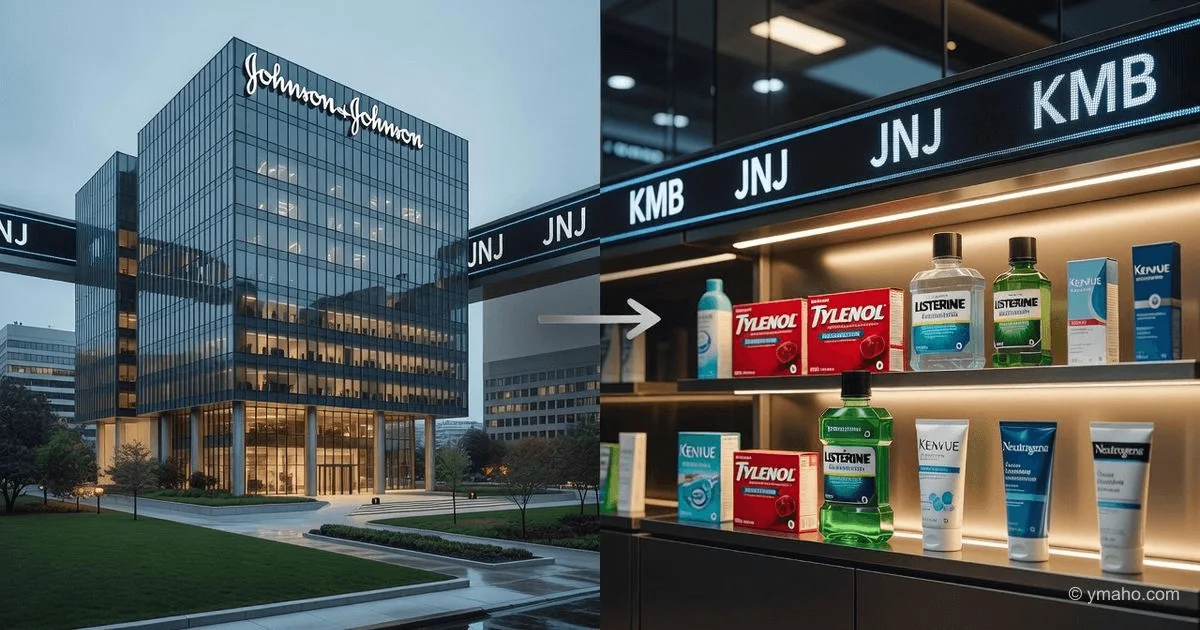
Johnson & Johnson Announces Spin-Off of Consumer Business into Separate Public Company Kenvue
The spin-off will take the form of a distribution of shares to JNJ shareholders. The target date is August 25. JNJ shares rose 0.9% on the news of a focus on pharmaceuticals.
Johnson & Johnson Spins Off Kenvue: Anatomy of a 'Quiet' Triumph the Market Missed
[The Gist]: What's Really Happening
Most analysts are writing about the spin-off of Johnson & Johnson's consumer business into Kenvue as a routine restructuring. Formally: spinning off brands like Tylenol, Listerine, and Neutrogena into a separate company, distributing shares to JNJ shareholders, with completion expected on August 25. JNJ shares rose 0.9% on the news of a focus on pharmaceuticals. But that's just the tip of the iceberg.
The real essence of what's happening is that Johnson & Johnson got rid of a 'problematic' asset long before the problems became obvious to the market. Kenvue is a company with revenue of about $15 billion a year, but with declining dynamics: in 2025, revenue fell 2.14% to $15.12 billion. Its main product, Tylenol, is under FDA investigation due to a potential link to autism.
My insider take: the deal to sell Kenvue to Kimberly-Clark for $48.7 billion, announced back in November 2025, is not just 'consolidation in the consumer sector.' It's a brilliant move by JNJ, which exited a business with falling revenue, growing legal risks, and low margins at the peak of the M&A market. And the market, looking at the spin-off, applauds JNJ for its 'focus on pharmaceuticals,' without even realizing that the main deal has already been struck.
Timeline and Context
The table below maps how JNJ planned and nearly completed one of the most elegant corporate maneuvers in history over two years.
| Date | Event | Impact on JNJ / KVUE | What's Hidden |
|---|---|---|---|
| May 2023 | JNJ spins off Kenvue into a separate public company via IPO | JNJ retains 9.5% of KVUE shares | Beginning of a 'soft' exit from the consumer segment |
| 2024 | Kenvue reports revenue of $15.46 billion | Growth of only 0.07% | Weak dynamics already visible |
| September 2025 | FDA adds warning to Tylenol packaging about autism risk | KVUE shares begin to decline | Legal risk materializes |
| November 3, 2025 | Kimberly-Clark announces purchase of Kenvue for $48.7 billion | KVUE shares rise, JNJ prepares to exit | JNJ sheds a problematic asset at a good price |
| Full year 2025 | Kenvue shows revenue of $15.12 billion — a 2.14% YoY decline | Confirmation of consumer segment weakness | JNJ exits in time |
| June 9, 2026 | JNJ announces spin-off and share distribution for August 25 | JNJ +0.9% in daily trading | Technical completion of the process |
| H2 2026 | Expected closing of Kimberly-Clark—Kenvue deal | JNJ shareholders receive cash and KMB shares | Final point in the story |
Note the key nuance: the news from June 9–10, 2026 is not 'we are spinning off the consumer business.' It's 'we are completing a spin-off that began three years ago, and by the way, this business has already been sold to Kimberly-Clark.' The market, however, reacts to the headline about a 'spin-off' and 'focus on pharmaceuticals,' not to the reality of the $48.7 billion deal.
Who Wins and Who Loses
Winners:
Johnson & Johnson (JNJ): The company executed a perfect exit. It exited a segment with falling revenue ($15.12 billion in 2025 vs. $15.46 billion in 2024, a 2.14% decline) and growing legal risks (Tylenol under FDA investigation). In return, JNJ receives $3.50 in cash for each Kenvue share plus 0.14625 shares of Kimberly-Clark, as well as a focus on high-margin pharmaceutical and MedTech businesses. Simply holding JNJ now gives shareholders the right to participate in the future growth of the pharmaceutical giant.
Google AdInline article slotKimberly-Clark (KMB): The company pays $48.7 billion but gains 10 billion-dollar brands, including Band-Aid, Neutrogena, and Tylenol. The combined company will generate about $32 billion in annual revenue and $7 billion in EBITDA, with identified synergy potential of $1.9 billion. This is a long-term bet on consolidation of the consumer health market.
JNJ shareholders: They get a 'pure' pharmaceutical company with higher growth rates and margins, while retaining indirect participation in Kenvue through the share distribution. Additionally, JNJ recently announced the purchase of Firefly Bio for $1 billion, strengthening its oncology pipeline. JNJ shares trade around $237, with a consensus target of $253.04 and a 'Moderate Buy' rating from 27 analysts.
Kenvue shareholders who held since the IPO: They will receive $3.50 in cash and shares of Kimberly-Clark, totaling $21.01 per share. Given that Kenvue traded around $20-22 in recent months, the deal offers a small premium, but not much more.
Losers:
Kenvue shareholders who bought at highs in 2023-2024: Kenvue went public in May 2023 at around $25-27 per share. The Kimberly-Clark deal values Kenvue at $21.01 per share. This means a loss of 15-20% for those who held since the IPO. Kenvue's revenue growth was zero or negative, and the FDA added risks — the price naturally declined.
Consumers of Tylenol and other Kenvue brands: The Kimberly-Clark deal and legal risks around Tylenol could lead to product formula changes, price increases, or even market withdrawal in an extreme scenario. The FDA has already added a warning about a potential link to autism, which itself reduces demand.
Johnson & Johnson shareholders who don't understand the deal structure: Some retail investors may not realize that the Kenvue spin-off is already 'priced in' to JNJ, and that they will receive Kimberly-Clark shares, not Kenvue. This could lead to confusion and suboptimal trading decisions. Canadian investors, for example, are concerned about the tax implications of spin-offs from US companies.
What the Media Isn't Saying
First. The 'spin-off' is the technical completion of a deal that has already happened. Media write about the Kenvue spin-off as if it just occurred. In reality, Kenvue became an independent company back in May 2023. Since then, JNJ has owned only 9.5% of Kenvue shares, and the current spin-off is simply the distribution of those remaining shares to JNJ shareholders. The main news is not the spin-off, but that Kenvue has already been sold to Kimberly-Clark for $48.7 billion, with closing expected in the second half of 2026.
Second. Why was JNJ in such a hurry to get rid of Kenvue? Because consumer health is a low-margin, low-growth business with growing legal risks. Look at the numbers: Kenvue's revenue fell from $15.46 billion in 2024 to $15.12 billion in 2025. In Q1 2026, revenue was $3.91 billion — up 4.49% from the same quarter last year, but the annual trend is still negative (-1.11% over the last 12 months). Kenvue's operating margin is around 18-20% (EBITDA margin ~19.4% in 2025). Meanwhile, JNJ's pharmaceutical business has a margin of 30-35%. JNJ simply replaced a 'bad' asset with a 'good' one, exiting the deal profitably for shareholders.
Third. Tylenol is a 'time bomb' that JNJ has passed to Kimberly-Clark. In September 2025, the FDA added a warning to Tylenol packaging about a potential link to autism and ADHD when used during pregnancy. Kenvue filed a petition with the FDA disputing this claim, but the risk remains. If future class-action lawsuits follow (similar to those with opioids and talc), liability will fall on Kenvue, and through the deal, on Kimberly-Clark. JNJ has escaped this circle of hell.
Fourth, and most importantly. JNJ didn't stop with Kenvue. The company is preparing to spin off its orthopedic business, DePuy Synthes. In January 2026, JNJ announced plans to spin off this division, which generated $9.2 billion in revenue in 2024. This is the second spin-off in three years. JNJ is systematically shedding all non-core assets, leaving only high-margin pharmaceuticals (oncology, immunology, neuroscience) and possibly the most innovative MedTech areas. Analysts at TD Cowen, Argus, and BofA call this an 'accelerated growth cycle.' The company, which was a conglomerate for 130 years, is transforming into a 'pure' biopharma.
Forecast: Next 30 Days and 90 Days
Next 30 Days (through July 11):
- Johnson & Johnson (JNJ) shares will trade in the range of $230–$245. The immediate effect of the spin-off news has already been priced in (+0.9%). Attention will shift to the closing of the Kenvue deal and news about the DePuy Synthes spin-off.
- The analyst consensus target is $253.04, with a 'Moderate Buy' rating. Given the current price of $237, the upside potential is about 7% in the coming months. But this requires positive news about the pharmaceutical pipeline.
- Watch for talc litigation (JNJ continues to settle mass lawsuits over ovarian cancer linked to talc in baby powder). Any negative court ruling could push shares down to $220.
Next 90 Days (through September 2026):
- Closing of the Kimberly-Clark—Kenvue deal, expected in the second half of 2026. JNJ shareholders will receive $3.50 in cash for each Kenvue share they own (via the distribution) and 0.14625 shares of KMB. This will add diversification to JNJ shareholders' portfolios.
- JNJ's Q2 2026 earnings report (expected in mid-July). Consensus EPS is around $2.70-2.75. If the company shows growth in the oncology segment (Darzalex, Carvykti) and provides a positive outlook for the second half of the year, shares could reach $250-255.
- Announcement of details for the DePuy Synthes spin-off. If JNJ confirms that the spin-off will occur in 2027 and provides the deal structure, shares could get an additional boost. However, there is a risk that the market will perceive a second spin-off as a sign that JNJ is 'shrinking' rather than 'focusing.'
Editorial Forecast
Asset: Johnson & Johnson (JNJ) shares. Direction: sideways with an upward bias over the next 24–72 hours. Key levels: support — $233 (50-day moving average), resistance — $240 (recent high). Confidence level: medium (55%). Main risk: negative news on talc litigation or unexpected tightening of US drug pricing regulation, which would hit the pharmaceutical sector broadly. However, given JNJ's strong pipeline (approvals for Carvykti, RYBREVANT, nipocalimab) and the defensive nature of the business, the shares remain attractive for long-term holding. We recommend 'holding' current positions and considering adding on a pullback to $230.
This analysis represents the opinion of the editorial board and does not constitute individual investment advice. All decisions to buy or sell assets are made at your own risk.
— Editorial Team