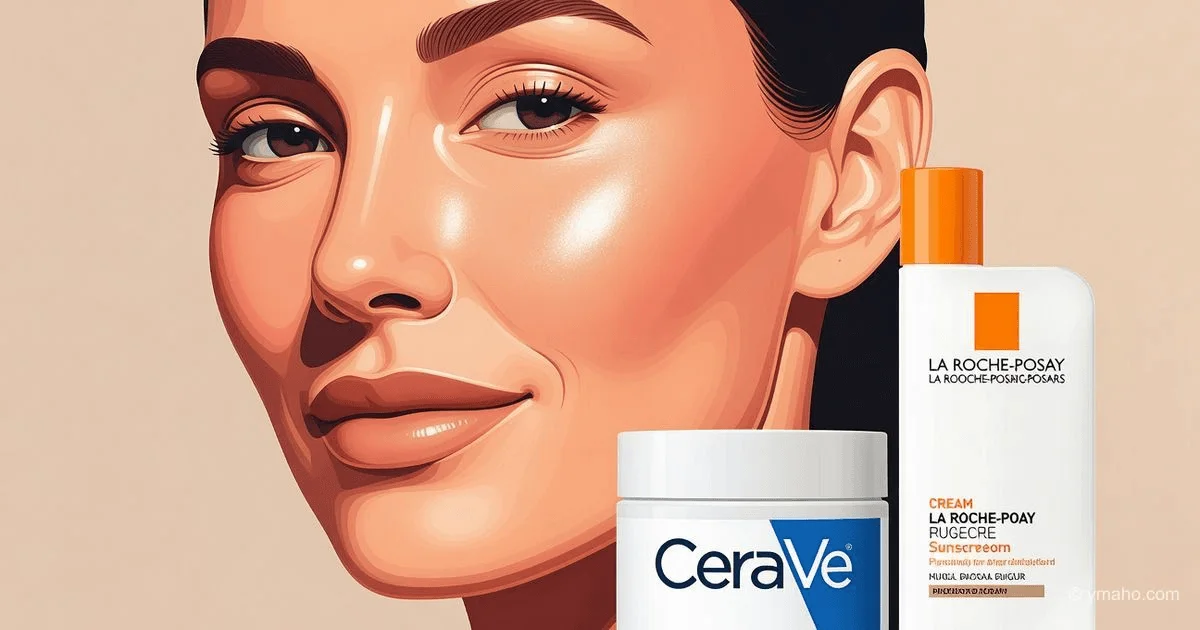
Dermatologists Approve Allure Readers' Choice: Best Products for Mature Skin 2026
Experts highly rated CeraVe moisturizing cream and La Roche-Posay Anthelios sunscreen milk. Special attention is given to skin barrier support and UV protection, as well as products like Laneige Lip Mask and The Ordinary Hyaluronic Acid.
Anti-Aging: Why 'Pharmacy' CeraVe Beat Luxury Brands, and What They're Not Telling You
In early 2026, amid global trends of recession and shrinking consumer budgets, a tectonic shift occurred in the premium anti-aging segment. The editorial team at Allure (a competitor to Vogue and Harper's Bazaar in the digital space) published the readers' choice ranking of the best products for mature skin.
The winners were not La Mer serums at $300 or La Prairie creams at $500. Victory went to CeraVe (hydrating cream at ~$15-18) and La Roche-Posay Anthelios (sunscreen milk at ~$35). This is a sign that the market perceived as 'popular recognition,' but which I analyze as a complete paradigm shift in consumer trust.
[The Core]: What's Really Happening
What's happening is the 'dermatologization' of the mass market. But not the kind they write about in glossies (that 'now there are good creams in pharmacies'). The reality is harsher: budget formulas are beginning to outperform luxury ones in clinical trials and 'real life,' not just in texture feel.
If before a woman over 40 bought a cream for hundreds of dollars for the 'packaging and fragrance,' now, under inflation pressure in the US and Europe, she demands evidence-based proof. CeraVe didn't win because it's cheap. CeraVe won because its formula with ceramides and niacinamide passed the test where luxury often fails: in supporting skin barrier function amid aggressive use of retinols and acids.
The main non-obvious insight:
The problem with aging skin is not a lack of collagen. It's a chronic, subclinical (invisible to the eye) inflammatory process (inflammaging) that destroys cell adhesion. CeraVe and La Roche-Posay won because their mass-market formulas (thanks to niacinamide and ceramides) actually extinguish the fire in the skin, whereas luxury 'anti-aging' concentrates are often overloaded with perfume and alcohols that fuel that fire for an instant 'tightness' sensation.
Timeline and Context
March 2026 — AAD (American Academy of Dermatology, Denver). This is where the unspoken decision was made. Kenvue (formerly J&J Consumer Health) presents 20 studies. They publish data on cell models: 15% vitamin C from Neutrogena Collagen Bank preserves the barrier.
Simultaneously, Olay announces a revolution: skin aging is not about collagen, it's about cell adhesion (how cells hold onto each other). Their research showed that 'exceptional agers' (people who look younger) have higher genetic expression responsible for cell cohesion.
April 2026 — Wave of Simplification. An anti-trend hits the market: 'three steps' (cleansing, moisturizing, SPF). Mass brands adopt multi-tasking: La Roche-Posay adds niacinamide and ceramides to SPF, CeraVe creates a mattifying gel-cream for oily mature skin (critical during perimenopause).
May 2026 (Finale). A scientific paper is published in Nature/Scientific Reports (Nature, 2026, Vol. 16, Article 4326). It proves: SPF 30 doesn't just block tanning. It prevents epigenetic aging. A study on 32 women showed that UV exposure accelerates GrimAge (the biological clock of skin), and SPF 30 completely blocks this acceleration.
Who Wins and Who Loses
Winners:
- Kenvue (CeraVe, Neutrogena, La Roche-Posay). Their EBITDA grows due to the 'defensive asset' effect. In a crisis, consumers don't give up skincare; they switch to 'pharmacy' brands with a medical background.
- La Roche-Posay Anthelios. The brand bets on BEMT (bis-ethylhexyloxyphenol methoxyphenyl triazine) — a modern filter that in 2026 is finally being considered by the FDA for approval in the US. Previously, the best filters were only with L'Oreal (Mexoryl); now La Roche-Posay gains a technological advantage.
- Consumers with hyperpigmentation. In 2026, science officially recognized: visible light (HEVL, 400-500 nm) causes persistent pigmentation in phototypes III-VI. Common chemical filters are powerless. Tinted mineral sunscreens with iron oxide win. La Roche-Posay offers them in the mass market, closing the melasma problem better than lasers.
Losers:
- Luxury conglomerates (Estée Lauder, LVMH Beauty). Their business was built on 70-80% margins and the myth of an 'exclusive ingredient.' Now dermatologists say: 'Peptides work, but cheap CeraVe with ceramides and niacinamide works just as effectively for the barrier as a $200 cream.'
- Brands relying on retinol without barrier support. AAD 2026 showed the focus shifted to skin barrier resilience. Aggressive retinol boosters without a proper base of ceramides and oats (like Aveeno) damage the skin. Aveeno showed that oats and beta-glucan protect hyaluronic acid from UV degradation. If you don't have such a system, you lose.
What the Media Aren't Telling You
Allure writes about 'readers' choice' but omits the severe overproduction crisis in beauty. The industry is overflowing. Product lifespan has dropped to 6 months.
First: CeraVe Healing Ointment (petrolatum 46.5%) took top positions. The media call it 'the twin of doctor's ointment.' But insiders know: in 2026, dermatologists returned to basic occlusive care (sealing moisture with petrolatum) after seeing Nature data that even suberythemal UV doses disrupt DNA methylation. Encapsulating the skin with petrolatum at night is the cheapest way to stop inflammation.
Second: Olay claims cell adhesion. But the media don't report that this is a direct blow to the 'collagen narrative.' For decades, we were sold collagen orally and topically. Now it turns out: without strong 'rivets' between cells, collagen simply 'leaks out.' Olay patented Triple Collagen Peptide, which affects adhesion specifically. This makes their Regenerist Micro-Sculpting Cream ($24) technologically more advanced than a $400 serum from competitors.
Third: The hidden war of filters. The US lags behind Europe and Asia in approving new UV filters by decades. Brands use a loophole: BEMT (Tinosorb S) has been used in Asia for years. A study at AAD 2026 showed that BEMT can close the protection gap at wavelengths 380-430 nm (border light). Companies lobby the FDA, but until that happens, American consumers will lag behind Europeans and Asians in protection against pigmentation. Insight: the best protection now is a combination of SPF 50 + antioxidants (vitamin C) + tinted mineral.
Forecast: Next 30 Days and 90 Days
Next 30 Days (June 2026):
A wave of rebranding will begin. Luxury brands will urgently launch 'minimalist' 'Dermatologist Approved' lines priced at $30-50. Estée Lauder will announce formula simplification. Forecast: advertising budgets for CeraVe and LRP will triple for the summer.
Next 90 Days (End of Summer 2026):
The peptide and 'exosome' market will explode. But on the mass market. Medicine has moved from hydration to signaling molecules.
- Technology: Following Olay's research on cell adhesion, creams mimicking young cell signals will appear.
- Expectations: CeraVe sales in the 'anti-aging' category will grow by 40% (compared to 2025), while mass-luxury (Estée Lauder) will drop by 10-12%.
- Risk: Shortage of tinted sunscreens. Understanding the danger of HEVL (blue light from the sun and screens), consumers will sweep tinted mineral products with iron oxide off the shelves. La Roche-Posay is already increasing production of its Anthelios Mineral Tinted line.
Conclusion: The era of 'magic in a jar' is over. The era of clinical dermatology in the mass market has begun. The consumer has become smarter, and the crisis harsher. A brand that does not publish a cell culture study and does not get a dermatologist's recommendation will die this season.
— Editorial Team