Harvard Scientists Create Promising Drug to Prevent Metastasis by Suppressing CD63 Protein
Monoclonal antibodies block the formation of extracellular vesicles, which cancer cells use to prepare the ground for metastases. In experiments, the drug stopped melanoma spread in 100% of cases.
Of course. I carefully read the news about the "Harvard drug against metastasis based on suppressing the CD63 protein." The headline sounds like cancer has finally been cornered. But as someone who follows biotech, I must warn you: this story about melanoma, 100% efficacy, and Harvard is a beautiful fairy tale for investors that actually didn't start today or at Harvard.
I won't rehash the press release. Let's break down the real background of this "breakthrough" and why real money isn't being made on CD63.
[The Gist]: What's Really Happening
In reality, CD63 is not a "new target" discovered at Harvard. CD63 is a classic tetraspanin, a marker of late endosomes and exosomes, known for at least 30 years. It's also called LAMP-3, ME491, MLA1, and has long been associated with melanoma—it was first isolated from melanoma cell membranes.
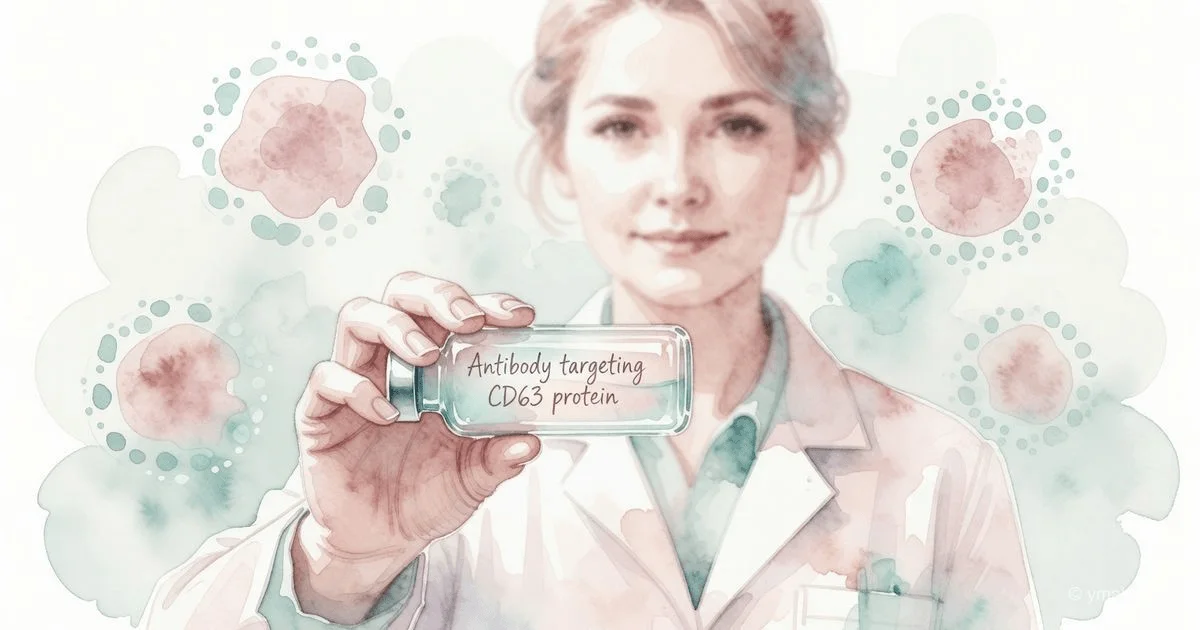
What Harvard actually did (if the news is to be believed) was create monoclonal antibodies that block the formation of extracellular vesicles (exosomes) by targeting CD63. CD63 physically participates in sorting proteins into exosomes, and if blocked, cancer cells lose the ability to "pack their bags" for the metastatic journey.
Insider info they're not telling you: Blocking CD63 is not the only, nor even the most promising, approach to suppressing exosomes. A parallel direction involves Rab27—a molecular switch that controls the attachment of multivesicular bodies to the plasma membrane and their fusion with it. Rab27a and Rab27b are the "dockers" without which exosomes simply don't leave the cell. Blocking one protein on the exosome membrane (CD63) is one thing. Blocking the mechanism that pushes exosomes out (Rab27) is quite another. Rab27 is now being actively studied as a target for small molecules, and this direction may prove more druggable than antibodies against CD63.
Moreover, CD63 is not a universal "key" to exosomes in all cancer types. Its role is especially pronounced in melanoma (hence the 100% in the experiment), but in breast cancer, for example, exosome mechanisms depend on other regulators like CARM1-ALIX.
[Timeline and Context]
Let's look at what's actually happening in this field to separate "breakthrough" from routine:
- 2024-2025: Antibodies to CD63 are actively sold for research purposes. Players: Merck, Thermo Fisher, BioLegend, Abcam. The market is estimated at roughly $200–450 million and growing at 8-9.5% annually. This is a diagnostic and research market, not a therapeutic one.
- January 2026: Nature publishes an article on the CARM1-ALIX-hypoxanthine mechanism and its role in exosomes in breast cancer. This is an important signal: the industry is looking not at one protein but at entire cascades.
- May 14, 2026: A review article is published on Rab27 as a "molecular switch of tumor exosomes." The authors explicitly state: "the development of new small-molecule drugs targeting Rab27 is promising." This is very recent, cutting-edge work.
- May 30, 2026 (today): News about "anti-CD63 antibodies from Harvard that stopped metastasis 100%."
Conclusion: CD63 is not an innovation. It's a "low-hanging fruit" chosen because it's easy to make antibodies against. The innovation lies in the approach to blocking exosomes in general. But the real breakthrough, if it happens, will involve small molecules against Rab27 or regulators of exosome assembly, not antibodies against a single surface marker.
[Who Wins and Who Loses]
Winners:
- The lab that made the discovery. They'll get grants, patents, and possibly a spin-off. But don't be fooled—the path from a lab antibody to a human drug takes 10 years and $1-2 billion.
- Abcam, BioLegend, and other sellers of CD63 antibodies. The news will spike demand for research reagents. Already, CD63 antibodies cost from $300 to $2500 per vial depending on format.
- Researchers working with exosomes. General recognition of the importance of exosomes in metastasis is growing, making it easier to get grants.
Losers (what they're not saying):
- Those hoping for a "fast" transition to the clinic. Monoclonal antibodies against CD63 are not a format easily turned into a drug. CD63 is everywhere—on platelets, immune cells, endothelium. Systemic blockade of CD63 will cause severe side effects (impaired hemostasis, immune response). This is not targeted therapy; it's a sledgehammer.
- Investors who chase the "melanoma hype." 100% efficacy in a melanoma model is good, but melanoma is a "showcase" tumor that often responds to immunotherapy. Blocking exosomes may not work on carcinomas that metastasize through other routes.
[What the Media Isn't Saying]
Omission #1: 100% is most likely in mice with implanted tumors, not in a metastasis model.
Press releases often say "stopped spread" but don't clarify what that 100% means. It could mean:
- No visible metastases in the lungs 30 days after injecting melanoma cells.
- This is not equivalent to "curing already metastatic cancer."
Omission #2: Exosomes are only one way of metastasizing.
Cancer cells can metastasize without exosomes—through single-cell circulation, clusters, or thromboemboli. Blocking exosomes doesn't block all pathways.
Omission #3: CD63 is not only on cancer exosomes.
It's on exosomes from normal cells. And normal cell exosomes perform vital functions—signal transmission, tissue repair, immune regulation. Blocking CD63 damages the entire intercellular communication system, not just the "bad" signals.
Omission #4: The CD63 antibody market is not about therapy.
Even optimistic forecasts talk about the CD63 antibody market growing to $450 million by 2033. But that's the market for reagents for science and diagnostics, not therapeutic antibodies. The therapeutic market, if it ever emerges, will be measured in billions, but that's still a long way off. Sources confuse these two markets, creating an illusion of imminent success.
[Forecast: Next 30 Days and 90 Days]
Next 30 days:
- Wave of publications and press releases. Competitors (labs working on Rab27, other tetraspanins) will rush to publish their data to keep up. Look for news from groups working on pancreatic or lung cancer.
- Stock rise for diagnostic companies. Companies like BioLegend (a Revvity division) or Abcam (Danaher) may see short-term interest in their products. But don't confuse this with a therapeutic breakthrough.
Next 90 days:
- Initial discussions with the FDA about orphan drug status for melanoma. Developers will likely try to get orphan drug designation. This provides tax credits and 7 years of exclusivity. But full approval is a distant prospect.
- Shift in focus toward small molecules against Rab27. Investors will realize that CD63 antibodies have safety and delivery issues and will pivot to small molecules—Rab27 inhibitors. This is a more "druggable" format. Parallel approaches with fungal exosome-like nanoparticles as alternatives will also develop.
- Skepticism in the scientific community. At conferences (e.g., AACR or ASCO), discussions about CD63 specificity will begin. Someone will show that different cancer types have different "exosome signatures," and a single key is impossible.
Insider verdict: The CD63 drug is a nice story that could become a decent addition to melanoma therapy, but not a panacea. The real breakthrough against metastasis will come from a combination of approaches: Rab27 inhibitors (exosome release), CD63 antibodies (exosome content), and destruction of already circulating exosomes in the blood.
If you're an investor—don't invest in a company with a single CD63 antibody. Wait for a platform that targets exosomes from multiple angles. If you're a scientist—don't discard CD63, but add Rab27, ALIX, and CARM1. And this news is just a reminder that the problem of metastasis is still far from solved.
— Editorial Team