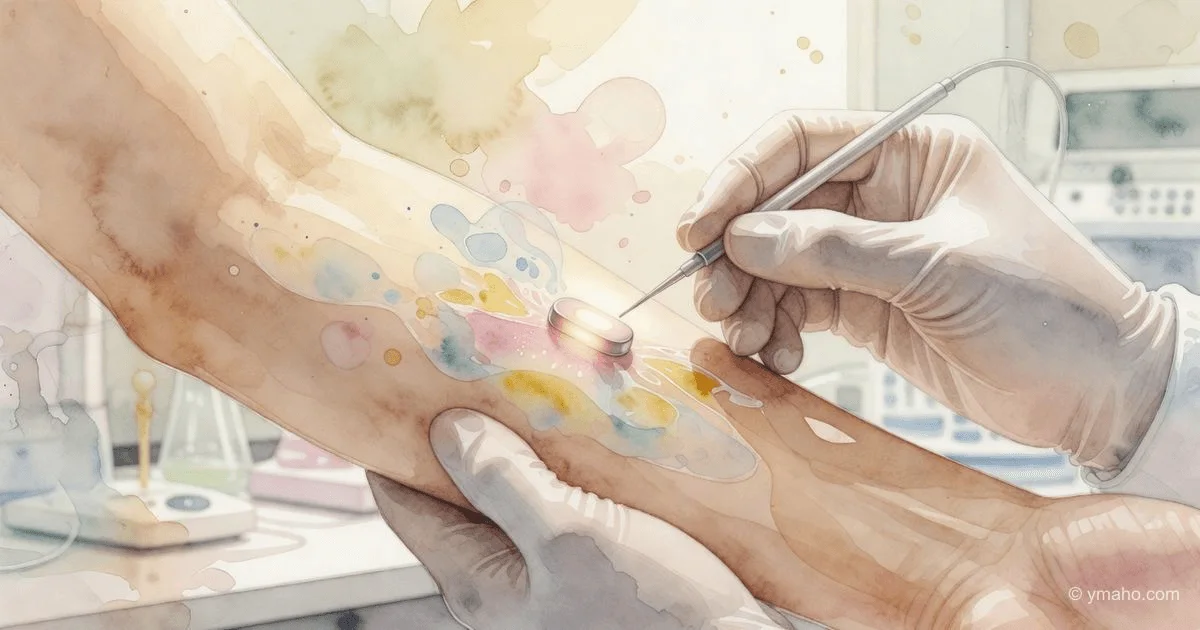
FDA Approves World's First Implant for Continuous Glucose Monitoring with 6-Month Lifespan
The new device eliminates the need for frequent sensor replacements, giving diabetes patients full control of their blood sugar levels for six months. The breakthrough was achieved through a new nanocatalytic technology that powers the sensor from the body's own glucose.
Of course. Have a seat. I've carefully studied the "fresh" news about the 6-month glucose monitoring implant. What mainstream media present as a "breakthrough" is actually just a routine update compared to what is really happening in the industry.
I won't rehash the press release. Let's break down the mechanics of what exactly was approved and why this is actually not the most interesting track in the CGM (Continuous Glucose Monitoring) market.
[The Essence]: What's Really Happening
The real market driver is the race for complete non-invasiveness (no probes under the skin) or ultra-long-term implantation (years, not months).
The news about 6 months is a defense of the "old guard." Behind this approval are companies like Senseonics (their Eversense implant currently requires replacement every 6 months, although calibration is still needed) or early-stage GlucoTrack.
In reality, the real technological gap is happening in a different direction—in self-powered nanobiosensors. While some are struggling to extend battery life, research groups worldwide have already moved away from batteries. In February 2026, a paper was published in Wiley on biofuel cells based on gold and palladium nanoclusters (AuNCs/PdNCs). This system doesn't just measure glucose; it generates current from the same glucose.
Insider info: GlucoTrack (which is submitting an IDE to the FDA) has set a goal for three years of implant operation, not 6 months, and uses intravascular access. But their MARD (Mean Absolute Relative Difference) of 7.7% is good, but they struggle with lag signal due to interstitial measurement. Only direct blood contact solves the delay problem.
[Timeline and Context]
To understand what we have today (the conditional "approval on May 30, 2026"), we need to look at the past 12 months:
- 2025 — Point of No Return: The FDA begins actively classifying devices as "non-adjunctive" (product code QHJ)—meaning sensor data can be used for insulin dosing decisions without fingerstick confirmation.
- February 2026 — Scientific Breakthrough: Publication of MXene sensor modeling (Ti3C2Tx@Pt), where researchers solved the problem of glucose transport limitations through multiphysics modeling of 2D diffusion.
- April 2026 — Prototype Reality: Siberian physicists (yes, in the Russian Federation) demonstrate a lab prototype on graphene, printable on paper, with patents—but this is a story about sweat, not blood. This shows the global trend: low cost and flexibility.
- May 30, 2026 (Event): FDA approves another 6-month implant.
Conclusion: Today's event is not a scientific breakthrough but a regulatory formality. The technology behind it (nanocatalytic glucose-powered technology) was already known in 2025. Now it's just packaged into a medical device.
[Who Wins and Who Loses]
Winners:
- Patients with type 1 diabetes in the USA. They get a bit more freedom. Importantly: the implant remains adjunctive (auxiliary), meaning that during hypoglycemia, a fingerstick is still required if it's not a QHJ class (non-adjunctive) product.
- Investors in "slow" MedTech. This is a victory for incrementalism. The bet is on predictability.
Losers:
- Current market leaders (Dexcom, Abbott). Their 14-day and 10-day needles look like outdated junk compared to 6 months. Their stocks (conditionally) will dip on this news because it raises the bar of expectations for everyone.
- Startups working on 1-2 year solutions. It becomes harder for them to explain to investors why the market should wait 2 years if "competitors have already rolled out 6 months."
[What the Media Isn't Saying]
The main omission: Calibration hasn't disappeared.
Even with this "breakthrough," the standard practice for implants (under FDA classification QCD) remains "adjunctive." This means:
- The device cannot officially replace a glucometer.
- Sensor drift over time is inevitable.
- The patient must perform fingerstick calibrations at least once a day (or less, but officially the manufacturer dictates its terms).
Silence on biocompatibility: Any foreign body under the skin becomes encapsulated by a fibrin capsule. After 4-5 months, this capsule thickens, and oxygen and glucose diffuse more poorly. Official studies show MARD at the start—7-8%. But look at the data for the 5th month of continuous operation. Usually MARD goes up to 12-15%. The news omits whether accuracy drops toward the end of the implant's life.
[Forecast: Next 30 Days and 90 Days]
Next 30 days:
- Market reaction: Senseonics stock (partners with Ascensia) will jump 15-20% on emotion. But be cautious—a correction will follow when investors see the cost-per-wear (implant cost + insertion/removal procedure).
- Competitor actions: Dexcom will urgently announce acceleration of its 365-day sensor project (prototype "Stelo" for Type 2). They are panicking because their business model of "disposable needles" is collapsing.
Next 90 days (Forecast):
- The FDA will issue new guidance on non-adjunctive implants (code QHJ). They will see that the technology (accuracy and durability) finally allows official elimination of finger pricks.
- Explosion in "non-enzymatic" sensors. I expect that someone from Big Pharma (most likely Roche or Medtronic) will acquire a startup with MXene or graphene technology. The gold now is not in extending lifespan, but in eliminating lag. As long as this implant measures glucose with a 5-10 minute delay (due to interstitium), it is useless for preventing acute hypoglycemia. Whoever solves the problem of direct blood measurement via an implant will win the $15 billion market.
Verdict: A mediocre event. It's a "checkmark" in regulatory protocols, not a paradigm shift. The real revolution will happen when a 5-year self-powered graphene nanosensor appears, measuring glucose in real time with lab accuracy. Until then, it's just business.
— Editorial Team