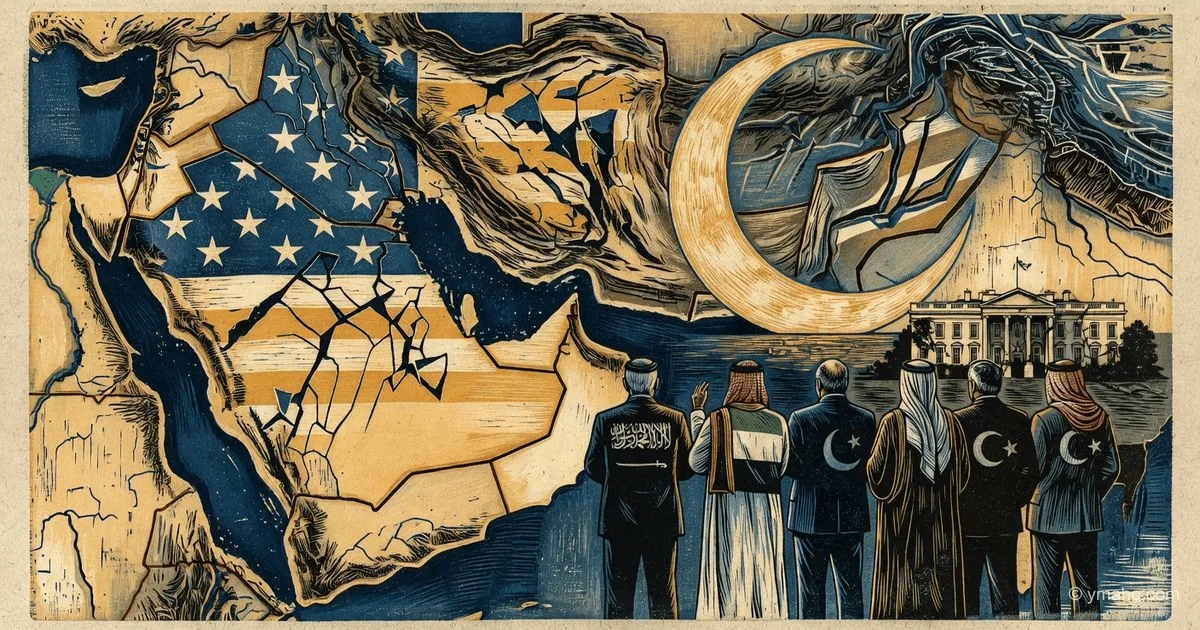
Bloomberg Reports: Shock of War with Iran Unites Former Rivals in the Middle East
The Guardian writes that the shock of war with Iran and its consequences have forced former rivals in the region to support a peace agreement, pressuring the Trump administration to accept a temporary deal.
Analytical article: 'War Shock' Unites Arabs Against Trump — and It Will Change the Middle East Forever
Author: Independent financial analyst
[The Core]: What's Really Happening
The Guardian's headline — 'Shock of War with Iran Unites Former Rivals in the Middle East' — sounds like a story of reconciliation and regional consensus. But if you read between the lines, you see something else: this is not unity against Iran. It is unity against the US.
Yes, Saudi Arabia, the UAE, Qatar, Turkey, Egypt, Jordan, Bahrain, and Pakistan — eight Muslim-majority countries — in an unprecedented joint démarche pressured Trump to accept a peace agreement. Yes, The Guardian explicitly writes that they 'outweighed Benjamin Netanyahu' in Washington. But the key takeaway that most analysts miss is this: Arab monarchies no longer believe the US can protect them.
Andreas Krieg, a professor at King's College London, quoted by The Guardian, says outright: 'The Gulf was shocked by the extent to which Washington defended Israel first from Iranian drones and missiles, despite trillions of dollars of Gulf investments in the US.' Translating into money language: the Arabs paid the US for protection, but got Israel prioritized.
And now they are rebuilding the region's security architecture without America.
Timeline and Context
To understand how fundamental this shift is, let's break down the timeline of recent weeks.
February 28, 2026 — The US and Israel launch the first strike on Iran, war begins. The Strait of Hormuz is blocked by Iran. Brent crude surges from $78 to $112.
Early April 2026 — A fragile ceasefire. But the strait remains effectively closed. Trump first promises 'total victory,' then finds himself trapped: neither the strait is open, nor has the regime in Tehran fallen.
Mid-May 2026 — Pakistan and Qatar begin active mediation between the US and Iran.
Late May 2026 — Eight Muslim-majority countries, in a collective call to Trump, demand he accept a deal. Trump publicly states: 'The deal is largely agreed.' But his own Secretary of State Marco Rubio says the agreement will take 'a few more days.'
Concurrently — The UAE, it turns out, had been striking Iran from the first days of the war as a third coalition member. And now the UAE is one of the main advocates for peace.
What's happening? In one month, Arab allies of the US went from 'helping bomb Iran' to 'forcing Trump to sign a peace deal at any cost.' Why?
Who Wins and Who Loses
Winners:
- Pakistan. The unexpected winner of the war. It was Islamabad, not Washington or Tel Aviv, that became the main mediator. Former Pakistani ambassador to the US Masood Khan stated: 'Pakistan couldn't fly solo. It needed to cover its flanks.' It did. Now Pakistan is a key player in the 'Muslim NATO' alongside Saudi Arabia, Turkey, Qatar, and Egypt.
- Saudi Arabia. Regaining influence after several years of competition with the UAE. It was the Saudis, together with the Pakistanis, who signed a mutual defense treaty a year ago. Now they are the foundation of the new regional architecture.
- Turkey and Egypt. Both worked through their channels in support of the peace process. Both are part of the new alliance.
Losers:
- The US. Direct conclusion from H.A. Hellier of RUSI in London: 'This is no longer a defense architecture built exclusively around the US. Gulf states are increasingly preparing for the possibility that Washington won't be there when they need it most.'
- Israel. Trump stated that Netanyahu 'will do whatever I tell him' on Iran. Analytical headline in the Times of Israel: 'Israel started the war with Iran as a US partner — and ends it on the sidelines.'
- The Trump administration domestically. Republican hawks, such as Senator Roger Wicker (chairman of the Armed Services Committee), already call the potential deal 'Obama minus' — that is, even worse than the 2015 nuclear deal, which Trump called 'the worst deal in history.' Mike Pompeo publicly condemned the negotiations, to which the White House responded: 'shut your stupid mouth.'
What the Media Leaves Out
Here is my main insight, which you won't find in official reports.
The 'peace agreement' that the Arabs are pushing is not a US victory. It is a US capitulation to a new regional reality.
Note the words of Abdul Khaleq Abdullah, a political science professor from the UAE: 'The UAE is a very pragmatic country. Iran remains a big threat, but it is no longer the imperial Iran we have seen for the last 20 years.'
What does this mean? The Arabs no longer demand regime change in Tehran. They no longer demand the destruction of the nuclear program. They demand only one thing: open the Strait of Hormuz and stop the war. Because the war is causing them greater economic damage than Iran itself.
But there is an even deeper layer that the media misses. In the leaked draft of the interim agreement, it is mentioned that Iran and Oman will jointly control shipping in the strait. Trump reacted: 'Oman will behave like everyone else. Otherwise we'll blow them up. They understand that.'
This is a threat to a US ally. Oman. A traditional mediator. And it shows how nervous the administration has become.
Second hidden fact: Europe is preparing to take the US's place. The Guardian reports that European countries expect to strengthen their role in the region. This means French and British military forces could gain bases in the Persian Gulf that were previously exclusively American.
And third fact: China is not mentioned in any of these articles. But Chinese ships continue to pass unhindered through the Strait of Hormuz, as I noted in previous reviews. While the Arabs argue with America over control of the strait, China simply uses it. This is Beijing's silent triumph in the Middle East.
Forecast: Next 30 Days and 90 Days
30 days (by end of June 2026):
- Probability of signing an interim peace agreement: 70%. Main obstacles — $24 billion in frozen Iranian assets and conditions for strait control.
- Brent crude upon signing the agreement will drop to $85-90 per barrel in the first 48 hours. If talks collapse, it will return to $105-110.
- The S&P 500 will continue to rise on peace optimism + AI (already 9 consecutive weeks of growth — not seen since 1985). But I warn: this is a classic 'blow-off top' before a correction.
90 days (by end of August 2026):
- Even with peace signed, restoring shipping through Hormuz will take months. As Robert Rennie of Westpac said: 'While Brent may decline on deal optimism, until Hormuz is actually open — not conditionally managed, not politically rationed, not partially bypassed — declines will be shallow and temporary.'
- The new regional architecture will begin to take shape: 'Muslim NATO' (Saudi Arabia + Pakistan + Turkey + Qatar + Egypt) vs. I2U2 (US + Israel + India + UAE).
- European forces will begin deployment in the Persian Gulf. This will be the first sign of a long-term reduction of US military presence in the region.
Editorial Forecast
Asset: Brent crude
Direction: Decline in the next 72 hours on peace talk optimism
Key levels: Current around $98-102 per barrel. Nearest support — $95, if broken — $90. Resistance — $105.
Confidence level: Medium (55%)
Main risk: Trump could derail talks at any moment to avoid looking weak before Republican hawks. If the White House announces new strikes on Iran, Brent will jump back to $110-$115 within 24 hours. Also risk: Israel's rejection of deal terms, which could trigger escalation on the Lebanese front.
Editorial opinion. Not investment advice.
— Editorial Team