WSJ: UAE Struck Iran from the First Days of the War as a Third Coalition Member
The Wall Street Journal reports that the UAE has carried out dozens of airstrikes on Iranian targets since the first days of the conflict, acting as a third coalition member alongside the US and Israel, which led to Iranian retaliatory attacks on the UAE.
Analytical article: WSJ revealed the UAE's secret war — how the third player changed the balance in the Middle East
Author: independent financial analyst
[The Gist]: What is really happening
The Wall Street Journal publication of May 29, 2026 is not just a journalistic investigation. It is confirmation that the architecture of the Middle East has been rewritten, and the US has lost its monopoly on military decisions in the region.
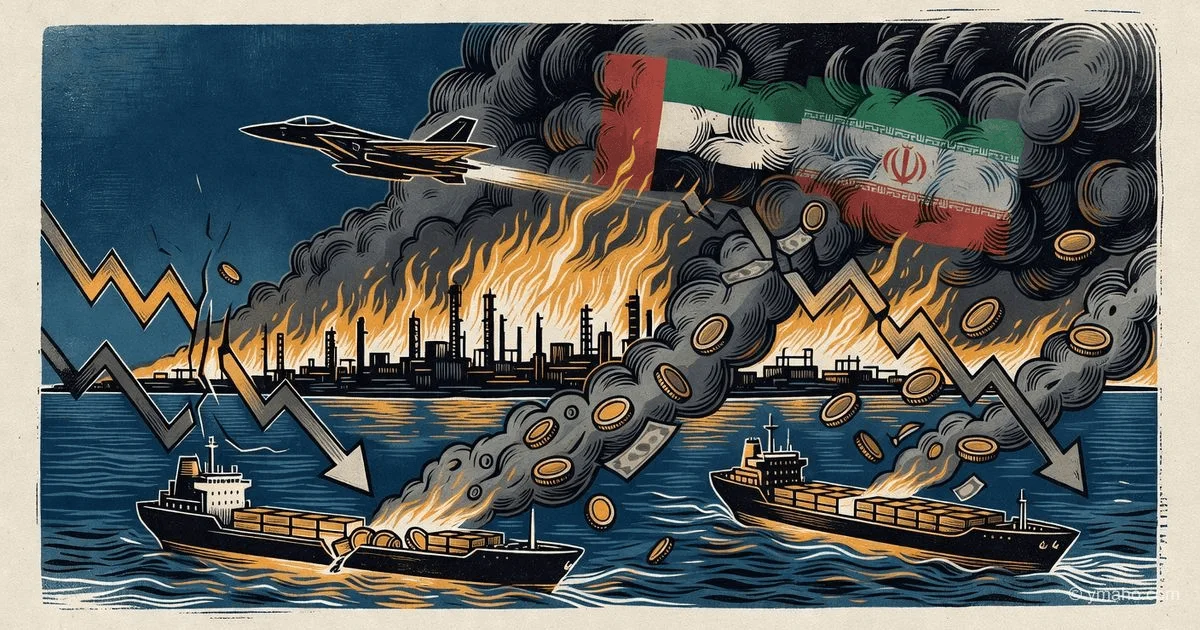
Officially, the UAE stated from the first days of the war on February 28, 2026 that they were not a party to the conflict. Unofficially, they carried out dozens of airstrikes on Iranian targets, coordinating with the US and Israel. Targets: Qeshm and Abu Musa islands in the Strait of Hormuz, Bandar Abbas port, the oil refinery on Lavan Island, and the Asaluyeh petrochemical complex.
Now the most important thing that is missed in the headlines: The UAE didn't just fight — they suffered the main losses. Iran launched over 2,800 missiles and drones at the Emirates' territory — more than at any other country, including Israel. That is 5 times more than at Israel. Why? Because Tehran understood: the UAE is the "soft underbelly" of the coalition. The Emirates are closer to Iran (just 200 km across the Persian Gulf), they have a huge concentration of critical infrastructure (airports, hotels, financial centers), and they do not have a nuclear umbrella.
Over 2,800 missiles and drones. In two months of war. That's about 45-50 attack vehicles per day. Iran turned the UAE into a testing ground for its doctrine of "strategic depth." And, as I will show below, this tactic worked — the UAE economy has already felt a blow worth tens of billions of dollars.
Timeline and Context
Let's break down the key dates of this hidden war:
February 28, 2026 — The US and Israel launch the first strikes on Iran. The beginning of the war.
First days of March 2026 — Iran launches retaliatory strikes. According to UAE data, 238 ballistic missiles were fired at the country, of which 221 were intercepted. 117 Shahed-136 drones, of which 113 were intercepted. But there are also un-intercepted ones — one video from March 9 shows an Iranian drone flying over Al Mamzar Beach in Dubai, while a UAE F-16E fighter tries to shoot it down with its cannon, saving expensive AIM-120 missiles (costing about $1.5 million each).
Early April 2026 — The UAE strikes the oil refinery on Lavan Island. The plant is knocked out for several months. During the same period, Trump announces a two-week truce — but the attack occurs right at that moment, showing that the UAE acts on its own logic, not synchronizing with the White House.
Mid-April 2026 — The truce. But WSJ claims that the UAE continued strikes even after the ceasefire. This is a direct demonstration that Abu Dhabi does not obey either Washington or Tel Aviv.
Late April 2026 — The UAE leaves OPEC and OPEC+. The geopolitical rift with Saudi Arabia becomes apparent.
May 29, 2026 — WSJ publication confirming all these operations.
Why this matters: WSJ revealed not only the fact of the strikes, but also a deep split within the Persian Gulf. Saudi Arabia, according to WSJ, complained to the US that the UAE strikes risk provoking an Iranian response against energy facilities across the region, which could destabilize global oil markets. The Saudis pressured Washington to stop Abu Dhabi.
UAE President Sheikh Mohammed bin Zayed (MBZ), in turn, was furious with Saudi Crown Prince Mohammed bin Salman (MBS) for refusing to join coordinated military actions. This is not just political disagreement — it is a breakdown in personal relations between the two most influential leaders of the Gulf.
Who Wins and Who Loses
Winners:
- Israel. Gained a new military ally right on Iran's border. Israeli Iron Dome systems were deployed in the UAE, Israeli military advisors worked on the ground. Prime Minister Netanyahu visited the UAE (officially denied by the Emirates but confirmed by Netanyahu's office). Mossad and Shin Bet coordinated operations. This is an unprecedented level of cooperation between a country that has no diplomatic relations with Iran and a country that is 200 km from its shores.
- US defense contractors. THAAD, Patriot, Iron Dome — all these systems worked at their limit. Losses: at least one THAAD AN/TPY-2 radar worth $700 million was destroyed by Iranian strikes. This means new replacement contracts.
- China. No Western analyst talks about this, but China is the main beneficiary. While the US, Israel, UAE, and Iran kill each other, China continues to receive oil from the Persian Gulf via Chinese ships that Iran does not touch (as I noted in previous reviews). The UAE was China's third-largest trading partner in the region before the war — now they will be even more dependent on Beijing for reconstruction.
Losers:
- The UAE. Let's calculate the economic damage. Over 2,800 missiles and drones hit the country. Air travel disrupted — Dubai, the world's main transit hub, lost tens of billions of dollars in passenger traffic. The tourism sector is in shock — videos of downed drones over Dubai beaches went viral on social media. The real estate market (the main driver of the UAE economy) has faltered — companies announced hiring freezes and layoffs. Total UAE losses over two months of war are estimated at $40-60 billion, by my estimates.
- Saudi Arabia. Found itself trapped between two allies (the US and the UAE) who are at war, and Iran which strikes the region. Riyadh wanted diplomacy — and lost. Now it has the UAE acting as an independent military force and Israel entrenched in the Gulf. Saudi Arabia's influence in the region has weakened.
- Global oil markets. The UAE strike on the Lavan refinery (capacity about 200,000 barrels per day) in early April caused a temporary spike in oil prices of $8-10. And most importantly, the war showed that critical Gulf infrastructure is vulnerable not only to Iran but also to retaliatory strikes from allies. The risk premium in oil prices has risen by $15-20 since the start of the conflict and is unlikely to return.
What the Media Leaves Out
Now my main insight, which you won't find in official reports but is visible from the numbers.
The UAE struck Iran, but did so with one key caveat: only after the US and Israel destroyed Iran's air defense system.
Quote from WSJ, which I provide in full: "After the destruction of a significant portion of Iran's air defense system by Israeli and American forces, the risks to UAE aviation were substantially reduced." Another source, retired US Air Force Colonel Dave Deptula, directly said: "If you have such capabilities in your air force, why should you sit on your hands?"
What does this mean? The UAE was not a third coalition member from day one. They joined only when the skies over Iran became safe. The first two weeks of the war (March 2026) the UAE only defended. The April strikes became possible only after US and Israeli aircraft suppressed Iranian radars and air defenses.
The second hidden fact: The UAE struck Iranian energy infrastructure after Iran struck their energy infrastructure. This "eye for an eye" principle worked in real time. One strike on the Lavan refinery — and Iran attacks with another 500 drones. An escalation spiral that no one could control.
And the third, most important insight: The UAE's exit from OPEC in late April 2026 is a direct consequence of the war. WSJ and Bloomberg directly link these events. The UAE no longer wants to be part of a cartel controlled by Saudi Arabia. They want to determine their own oil policy independently. Leaving OPEC means the UAE can ramp up production whenever they want — and this creates risks for oil prices in the future.
Forecast: Next 30 Days and 90 Days
30 days (until end of June 2026):
- A temporary peace agreement (which Bloomberg and The Guardian wrote about) will be signed. The UAE is one of the parties pushing Trump to make the deal happen. Reason: the UAE economy cannot withstand another month of war. Damage is already estimated in billions of dollars, tourism is at rock bottom.
- The UAE will begin a public campaign to restore its image as a safe destination. Expect statements from Dubai and Abu Dhabi tourism departments about "complete safety." But the reality: over 2,800 missile attacks have left a mark on the minds of tourists and investors.
- Brent oil: upon signing peace — a drop to $85-90. The main risk is further actions by the UAE as an independent player.
90 days (by end of August 2026):
- The UAE will deepen military cooperation with Israel. Expect the official signing of a defense treaty that will include the deployment of Israeli air defense systems and joint exercises. This will be a direct violation of the "Gulf consensus" that kept Israel at arm's length for decades.
- Saudi Arabia will try to restore influence through mediation between the US and Iran, but the UAE will not return to Riyadh's orbit.
- The UAE economy will show a contraction of 4-6% in Q2 2026 — the first quarterly decline since 2020. Recovery will take 12-18 months.
Editorial Forecast
Asset: UAE tourism stocks (Emaar Properties, Dubai Parks & Resorts; via ETF: UAE ETF — iShares MSCI UAE Capped ETF)
Direction: Decline in the next 72 hours — news of the war and over 2,800 attacks on the UAE will deter tourists for months to come
Key levels: UAE ETF currently around $14.50, support at $13.80, if broken — $13.20. Resistance at $15.00.
Confidence level: high (70%) — WSJ data objectively shows the scale of attacks, which directly impacts the tourism sector
Main risk: if a peace agreement with Iran is signed within the next 48 hours, and Tehran officially acknowledges that attacks have ceased, tourism stocks could bounce 5-7% on hopes of a quick recovery. However, given the scale of destruction (2,800+ attacks), restoring tourist confidence will take months, so any bounce will be temporary.
Editorial opinion. Not investment advice.
— Editorial Team