Investec Reports Fragile Ceasefire in the Middle East and Risks of New Escalation
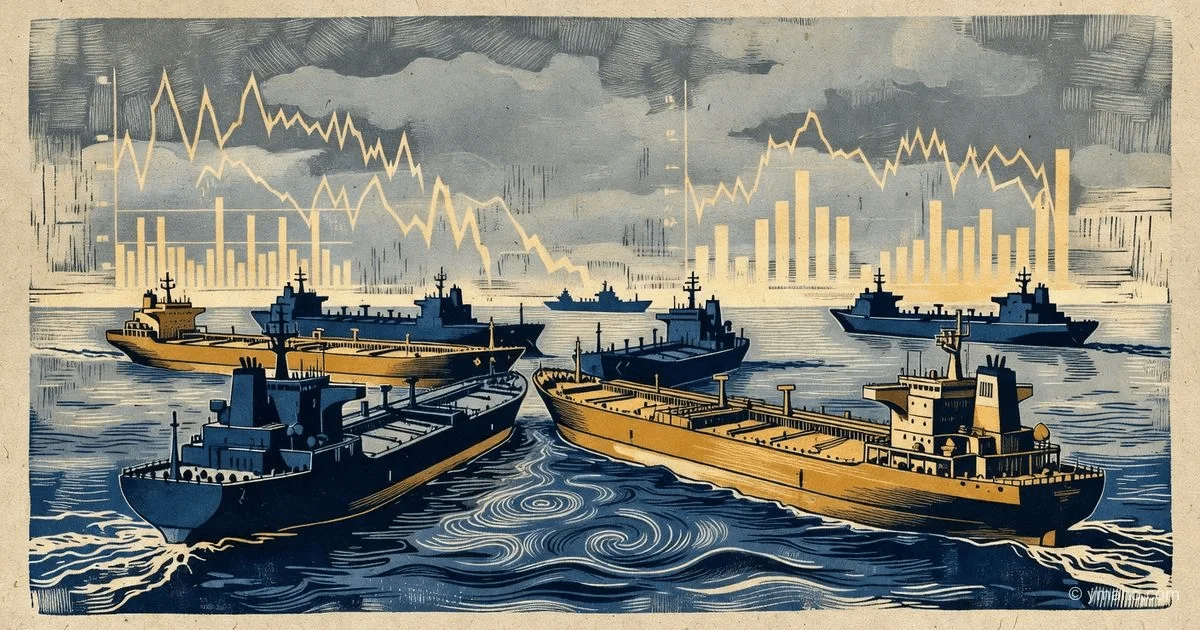
Investec economists note in their May review that the ceasefire remains very fragile, with the key risk being a prolonged blockade of the Strait of Hormuz, which could trigger a new surge in energy prices and lead to a recession.
Analytical article: Investec called the ceasefire "very fragile." What markets stubbornly ignore
Author: independent financial analyst
[The Gist]: What's Really Happening
Investec's official forecast from May 27, 2026, sounds deceptively calm: the baseline scenario is global GDP growth of 3.0% in 2026 and 3.1% in 2027, assuming a swift reopening of the Strait of Hormuz.
But these numbers are a mask. Read between the lines: Investec economists openly admit that the ceasefire remains "very fragile," and the key risk—a prolonged blockade of Hormuz—could trigger a new surge in energy prices and lead to a recession.
A colossal disconnect. Markets continue to trade as if the conflict is over. CNBC reported on May 28 that Brent oil is jumping between $87 and $96 depending on headlines. Traders react to every statement from Washington or Tehran as if everything will return to normal tomorrow. But the reality described by Investec says otherwise: "physical oil flows remain constrained due to disrupted routes, longer transit times, and higher freight and insurance costs."
The key point no one wants to hear: even if a deal is signed tomorrow, oil won't return to $60-70. Callum Macpherson, head of commodities at Investec, directly states that everything depends on "confidence that the war is truly over and there will be no new outbreak." And such confidence does not exist and will not exist.
Timeline and Context
Let's break down what's actually happening in the Middle East, according to Investec and CNBC.
May 27, 2026 — The US and Iran reach an agreement to extend the ceasefire for 60 days and launch new nuclear talks. Seemingly progress. But on the same day, Iran launches a failed drone attack on a US military base and a missile strike on Kuwait (intercepted by Kuwaiti forces). This is not a "ceasefire." It's war with tea breaks.
May 28, 2026 — CNBC publishes an interview with Macpherson from Investec. He says markets find it "incredibly difficult" to understand what's happening, signals from Washington and Tehran change every hour, and diplomatic progress is often refuted within hours.
A concrete example of contradictions — On May 28, reports emerge that Iranian officials discussed a memorandum of understanding with the US. The White House soon calls this "untrue."
Current situation (May 30, 2026) — The Strait of Hormuz is partially blocked, Iranian vessels continue to inspect tankers, and the US Navy is blockading Iranian ports. According to Kpler, Iran still exports about 1.85 million barrels per day, but under tight restrictions.
Why this is critical for markets: May data showed the US savings rate fell to 2.6%—a four-year low. American households are already feeling the pressure of high gasoline and food prices. If oil jumps again to $110-120, retail sales will collapse, and with them, the economy.
Who Wins and Who Loses
Winners:
- Energy sector. Even at $90-100 per barrel, oil companies reap superprofits. Investec directly states that analysts continue to raise earnings forecasts for the energy sector.
- Short positions on oil? No, long. Markets still underestimate the risk. Matt Britzman from Hargreaves Lansdown notes that prices around $90-95 show a "clear risk premium," but not a full one.
- China. According to FSMOne, the structural winners of the crisis are Japan, Korea, Taiwan, Singapore, and China, which benefit from the restructuring of energy security and the ongoing semiconductor cycle. Beijing continues to receive oil through Hormuz, while Europe and the US fight for every tanker.
Losers:
- Europe. Investec's forecast for the eurozone is growth of only 0.2% quarter-on-quarter in Q2 and Q3 2026. Annual inflation has already reached 3.0%, and this is just the beginning. The ECB will be forced to raise rates (two 25-basis-point hikes in June and July), which will kill the already fragile recovery.
- US retail investors and households. The savings rate fell to 2.6%—a low since 2022. People are spending savings to cover rising fuel and food bills. This is not consumer optimism—it's forced depletion of savings.
- South Africa and developing countries dependent on energy imports. Investec, in its review of South Africa, raised the weight of the baseline scenario to 55%, but acknowledges that risks are tilted to the downside due to the Middle East war.
What the Media Isn't Saying
Now for my main insight, which you won't find in official reports.
Investec outlines three scenarios. But there are actually four, and the fourth is the most likely.
Investec's global review describes the following options:
- Baseline scenario (probability?) — relatively quick resolution of the conflict, opening of the strait, GDP growth 3.0-3.1%
- Prolonged blockade scenario — new price surge, recession
- Worst-case scenario — return to hostilities
But there is a fourth scenario that Investec is silent about, yet emerges from their own analysis: a prolonged, low-intensity confrontation with a partially functioning strait and a structurally high risk premium.
Note what Macpherson says: "There is evidence that some vessels are passing through the strait, but little sign of a return to normalcy." Sim Moh Siong from OCBC warns that oil price declines are unlikely to be rapid, and "infrastructure damage, renewed strategic stockpiling, and a higher structural risk premium are likely to keep prices elevated."
What does this mean in practice? Oil will never return to $60-70. The new equilibrium is $85-95. The geopolitical risk premium, which used to be $5-10, is now $20-25.
The second hidden fact: stock markets are completely detached from the reality of physical flows. The Washington Post (cited in the analysis) warned back in April about a "disconnect" between market signals and on-the-ground reality. In May, this disconnect only widened. The S&P 500 hit all-time highs, while the real economy of Western countries is choking on high energy prices.
A quote from the Washington Post that perfectly describes the situation: "Investors don't seem to realize that we are still in a state of war. It's not as simple as turning on a tap to get oil flowing again."
Forecast: Next 30 Days and 90 Days
30 days (through end of June 2026):
- The 60-day ceasefire announced on May 27 will be formally observed, but incidents (like the drone attack on May 28) will continue.
- The ECB will raise rates by 25 basis points on June 11. Investec forecasts two hikes—in June and July—which is surprisingly aggressive for Europe.
- Brent oil will trade in the range of $90-105. Without escalation, the lower end; with new strikes, the upper end.
- The S&P 500 will begin a 3-5% correction as investors realize that "imminent normalization" is not happening.
90 days (through end of August 2026):
- Key indicator: the spread between spot oil prices and futures. Currently about $10-15 (spot higher). If it widens to $20-25, that signals physical scarcity.
- The European economy will show zero or negative growth in Q2. This will force the ECB to reconsider its hawkish plans.
- The US savings rate will fall below 2%—an all-time low. This will trigger a decline in consumer spending and possibly a Fed pivot toward easing.
- Gold—the main beneficiary. If oil stays above $100 and stock markets correct, gold will break $2,600 per ounce.
Editorial Forecast
Asset: Brent oil
Direction: Up in the next 72 hours—markets still underestimate the risk of a ceasefire breakdown
Key levels: Current value around $94-96. Nearest resistance—$100. Support—$90. A break above $100 opens the path to $108-110.
Confidence level: Medium (55%)
Main risk: If in the next 72 hours there is confirmation of progress in negotiations (e.g., a joint US-Iran statement on concrete steps to open the strait), oil could fall to $88-90. However, given that on May 27 a 60-day ceasefire was announced, and the next day Iran attacked a US base, any diplomatic statements cannot be trusted. Markets are gradually beginning to understand this, creating asymmetric upside risk for prices.
Editorial opinion. Not investment advice.
— Editorial Team