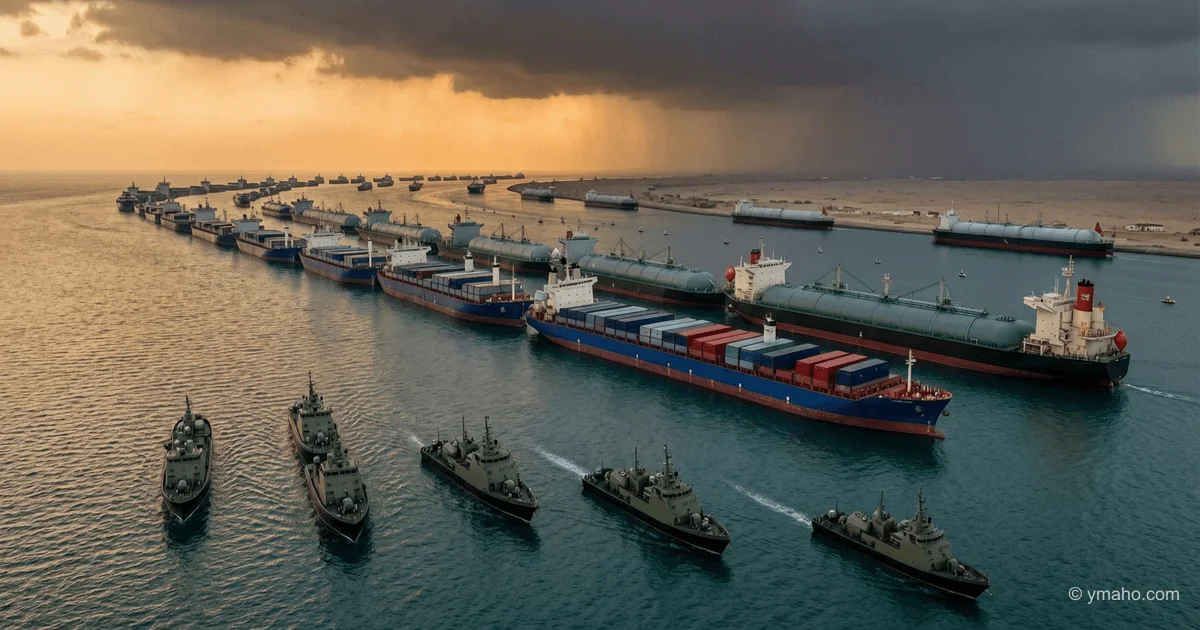
Markets Remain Tense: Strait of Hormuz Blockade Could Quickly Send Them Back into Risk-Off Mode
Despite the current rise in risk appetite, analysts warn that the news flow on Iran, sanctions, and military activity remains unstable. The Strait of Hormuz is formally still under blockade, creating a constant risk of markets returning to safe-haven assets.
Markets on a Powder Keg: Why the Strait of Hormuz Blockade Has Already Changed the Game, Even if Brent Has Temporarily Fallen
The Gist: What's Really Happening
At first glance, May 6, 2026, was a day of collective relief for global financial markets. Asian indices hit all-time highs, Brent crude plunged 7.3% to $83.6 per barrel, and the VIX volatility index fell below 15 points. The trigger: statements from Donald Trump and Pentagon chief Pete Hegseth about "progress in negotiations with Iran" and a pause in Operation "Project Freedom."
The market bought the de-escalation narrative. But that's just the facade. Behind it lies a reality that professional asset managers discuss in private chats but almost no one voices publicly: the Strait of Hormuz blockade hasn't gone away. It has simply shifted from a hot phase to an institutional one. And it is this new form of blockade that poses a far more serious threat to long-term investors than missile strikes.
The issue is that markets are used to assessing geopolitical risk as discrete events: a missile strike sends prices up, a ceasefire sends them down. But the Strait of Hormuz blockade in its current state is not an event. It is a structural shift in the architecture of global trade that will not be resolved by a 14-point memorandum or a temporary truce. And while retail investors celebrate falling oil prices, institutional players are quietly shifting their portfolios into instruments that perform best in a world of permanent maritime route instability.
Timeline and Context
The current situation did not arise spontaneously. It is the result of a chain of decisions, each bringing markets closer to a point of no return.
On February 28, 2026, the US and Israel launched a military operation, "Epic Fury," against Iran. Tehran's response was immediate: the IRGC effectively blockaded the Strait of Hormuz, through which about 20% of the world's oil supply passes. Traffic dropped from a pre-war 130 vessels per day to nearly zero.
During March-April, war risk insurance premiums soared from 0.2% of vessel value to 7.5–10%. For a tanker worth $138 million, a one-time premium reached $14 million, compared to $345,000 in normal times. This made commercial transit through the strait economically unviable regardless of the military situation.
By early May, over 1,600 vessels were trapped in the Persian Gulf. Shipping companies—Maersk, Hapag-Lloyd, and others—publicly stated they would not return to the strait without a "practically verifiable peace agreement."
On May 3, Trump announced "Project Freedom," an operation to escort commercial vessels. On May 4, two ships under the US flag passed through the strait. On May 5, Saudi Arabia denied the US use of its bases and airspace, and the operation was suspended. That same day, the IRGC demanded that all vessels use only the Iranian corridor.
It was at this moment—May 5–6—that the market rally occurred, based on interpreting the suspension of the US operation as "de-escalation." The market saw the US retreat as a step toward peace. In reality, it was a step toward cementing Iranian control over the strait.
Who Wins and Who Loses
Short-term winners are hedge funds that managed to reposition. Algorithmic strategies focused on news flow interpreted "de-escalation" as a signal to buy risk assets. The rise in Asian indices on May 6 was partly technical: a massive short squeeze after weeks of accumulated instability.
Medium-term losers are long-term institutional investors, pension funds, and sovereign wealth funds increasing their equity allocation at all-time highs. They are buying not a real reduction in risk, but a repackaging of it. The blockade risk hasn't disappeared; it has changed form, becoming less visible but more persistent.
The main strategic winner is Iran. The suspension of "Project Freedom" and the IRGC's declaration of a "single safe corridor" mean that Tehran has seized control of the narrative: it is not the US ensuring freedom of navigation, but Iran graciously allowing passage to select vessels. China, India, and Pakistan are already receiving informal transit guarantees for their ships.
The main strategic loser is the United States. The failure of "Project Freedom" exposed Washington's inability to ensure freedom of navigation in a critical strait, even with the most powerful naval force in the region. The consequences extend far beyond the Middle East: allies in Asia, watching the situation in the Taiwan Strait, are drawing their own conclusions.
What the Media Isn't Saying
Insight one: The market trades not reality, but the speed of its realization. The current rise in risk appetite is a classic bear market rally pattern, fueled by a short squeeze. Goldman Sachs prime brokers recorded the highest volume of short covering since March 2020 during the morning hours of May 6. This means a significant portion of the rally was technical and does not reflect a fundamental improvement. Once short-seller pressure is exhausted, the market will be left alone with reality: the strait is blocked, 1,600 vessels are stranded, and insurance premiums are prohibitive.
Insight two: The blockade has already been institutionalized through the insurance market. The most important point missed by mainstream financial press: even if Iran and the US sign a peace treaty tomorrow, insurance premiums will not return to pre-war levels. The war risk insurance market has relearned to assess the Strait of Hormuz as a zone of permanent risk. Underwriters at Lloyd's of London have already reclassified the strait as a "high-risk zone with structural instability." This means the risk premium will be embedded in freight costs for years to come, adding an estimated $3 to $5 to the cost of each barrel of oil passing through the strait.
Insight three: The oil price has ceased to be a reliable indicator. The 7.3% drop in Brent on May 6 was perceived as a de-escalation signal, but it was amplified by the release of additional spot volumes of Saudi oil into the market. According to insider information from Geneva traders, Riyadh, fearing further escalation and potential strikes on its infrastructure, decided to maximize exports in a short window of relative stability. This one-off event distorted the price signal. Without it, the Brent drop would have been significantly more modest.
Insight four: Chinese and Indian refineries are hedging differently. While Western investors track Brent and WTI, major Asian oil consumers are restructuring supply chains. Chinese state-owned traders are actively signing long-term supply contracts through the Iranian corridor, embedding the IRGC's $2 million passage fee into the contract price. This is not a temporary measure but an acknowledgment of the new strait regime as a given.
Forecast: Next 30 Days and 90 Days
30 days (through early June 2026)
Markets will continue to trade on hopes for negotiations, but volatility will increase. A memorandum of understanding between the US and Iran may be signed, but its practical value will be close to zero: it provides for a 30-day period of further consultations, during which the blockade will be eased "gradually." Iran will retain leverage throughout this period.
The key trigger for a return to risk-off mode will be the first incident in the strait after the memorandum is signed. Given that the IRGC will continue to control passage and collect fees, the probability of a navigational error, unauthorized deviation from the Iranian corridor, or provocation by one of the many proxy groups remains extremely high. One missile, one hit tanker—and Brent will return above $95 per barrel within a day, with the VIX jumping above 25 points.
90 days (through late July–early August 2026)
By August 2026, markets will have to acknowledge the new reality: the Strait of Hormuz is no longer a free maritime passage in the sense it has been since the 1980s. Iranian control, cemented by the IRGC's May 5 ultimatum, becomes the new normal. Bilateral agreements with Asian oil consumers are creating a two-tier system: countries loyal to Tehran get access to cheap oil with minimal insurance premiums; everyone else pays the full risk price.
For financial markets, this means a structural increase in the inflationary backdrop. Brent oil in the $85–100 per barrel range will become the new normal, not a temporary spike. This will pressure corporate profits for transport and industrial companies while simultaneously creating sustained demand for safe-haven assets—gold, the Swiss franc, the Japanese yen.
But the main shift is psychological. For decades, markets operated under the paradigm that US military power guarantees the freedom of global trade. The Strait of Hormuz blockade and the failure of "Project Freedom" have shattered that paradigm. Now, any other maritime chokepoint—the Strait of Malacca, Bab el-Mandeb, the Taiwan Strait—will be assessed by investors through the lens of the Hormuz precedent. This means the geopolitical premium in asset prices is here to stay; it will become a permanent component of market pricing.
Markets that rallied on May 6's hope have yet to grasp the scale of this transformation. But when they do, safe-haven assets will see capital inflows comparable to the start of the COVID-19 pandemic in March 2020. And those buying stocks at all-time highs today will find themselves on the wrong side of that trade.
— Editorial Team









