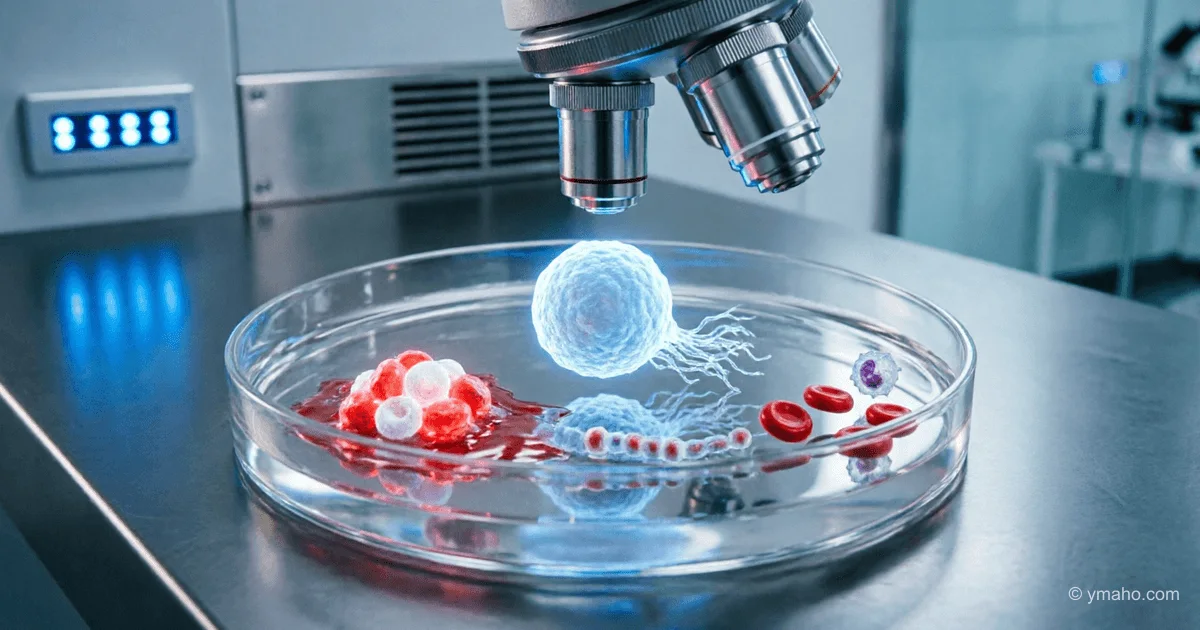
Technology for Producing Blood Cells from Stem Cells in the Lab Created
Australian researchers have, for the first time in the world, developed a method to generate human blood cells from stem cells in vitro. The technology could potentially replace bone marrow transplantation and allow correction of genetic defects in blood cells.
Blood from a test tube: How Australian scientists revolutionized hematology in 25 years
Introduction
Bone marrow transplantation saves thousands of lives each year, but for many patients it remains out of reach—a suitable donor cannot be found. In late April 2026, researchers at the Murdoch Children's Research Institute in Melbourne announced a breakthrough that could forever change this situation: for the first time in the world, they succeeded in creating functional human hematopoietic stem cells in laboratory conditions. This achievement, dubbed the "holy grail" of cell biology, opens the door to personalized therapy for blood cancers, genetic diseases, and a fundamentally new paradigm in hematology.
Event Details and Timeline
The breakthrough announcement was published on May 1, 2026, but the history of this achievement spans more than a quarter of a century. Three Australian scientists—Professors Elizabeth Ng, Andrew Elefanty, and Ed Stanley—worked together for 25 years, initially at the Walter and Eliza Hall Institute and Monash University, and for the last 13 years at MCRI.
The key scientific challenge was to replicate in the lab the extremely complex process of embryonic development. The researchers started with induced pluripotent stem cells—"immortal" cells capable of turning into any tissue in the body. "We had to reconstruct embryonic development step by step, and then reproduce the entire process from scratch in the lab," explained Professor Ng.
The method involved a stepwise application of a specially designed "cocktail" of growth factors in a precisely calibrated sequence. Initial attempts were unsuccessful: the stem cells stubbornly produced primitive yolk sac blood—the earliest form of blood, whose only job is to support the embryo, not to create hematopoietic stem cells. "The first blood containing stem cells arises inside the embryo, in an area near the developing kidney—the so-called aorta-gonad-mesonephros. We needed to understand how to obtain blood specifically from there," says Ng.
The breakthrough came from activating HOXA family genes using specific growth factors. This caused the mesodermal tissue to transform into hematopoietic endothelium of the embryonic aorta—exactly the tissue that gives rise to true hematopoietic stem cells. However, it took another eight years to perfect the technology.
The decisive experiment took place in 2020. The scientists froze the obtained cells, then thawed them and injected them into immunocompromised mice. Months of blood tests showed no results—and then suddenly human blood cells appeared. As Professor Elefanty recalls: "Suddenly we saw that the mice had many human blood cells. It was a true eureka moment." The cells successfully engrafted in the animals' bone marrow and began continuously producing all types of blood cells—red blood cells, neutrophils, platelets, B and T lymphocytes, macrophages.
Funding for the project came from the National Health and Medical Research Council of Australia, the Medical Research Future Fund, the Australian Research Council, and several charitable organizations, as well as support from the Novo Nordisk Foundation and Retro Biosciences Inc.
Impact and Significance
For patients. The main advantage of the new technology is independence from bone marrow donors. Today, successful transplantation requires near-perfect HLA antigen matching, making the search for a suitable donor a critical barrier. Laboratory creation of hematopoietic stem cells from the patient's own cells completely eliminates the compatibility issue and the risk of graft-versus-host disease—a severe complication affecting 30–50% of patients after allogeneic transplantation.
Professor Elefanty emphasizes that treating patients with bone marrow failure and avoiding the immunosuppression required for donor transplants will be the first clinical applications of the technology. Prospects also cover patients with leukemia and those with inherited blood disorders.
For biomedical science. Creating hematopoietic stem cells has long been considered one of the most difficult challenges in science due to the extreme rarity of these cells in the body and their finicky nature in culture. MCRI's success proves the fundamental feasibility of replicating the most complex stages of embryonic hematopoiesis in controlled laboratory conditions. The significance of this achievement is comparable to Shinya Yamanaka's generation of induced pluripotent stem cells—it opens up an entire field of research.
For gene therapy. One of the most exciting implications is the ability to edit genetic defects at the level of blood stem cells. "We can correct genetic defects in blood cell development and create a new, corrected hematopoietic system for patients," explains Elefanty. This means potential cures for diseases such as sickle cell anemia, thalassemia, and a range of congenital immunodeficiencies without the need to find a compatible donor.
Resources and economics. MCRI researchers are already working on automating the process. A parallel trend is indicative: Panasonic announced the development of an automated system for producing iPS cells, which could reduce the cost from approximately $330,000 to about $6,700 per procedure (converted from ¥50 million to ¥1 million at current exchange rates). Applying similar approaches to MCRI's new technology could make it economically viable in the long term.
Reactions from Key Players
The scientific community greeted the result with great enthusiasm. The publication in Nature Biotechnology cemented the priority of the Australian group. Professor Andrew Elefanty presented the achievement as the culmination of a generation of scientists' efforts: "Many thought it would never be possible. We had to discover almost everything—develop methods to grow and handle pluripotent stem cells, and then figure out how to make them follow the same path they take during normal human development."
Biotechnology companies have shown interest in the development. CSL Innovations and Retro Biosciences Inc. have already supported the research, indicating serious commercial potential. Notably, Retro Biosciences—a company specializing in cellular reprogramming and life extension—saw strategic value in this platform.
Media worldwide covered the event as a breakthrough of the highest order—from Vietnam's VNA news agency to Malaysian television. The Australian press emphasized national pride: the work was done in Melbourne by local scientists with support from Australian government funds.
Concurrently, at MCRI, other groups achieved outstanding results in creating miniature kidney organoids and heart tissues from stem cells. This builds the institute's image as one of the world leaders in regenerative medicine.
Forecast and Conclusions
Clinical trials in humans are already being prepared—this is the next critical step. If the technology proves safe and effective in patients, we can expect a gradual transformation of hematology. The first recipients will be patients with bone marrow failure for whom donor search is impossible. Then indications will expand to leukemias and genetic blood diseases.
In the perspective of 10–15 years, the technology could change the paradigm itself: instead of urgently searching for a compatible donor, patients will have personalized hematopoietic stem cells created from their own tissues, genetic defects corrected, and then returned. This would turn bone marrow transplantation from a complex logistical operation with high risks into a routine procedure.
However, serious challenges remain before widespread adoption. Scaling up production—cells must be generated in volumes sufficient for transplantation into an adult patient. Quality standardization—each batch of cells must meet strict purity and functionality criteria. Cost—even with automation, the therapy will remain expensive in the early years; reducing it to mass accessibility, based on the experience of other cell technologies, will take 8–12 years.
The most important aspect of this event is the confirmation of a fundamental principle: the human body is no longer the only source of hematopoietic stem cells. The 25-year journey of three Australian scientists proved that the "impossible" in biology is a temporary category. As Professor Elefanty said: "We are potentially opening a new field of therapy—creating stem cells and other blood lineages for transplantation." And this new field promises to give a chance at life to those who had none.
— Editorial Team









