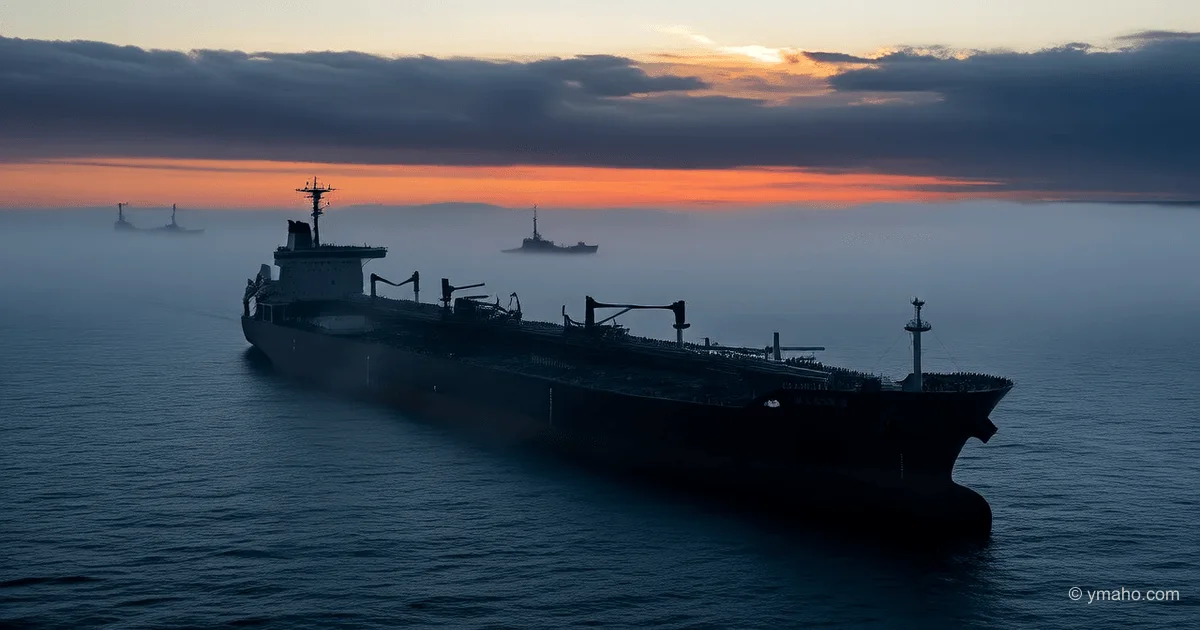
Oil Markets in Turmoil: Brent Surpasses $107 Amid Supply Disruptions
Brent crude oil prices surged 3.4% to $107.77 per barrel due to a stalemate in US-Iran talks and the effective blockade of the strait for tanker traffic.
Brent, breaking through $107.77 per barrel, is a symptom not just of a deficit, but of a fundamental breakdown in the pricing mechanism of the global market. We have entered a zone where physical deliveries are no longer the main driver. Now, fear, the inability to insure cargo, and complete legal uncertainty in the Strait of Hormuz are calling the shots.
The Essence: What Is Really Happening
The market no longer believes in a quick resolution to the conflict. The 3.42% rise in a single session is not a reaction to news of disruptions, but to the US Energy Information Administration's (EIA) acknowledgment that the strait will be effectively closed at least until the end of May. This acknowledgment means the collapse of previous forecasts that assumed the strait would reopen as early as late April.
The crux is that a physical supply deficit of 3.8 million barrels per day is compounded by the "insurance weapon." As soon as the Lloyd's Market Association designated the region a war zone, the cost of war risk insurance skyrocketed to prohibitive levels. In effect, the private insurance market closed the strait to commercial shipping faster than Iranian speedboats or mines could. A tanker can physically pass, but it cannot get insurance; without it, ports refuse the vessel, banks won't finance the deal, and charterers cancel contracts. It's a vicious circle.
Timeline and Context
The chain of events is straightforward. On February 28, a US-Israeli military operation against Iran began. The escalation of mutual threats led Iran, in response to strikes, to effectively block traffic through Hormuz. By mid-April, the Trump administration attempted to launch Operation "Project Freedom" but quickly scrapped it due to Saudi Arabia and Kuwait refusing to provide airspace. Currently, the US president says ceasefire talks are on "artificial life support."
Key point: the market realized that even if hostilities cease tomorrow, restoring logistics will take months. The EIA stated outright that returning to pre-conflict production and export levels will take at least until late 2026 or early 2027. This is not a temporary glitch; it's a structural rupture. Added to this is the destruction of inventories: from March 1 to April 25, global reserves shrank at a record pace—averaging 4.8 million barrels per day.
Who Wins and Who Loses
Winners. Major European oil companies—Shell, BP, and TotalEnergies—have already earned $22 billion in net profit in the first quarter from trading operations alone. They monetize volatility, having diversified supply routes bypassing the Persian Gulf. Also winning are tanker fleet owners operating on routes avoiding Hormuz: charter rates on the Middle East-China route have soared to $423,736 per day.
Losers. Asian importing countries, especially Indonesia, Vietnam, Pakistan, and the Philippines. They are critically dependent on energy imports from the Gulf and lack sufficient strategic reserves. According to JPMorgan Chase & Co., OECD countries will approach "operational minimum" inventory levels as early as summer—the level below which terminal and pipeline disruptions begin.
US oil giants—ExxonMobil and Chevron—find themselves in an ambiguous position. ExxonMobil's first-quarter profit fell 46% to $4.2 billion; Chevron lost 37% to $2.2 billion. The reason: direct losses from supply disruptions in the Middle East, which are not offset even by high prices. US companies are squeezed between a rising barrel price and the physical impossibility of shipping it out.
What the Media Isn't Saying
Insider view: the "insurance weapon" as a tool of war. Most commentators focus on military actions—strikes, missiles, speedboats. But the real blockade happened earlier. Within 48 hours of the first airstrikes on February 28, war insurance premiums increased fivefold, then to 60 times the pre-crisis level. The Lloyd's Joint War Committee expanded the list of high-risk zones to the entire Arabian Gulf.
And here's the key: Iran doesn't need to sink tankers to stop shipping. It just needs to create a threat that forces insurers to reassess risks. This is a "self-fulfilling weapon": no country, no regulator decides to close the strait. The market does. Every link in the chain—reinsurer, P&I club, shipowner, charterer, port authority—acts in its own commercial interest and collectively creates an impenetrable barrier.
By March 5, all major insurers—Gard, Skuld, NorthStandard, London P&I Club, and American Club—had issued notices changing coverage terms. They didn't revoke insurance, but offered new policies at rates roughly 60 times higher—about $30,000 per week instead of $25,000 per year. Commercially, this is the same as having no insurance at all. That's how the "insurance weapon" works, and it's the key non-obvious factor behind the current price surge.
Forecast: Next 30 Days and 90 Days
Next 30 days (by mid-June 2026).
Brent will test the $120 per barrel level. Trading consultancy Ritterbusch and Associates already sees potential for another $10-$12 rise until the price becomes so destructive that it forces the US or Iran to make concessions. Japan will exhaust its strategic reserve, which was used to stabilize the market in May. By the end of June, the world will be left only with the US Strategic Petroleum Reserve (SPR) and Chinese stocks, but Beijing will likely not release them. The market will enter a phase of acute deficit, where any new supply disruption will trigger explosive price growth.
Next 90 days (by mid-August 2026).
By then, Goldman Sachs and other analysts predict global inventories will fall to a critical "operational minimum." This is the level at which pipelines and terminals cease to function stably due to a lack of line fill. Brent could reach $150 per barrel, as Goldman Sachs analysts warn. In this scenario, the global economy will slide into recession, demand will be forcibly compressed due to unaffordable fuel prices. Aviation and maritime shipping will shrink by 15-20%. The only way to break this trend would be either a full-scale US military operation to clear the strait or the capitulation of one side of the conflict. But by then, the oil price may have already inflicted irreversible damage on the global economy, comparable to the 2008 crisis.
— Editorial Team









