Russia May Imprison People for Unlicensed Cryptocurrency Exchange: What This Means for Ordinary Citizens
Russia is preparing a new law that would, for the first time, introduce criminal liability for unlicensed cryptocurrency exchange—provided such activity causes significant financial harm. This isn’t just another warning: it means real prison sentences, fines, and compulsory labor. Although the law has not yet been adopted, it clearly signals the direction of digital asset regulation in the country.
What Exactly Would Be Banned?
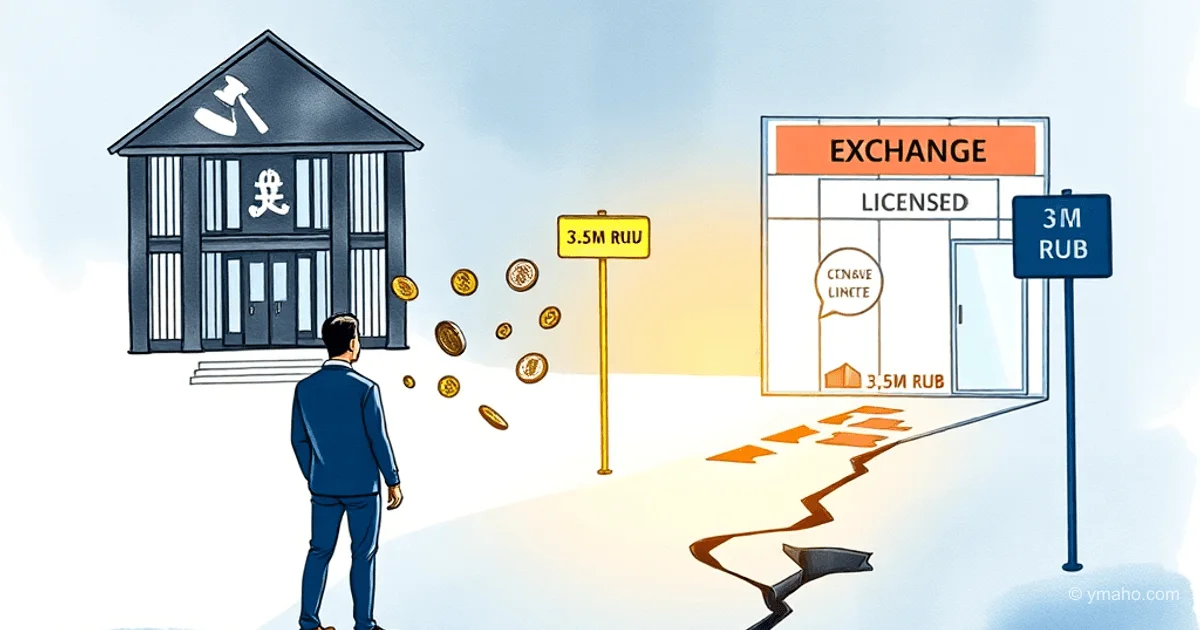
A government commission has approved a draft amendment to Article 171(7) of the Russian Criminal Code. According to the document, organizing unlicensed digital currency circulation is punishable if it results in damage or illicit income exceeding RUB 3.5 million (defined as “significant”). If the amount exceeds RUB 13.5 million, it qualifies as “especially significant” harm—and penalties become stricter.
“Unlicensed circulation” refers to cryptocurrency operations conducted without a state-issued license. Under other related initiatives, only licensed specialized companies—so-called crypto exchanges—will be permitted to facilitate cryptocurrency conversions. While no such licensed entities currently operate officially in Russia, the government is already laying the regulatory groundwork for their future operation.
What Penalties Are Proposed?
Penalties vary depending on scale:
- For damage or income of RUB 3.5 million or more: a fine of RUB 100,000–300,000 (or up to one to two years’ worth of income), compulsory labor for up to four years, or imprisonment for up to four years plus a fine of up to RUB 80,000.
- For damage or income of RUB 13.5 million or more—or involvement in an organized group: compulsory labor for up to five years or imprisonment for up to seven years, plus a fine of up to RUB 1 million (or up to five years’ worth of income).
Such cases will be investigated by officers from the Investigative Committee and the FSB—meaning these offenses will be treated as serious crimes, not administrative violations.
Why Does This Matter Even to People Who Don’t Trade Crypto?
Many think: “I just hold Bitcoin—I’m not affected.” But the line between “holding” and “exchanging” can be blurry. For example, regularly converting cryptocurrency to rubles via P2P platforms (such as Binance P2P or LocalBitcoins) could lead authorities to classify you as an organizer of unlicensed circulation—especially if transaction volumes are substantial.
Moreover, the law exerts pressure across the entire market. Banks and payment systems are already blocking accounts linked to cryptocurrency activity. This new law will intensify that trend: legal exchange options won’t appear anytime soon, while unlicensed ones will become increasingly risky.
Key Facts to Remember
- The law is not yet adopted—it hasn’t even been submitted to the State Duma.
- Liability applies only to organizing unlicensed circulation—not to simple ownership of cryptocurrency.
- The critical threshold is RUB 3.5 million in damage or illicit income.
- Investigations will be handled by the FSB and the Investigative Committee of Russia—a serious escalation.
- In the future, only licensed companies will be allowed to exchange cryptocurrency—and none exist yet in Russia.
What Does This Mean for Ordinary Citizens?
If you simply hold cryptocurrency as a store of value, nothing changes—for now. But if you frequently convert it into rubles—especially in large amounts—you should proceed with caution. The state is gradually shutting down “gray” schemes and aims to bring all such operations under oversight. Avoid public activity tied to exchanging cryptocurrency, and refrain from using a single bank account for frequent crypto-related transactions. A legal market may emerge in the coming years—but for now, it remains purely conceptual.
— Editorial Team









