US Dollar Strengthens Amid Hawkish Fed Split and Geopolitical Instability
The DXY dollar index remains persistently high amid the Fed meeting and the market's abandonment of rate cut expectations; analysts expect further dollar strengthening if active hostilities resume between the US and Iran.
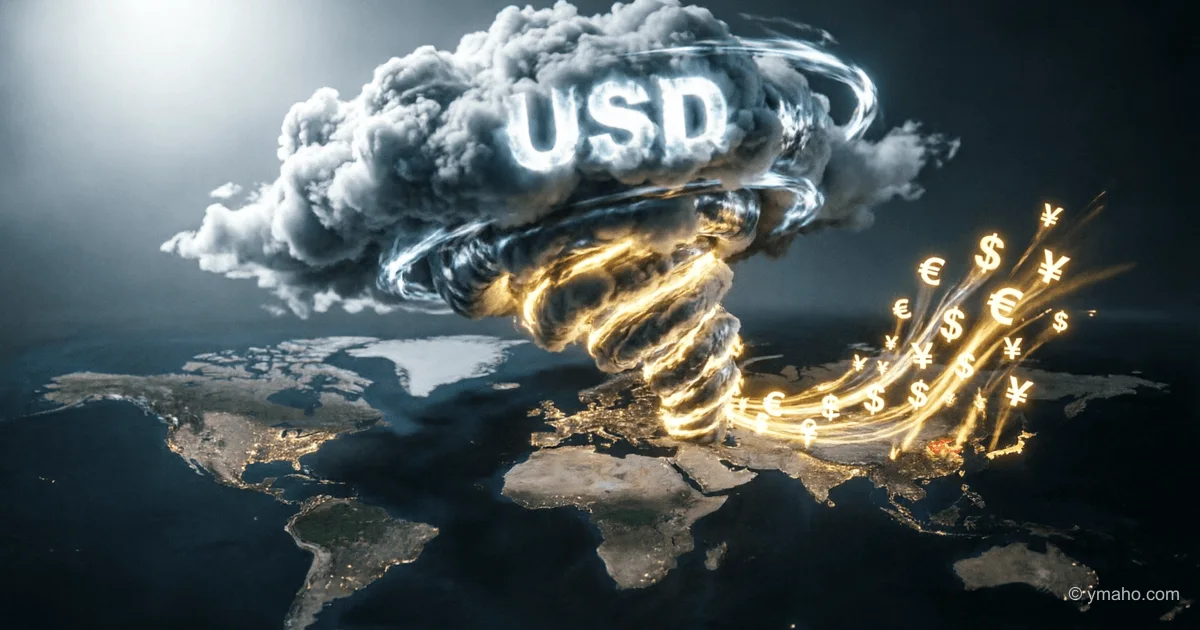
The paradoxical strengthening of the US dollar amid geopolitical chaos and internal Fed dissent is not a sign of American economic strength, but evidence of the deepest dysfunction in the global financial system. The DXY index, firmly above 110, acts like a giant vacuum cleaner, sucking liquidity from the world's periphery to the center. But within that center, a tectonic rift is brewing: the dollar strengthens not because of US successes, but because the rest of the world looks even worse, and because the global margin call on short dollar positions has already begun.
The Core: What's Really Happening
The essence of what's happening is forced and destructive capital repatriation. Every dollar of DXY strengthening is someone's margin call in Singapore, London, or São Paulo. A huge number of non-US borrowers (governments, corporations, and hedge funds) have been piling on dollar-denominated debt for years, taking advantage of the low-rate era. Now that the Fed is not only refraining from cutting rates but hinting at hikes, servicing that debt becomes exponentially more expensive.
To repay loans, borrowers are forced to sell national currencies and buy dollars, driving the dollar even higher. This is called the "dollar death spiral" for emerging markets. But in 2026, not only traditional victims like Argentina or Turkey have fallen into this trap. Japan, South Korea, and even major European banks are in the danger zone. The DXY index at 110 is not just a number on a Bloomberg screen; it's a level at which trillions of dollars in currency swaps, struck between the Fed and other central banks in calmer times, are breaking.
The Iran crisis and the oil price spike exacerbate the situation asymmetrically. When oil rises by $20 a barrel, energy import bills for Japan and India soar by tens of billions of USD. They are forced to buy even more dollars to pay these bills, but their suppliers (Arab monarchies) no longer reinvest the petrodollars in US Treasuries as before; instead, they keep them in gold or invest in China. The dollar returns home reluctantly and at a high cost, creating a dollar liquidity shortage in offshore markets.
Timeline and Context
Markets expected the dollar to weaken after the Fed's April 28-29 meeting on a dovish signal. Instead, the world saw 4 dissenting votes and the prospect of a rate hike. This led to a repricing of the entire federal funds futures curve. The probability of a June rate hike jumped from 15% to 42%. This is a tectonic shift for the forex market, where all positions were built around a "weak dollar."
The context includes an unspoken understanding between the US Treasury and major American banks. Since early May, the Treasury has been aggressively issuing short-term T-bills to finance the growing deficit and military spending. They need a strong dollar so that foreigners continue to buy these securities. If DXY falls below 105, foreign holders will start locking in losses, as currency revaluation will eat up all their coupon yield. The Trump administration cannot afford that in the face of a recession. So the Pentagon and State Department are playing escalation with Iran, which paradoxically works to strengthen the dollar as a "safe-haven currency." A strong dollar amid geopolitical crisis is economic oxygen for the US government, allowing it to continue spending without immediate inflationary punishment.
Who Wins and Who Loses
The biggest loser is the Japanese yen and the Bank of Japan. USD/JPY has broken through 155 and is steadily moving toward 160. Japan is in a hopeless position: it imports 99% of its oil, and every escalation in the Gulf hits its trade balance. The Japanese Ministry of Finance has already spent $35 billion on currency interventions in March and April, but to no avail. The carry trade (borrowing in yen at low rates to buy dollar assets) has reached an all-time high, and if the Bank of Japan raises rates to protect the currency, it will blow up the global carry trade, triggering a chain reaction of asset liquidation from Brazil to the NASDAQ.
Another victim is China and the yuan (CNY). The People's Bank of China is desperately defending the 7.30 level against the dollar, burning through foreign exchange reserves and tightening capital controls. But pressure is mounting because high oil prices and weak domestic demand create a toxic mix for the yuan.
The winner in this situation is the American tourist and importer. A strong dollar means that imported goods from Europe and Asia (excluding energy) become cheaper. This creates a strange split in the economy: domestic services and gasoline become more expensive, while imported electronics and clothing become cheaper, slightly smoothing the overall CPI but masking the real inflationary spiral in non-tradable sectors.
What the Media Isn't Saying
Major media paint a picture of a "bull market for the dollar." They don't mention that dollar strength is a direct threat to the profits of S&P 500 companies. About 40% of the revenues of corporations in this index are generated abroad. When the dollar rises, their foreign sales, when converted back to USD, shrink. Already in the second quarter of 2026, we will see a "surprise": giants like Apple, Microsoft, and Coca-Cola will begin writing off billions in losses from currency revaluation. This is something few factored into stock valuation models (P/E) in March 2026. Thus, a strong dollar combined with high rates creates a double blow to the stock market.
Moreover, there is a hidden risk in the swap market. The cross-currency basis swap spread for dollar loans for Japanese and European banks is becoming increasingly negative, signaling deep stress. Banks are paying a huge premium just to get access to physical dollars for short periods. If a major European energy trader, caught short on margin for dollar-denominated gas or oil futures, defaults, we could see an instant freeze in dollar lending. The Fed would have to secretly or openly resume currency swap lines to prevent a collapse of European and Japanese banks, acknowledging that the current dollar exchange rate is a weapon of mass destruction out of control. This risk, not inflation per se, is what is being discussed in "red phone" conversations between Powell and Lagarde.
Forecast: Next 30 Days and 90 Days
30-day horizon (by June 6, 2026).
The DXY dollar index will continue to rise to 112-113 on expectations of a Fed rate hike. A break above 112 will trigger a cascade of stop-losses on long euro and yen positions. EUR/USD will fall to 1.01, and USD/JPY will test 158. This will force the Japanese Ministry of Finance to launch a new, more aggressive intervention, possibly coordinated with the Fed (tacitly). However, without a real change in US rates, interventions will only slow, not reverse, the trend.
90-day horizon (by August 2026).
A Fed rate hike in July-August will paradoxically mark the peak for the dollar, not the start of a new rally. Markets, looking ahead, will realize that the US economy cannot sustain such high real rates. Active pricing of a US recession will begin. Once the pendulum swings from inflation fear to recession fear, the dollar will start to weaken sharply by the end of August. DXY will retreat to 106, the euro will rally to 1.06, and gold will soar to new all-time highs above $3,500. It is at this point that the most dangerous scenario unfolds: if the dollar falls too quickly, foreign holders of US government bonds may start a massive sell-off, blowing out 10-year Treasury yields to 5.5% without the Fed being able to intervene without triggering hyperinflation. Thus, the strong dollar now is merely a prelude to its possible chaotic collapse in late summer 2026.
— Editorial Team









