ISCT 2026: Dual-Action CAR-T Therapy Shows 100% Remission in Multiple Myeloma
Clinical update on TPST-2003 (CD19/BCMA CAR-T) shows complete response in all 15 CAR-T-naive patients in the REDEEM-1 and POEMS-1 trials; no severe neurotoxicity or high-grade cytokine storm reported.
Dual-Action CAR-T and 100% Remission: Why ISCT 2026 Data Is Not Just 'Another CAR-T'
When Tempest Therapeutics presented updated data on TPST-2003 at the annual ISCT conference in Dublin on May 6, 2026 — 100% complete response in all 15 CAR-T-naive patients — the market reacted predictably: TPST shares jumped, headlines blared "revolution." But within the cell therapy industry, this presentation sparked a far more complex reaction — a mix of genuine admiration and deep skepticism. Because behind the "100%" figure lies a story of how a small biotech company is trying to walk the fine line between breakthrough and statistical illusion.
The Substance: What's Really Happening
Formally, this is about TPST-2003 — an autologous CAR-T therapy with a parallel dual construct simultaneously targeting CD19 and BCMA. REDEEM-1 (NCT06223646) is a multicenter, open-label phase 1/2a study conducted entirely in China by Tempest's partner, Novatim Immune Therapeutics. Eight clinical sites, target enrollment of 32 patients; as of the data cutoff on January 31, 2026, 13 patients had received infusion in REDEEM-1. Of these, 10 CAR-T-naive patients were evaluable for efficacy — and all 10 achieved complete response per IMWG criteria.
But the real story is not about the molecule or the 100%. The real story is about the architecture of clinical development that Tempest built like a chess game of anticipation.
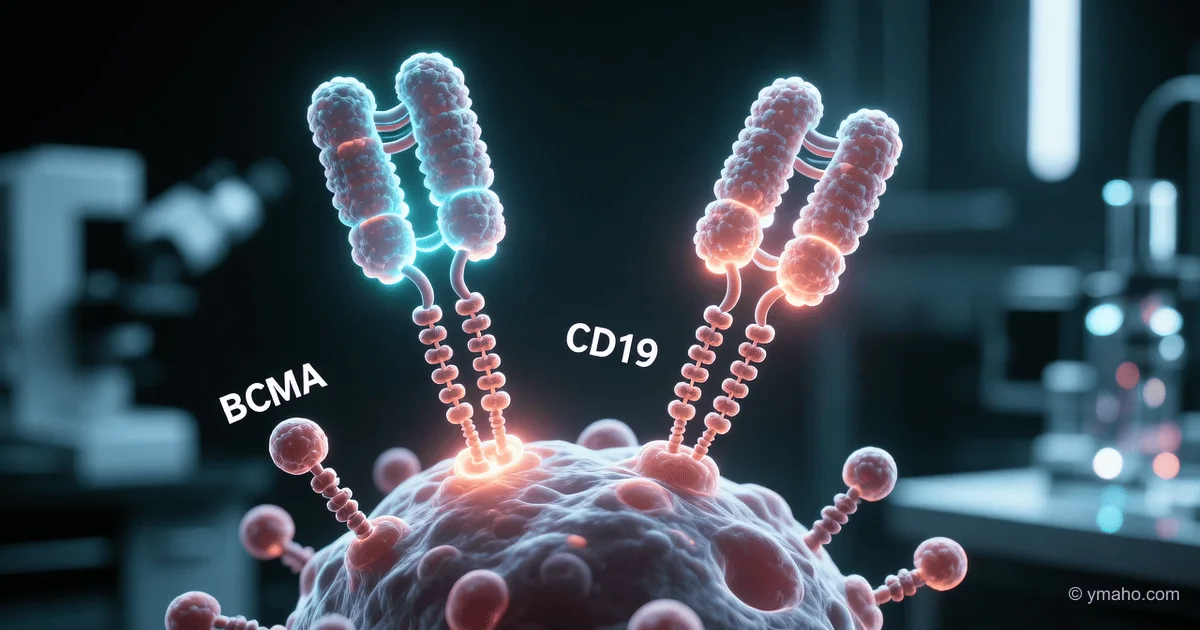
First: the parallel CAR structure means that two independent CARs are expressed on the surface of a single T cell — one recognizes BCMA, the other CD19. This is not a tandem construct where both domains are linked sequentially. These are two full receptors working simultaneously. Why is this needed? Mature myeloma cells express BCMA, but early B-cell precursors, which can serve as a reservoir for relapse, do not carry BCMA — but they do carry CD19. Moreover, after relapse on BCMA-targeted therapy, tumor cells often lose BCMA (antigen escape). Dual targeting closes both escape pathways.
Second: Tempest deliberately split the geography of development. Clinical data are generated in China by Novatim, while the regulatory dossier and future US launch are built through manufacturing transfer to Cincinnati Children's AGCTC. This allows the company to leverage the speed and cost of Chinese clinical trials while simultaneously preparing the product for the FDA with a US manufacturing base. By the end of April 2026, the lentiviral vector had already been delivered to AGCTC, and technology transfer is on track for completion in Q3 2026.
Timeline and Context
The story of TPST-2003 began long before ISCT 2026. The first study — a phase 1/2 IIT (NCT04714827) — started in China several years ago and enrolled 24 patients with relapsed/refractory multiple myeloma. It was there that the first efficacy signals were obtained, including a median progression-free survival (PFS) of 23.1 months in patients with extramedullary disease — a population historically very difficult to treat with existing CAR-Ts.
Key timeline:
- July 2025: Erigen licenses rights to TPST-2003 from Novatim for territories outside China, India, Turkey, and Russia.
- November 2025: Tempest acquires the dual-targeting CAR-T portfolio from Erigen; TPST-2003 becomes the company's lead asset.
- January 2026: Interim data from REDEEM-1 — 100% CR in the first 6 patients.
- April 2026: Lentiviral vector delivered to AGCTC; manufacturing transfer activated.
- May 6, 2026: Presentation at ISCT in Dublin — 100% CR in 15 patients, safety data (no Grade >3 CRS or ICANS).
Context without which this story cannot be understood: the CAR-T market for myeloma is already crowded. Carvykti (ciltacabtagene autoleucel, Janssen/Legend) and Abecma (idecabtagene vicleucel, BMS/2seventy bio) are FDA-approved and actively deployed. Carvykti shows depth of response that is hard to surpass and is moving into earlier lines of therapy. Meanwhile, AstraZeneca acquired Gracell Biotechnologies for approximately $1.2 billion in 2024, gaining AZD0120 (GC012F) — another CD19/BCMA dual-targeting CAR-T that is already in a phase 1b/2 study in the US under the name DURGA-1.
Tempest enters a field where giants with budgets an order of magnitude larger than its market cap are playing. The only way to compete is data. And so far, the data favor Tempest.
Who Wins and Who Loses
Tempest wins — the obvious beneficiary. The company's Nasdaq market cap (ticker TPST) will get a serious boost after the ISCT data doubled the previous dataset. But it's not just about the stock. The company is approaching a key catalyst — a meeting with the FDA to discuss the design of a registrational study by the end of 2026.
The concept of parallel dual-targeting wins. If the progression-free survival data (median PFS 23.1 months in patients with extramedullary disease) are reproduced in a registrational study, TPST-2003 could be positioned as a potentially class-leading therapy — not just "another CAR-T" but a treatment of choice for the most challenging population.
Patients with POEMS syndrome win — a rare plasma cell disorder for which TPST-2003 showed 100% CRVEGF (normalization of serum VEGF levels) in all 5 evaluable patients. This is an orphan indication with extremely limited treatment options.
Approved BCMA-only CAR-Ts lose — not today, but in the long run. If dual-targeting truly prevents antigen-negative relapses, single-target products will lose market share to dual-targeted counterparts. Abecma is particularly vulnerable, already lagging behind Carvykti in depth of response.
Skeptics of "Chinese data" lose. Tempest was able to present not 6 but 15 patients — and the safety profile remained pristine. The "small sample size" argument hasn't gone away, but the trend is consistent, weakening the critics' position.
What the Media Isn't Saying
First non-obvious insight: the patient who previously received BCMA CAR-T did not respond. In Tempest's press release, there is a phrase many skip: "A single patient, who had previously received a BCMA-targeting CAR-T, did not respond." This is critically important information. TPST-2003 failed in the very patient for whom dual-targeting should theoretically be a rescue — the one whose tumor had already escaped BCMA therapy. If this pattern is reproduced in a larger sample, the positioning of TPST-2003 as a therapy for post-BCMA CAR-T patients will be called into question, narrowing the market niche.
Second non-obvious insight: the three-dose-level design has already revealed a paradox. TPST-2003 is being tested at doses of 1×10⁶, 2×10⁶, and 3×10⁶ cells/kg — and responses are seen at all levels, with no clear dose-response relationship. This creates a dilemma for the registrational design: if the lowest dose works as well as the highest, why use a higher dose? But if the lowest dose is registered, will there be a hidden population that needs a higher dose? Tempest will have to answer this question before the FDA.
Third non-obvious insight: the technology transfer to Cincinnati Children's AGCTC is more than just a "key manufacturing milestone." It is a bet that the cell product manufactured in the US will be identical to the product manufactured in China. Analytical comparability is one of the most challenging regulatory tasks in the CAR-T industry. The slightest difference in cytokine profile, exhaustion marker expression, or transduction efficiency could force the FDA to require an additional bridging study — a delay of 12-18 months and costs of approximately $15-25 million.
Fourth non-obvious point: Tempest is accelerating its timeline with an eye on AZD0120. AstraZeneca/Gracell already presented preliminary phase 1b/2 data at the TCT Meetings in February 2026, and expert commentary was "encouraging." AZD0120 has an additional advantage — rapid manufacturing technology (less than 3 days from apheresis to finished product versus weeks for traditional CAR-Ts). If AZD0120 gets FDA approval first, the window for TPST-2003 will narrow sharply.
Fifth non-obvious insight: the 23.1-month median PFS includes patients who received infusion in the IIT study years ago. Tempest pools data from REDEEM-1 and the old IIT into a combined set of 29 CAR-T-naive patients, where ORR is also 100%. This creates the illusion of a larger dataset, but the IIT was conducted under different conditions, possibly with different inclusion criteria and a different manufacturing batch. The FDA will analyze these two cohorts separately.
Forecast: Next 30 Days
Second half of May 2026. Wall Street analysts will release a series of notes with target prices for TPST. The key question is the probability of FDA approval. Conservative estimates will range from 40-50% given the program stage, optimistic ones up to 70% given the data.
Late May to early June. Additional details on the registrational study design are expected — presumably a randomized comparison with one of the approved BCMA CAR-Ts in the extramedullary disease population. Tempest may announce receipt of written FDA comments following the pre-IND meeting.
ASCO 2026 (late May to early June). If Tempest submitted an abstract with REDEEM-1 data to ASCO, this will be the main venue for validating results before the US oncology audience.
Forecast: Next 90 Days
July 2026. Completion of formal technology transfer to Cincinnati Children's AGCTC. The first US-manufactured batch of TPST-2003 will undergo analytical validation. The company will not publish the results, but if comparability is confirmed, it will remove one of the main risks before the IND.
August 2026. Official IND submission to the FDA is expected. Simultaneously, Tempest will begin negotiations with US clinical sites for the registrational study. Key candidates: MD Anderson, Memorial Sloan Kettering, Dana-Farber.
September 2026. First public discussion of long-term survival data. If median PFS in REDEEM-1 approaches the 23 months from the IIT, TPST-2003 will gain a strong argument for class-leading potential. If the first signs of relapse appear in patients with extramedullary disease, the thesis of special efficacy in this population will begin to unravel.
Late Q3 to early Q4 2026. Likely start of the registrational study in the US. This will be the main inflection point for Tempest: the start of patient enrollment in a US study simultaneously validates the manufacturing transfer, the acceptability of the data to the FDA, and the readiness of US centers to work with the new product.
The main strategic takeaway: TPST-2003 is not just "another CAR-T with good data." It is a test case for the entire dual-targeting cell therapy industry. If Tempest succeeds in taking the product from concept to registration through a hybrid Chinese-American development model, it will set a precedent that changes the economics of the entire field. If not, the industry will get another reminder that 100% remission in 15 patients and market success are two completely different things.
Financial estimate: the CAR-T therapy market for multiple myeloma in 2026 is approximately $4.5 billion (USD) and is projected to reach $8-10 billion by 2030. If TPST-2003 captures even 10-15% of this market in the extramedullary disease niche, peak sales could be around $500-750 million. For a company with a current market cap in the hundreds of millions, this is transformational potential — but only if the data hold up under scaling.
— Editorial Team









