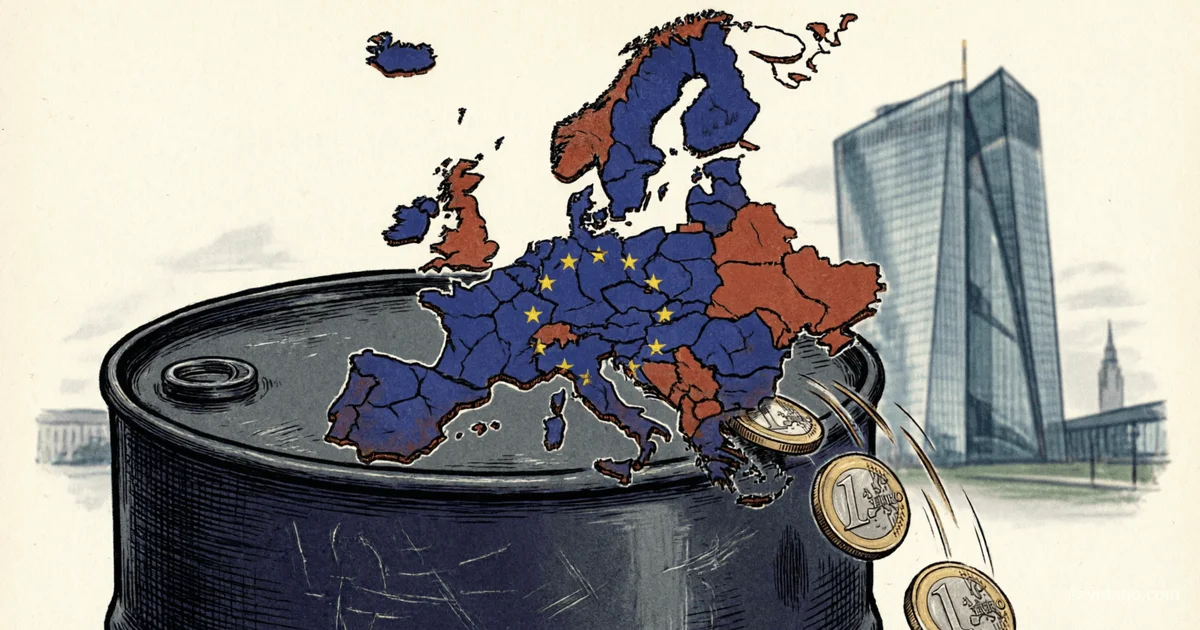
Middle East Energy Shock Hits Euro and EU Economy
The deteriorating economic outlook for the eurozone amid expensive oil complicates the ECB's plans to tighten policy. The divergence in economic growth between the US and the eurozone is putting pressure on the euro exchange rate, whose downward trend, according to analysts, is confirmed by macroeconomic data.
Europe in a Trap: Why the Energy Shock Hits the Euro Harder Than It Seems
Author's analytical review
[The Gist]: What's Really Happening
The news that the Middle East energy shock has hit the euro and the EU economy seems trivial at first glance. High oil prices — Europe imports → euro weakens. Simple logic.
But the reality is much more complex and alarming. What we are witnessing now is a structural breakdown of the eurozone's two-decade economic model.
Look at the dynamics. Back in December 2025, when forecasts were optimistic, the EUR/USD pair traded around 1.16-1.18, and analysts expected a rise to 1.20. The Fed was cutting rates, the EU economy showed moderate recovery, and global de-dollarization played into the euro's hands.
Now the picture has turned upside down. The Fed, on the contrary, signals possible rate hikes. Europe is entering a technical recession or teetering on its brink. And most importantly, the ECB has found itself in a monetary trap: it must tighten policy due to inflation, but cannot because it would kill already fragile growth.
This is exactly what ECB Executive Board member Frank Elderson said back in April: repeated energy shocks make achieving price stability "an increasingly challenging task."
Timeline and Context
Let me reconstruct the sequence of events over the past two weeks. It shows how quickly the consensus changed.
April 2026 — Eurozone inflation begins to accelerate due to rising energy prices after the start of the Middle East conflict.
April 6-7, 2026 — ECB's Frank Elderson publishes a blog warning: "Repeated energy shocks test all conditions for the central bank to ignore them." This is the first public signal from the ECB that the situation is getting out of control.
May 20, 2026 — The European Commission publishes its spring economic forecast. The numbers shock markets: eurozone GDP growth in 2026 is cut to 0.9% (from 1.2% in the autumn forecast), and inflation is raised to 3.0% (from 1.9%).
May 20-21, 2026 — Valdis Dombrovskis presents the forecast publicly. He admits: "Inflation started to rise a few weeks after the start of the conflict, driven by a sharp increase in energy prices, and economic activity is losing momentum." He also notes that rising energy prices "effectively redirect income from the EU economy to energy-exporting countries."
May 20-21, 2026 (simultaneously) — S&P Global publishes the composite PMI for May — 47.5 points, the lowest since October 2023. The data show a contraction in eurozone activity.
Now (May 25, 2026) — I am writing this analysis. The EUR/USD pair is under pressure. Markets await the ECB meeting on June 10-11.
What is important in this timeline: the European Commission forecast and the PMI data were released simultaneously, creating a "perfect storm" effect. Both sources confirmed the worst expectations: Europe is slowing faster than assumed, and inflation is accelerating faster.
At the same time, note Dombrovskis's caveat: "The situation should improve slightly in 2027, if tensions in energy markets ease." The key word is "if." Officials have no certainty.
Who Wins and Who Loses
Winner #1 — The US dollar. According to Societe Generale's forecast, "US economic superiority will be felt more strongly" amid lower eurozone growth forecasts. The DXY (dollar index) fluctuates in the range of 96-101, and if current trends persist, it could break the upper bound.
Winner #2 — Energy-exporting countries. Dombrovskis directly said that rising energy prices "redirect income from the EU economy to energy-exporting countries." These are Norway, UAE, Qatar, the US. They reap excess profits from the European crisis.
Loser — All European industry, but especially Germany. The forecast for the largest eurozone economy is cut to 0.6% — twice as bad as the previous forecast. The German export sector, reliant on cheap energy, is being destroyed.
Non-obvious loser — European households. Consumer confidence has fallen to a 40-month low. People are bracing for higher heating and fuel bills, while real incomes are not rising. This will weigh on domestic demand, which is already weak.
Those not named but in the game — hedge funds that have opened short positions on the euro. The Bloomberg consensus forecast for EUR/USD at end-2026 is 1.20, but Societe Generale gives a more conservative forecast of 1.16. My forecast is even lower — 1.08-1.10 by year-end. Funds that bet on a falling euro will profit from this trend.
What the Media Are Not Saying
Insight #1 — The ECB's dilemma is worse than the Fed's.
The Fed also has a dilemma: inflation above target, growth slowing. But the Fed has one advantage — the US economy is still growing (albeit slower). Europe does not have that advantage.
Look at the numbers: eurozone growth forecast is 0.9%. That is de facto stagnation. Meanwhile, inflation is 3.0%. The ECB must fight inflation, but any rate hike will kill growth. Any easing will fuel inflation.
And that is why, as Bloomberg writes, markets are already pricing in two ECB rate hikes in 2026 — in June and September. At the same time, analysts expect rate cuts to begin only in March 2027.
This means the eurozone economy will be under pressure from high rates throughout 2026 and early 2027. No growth. High inflation. Rising rates. This is classic stagflation, although officials avoid the term.
Insight #2 — The hidden problem of food and fertilizers.
Dombrovskis mentioned this in passing, but it is critically important. The energy shock hits not only fuel and heating. It hits fertilizer production. Europe lost a significant part of this sector after 2022. Now the situation is repeating.
Without fertilizers — lower crop yields. Lower yields — rising food prices. Rising food prices — social tension. The ECB cannot ignore food inflation; it hits the poorest and fuels inflation expectations.
This means inflation in Europe could remain high even after energy prices stabilize. The food channel has a lag of 3-6 months. That is, the worst is yet to come.
Insight #3 — Why the euro will not recover even after peace.
The Bloomberg consensus forecast for EUR/USD at end-2026 is 1.20. This forecast, in my view, is too optimistic. It assumes a quick resolution of the conflict and economic recovery.
But even if peace is signed tomorrow, business and consumer confidence will not recover quickly. Investments have already been postponed or canceled. Supply chains have been restructured. Debt burdens have increased.
Societe Generale gives a more realistic forecast — 1.16 at end-2026. I would bet on 1.10 or lower. Because Europe is emerging from this crisis weaker than it entered.
Forecast: Next 30 Days and 90 Days
Next 30 days:
- ECB meeting June 10-11 — markets expect a 0.25 pp rate hike. Probability: 65-70%. If the hike happens, the euro will strengthen briefly (1-2%), but that strength will be sold (sell the rally).
- EUR/USD pair — range 1.05-1.09 in the coming weeks. A break below 1.05 is possible on news of escalation in the Middle East.
- European stock indices (Euro Stoxx 50, DAX) — under pressure. ECB rate hike plus weak economy = 2-4% decline in June.
Next 90 days:
Baseline scenario (55% probability): ECB hikes in June, then pauses to assess effects. Eurozone economy remains sluggish (0.5-0.8% growth in 2026). Inflation gradually declines to 2.5% by year-end. EUR/USD at 1.08-1.12.
Escalation scenario (30% probability): Middle East conflict intensifies, oil at $120-140. Europe enters recession (negative growth in Q3-Q4). ECB forced to hike rates to 3.0%+ to fight inflation despite recession. This is a stagflation scenario. EUR/USD falls to 1.02-1.05.
De-escalation scenario (15% probability): Quick peace deal, energy prices fall, inflation slows. ECB refrains from rate hike. Economy avoids recession but remains weak. EUR/USD recovers to 1.12-1.15.
Editorial Forecast
Asset: EUR/USD pair
Direction: Sideways with a downward bias over the next 24-72 hours. Pressure will persist until the ECB meeting on June 10-11.
Key levels: Resistance — 1.0750, support — 1.0450. Likely trading range — 1.0500-1.0700
Confidence level: Medium (55%). The European Commission forecast and PMI data are already priced in, but the market awaits signals from the ECB before the June meeting.
Main risk: Unexpectedly hawkish rhetoric from the ECB (e.g., a signal of two hikes in 2026) could temporarily strengthen the euro to 1.08-1.09. But this strength is likely temporary, as fundamental factors remain bearish for the euro.
This forecast is an analytical opinion of the editorial board and does not constitute individual investment advice. Make decisions based on your own risk assessment and consultation with licensed financial advisors.
— Editorial Team









