Why Record Profits at Ukraine’s Energy Trader Concern All of Europe
Imagine if your local electricity provider suddenly started making multiples more during a war. For Ukraine, this is reality: last year, D.Trading doubled its net profit despite ongoing shelling. Why does this matter beyond Kyiv? Because the stability of Ukraine’s power grid acts as an anchor for all of Europe, which is grappling with an energy crisis.
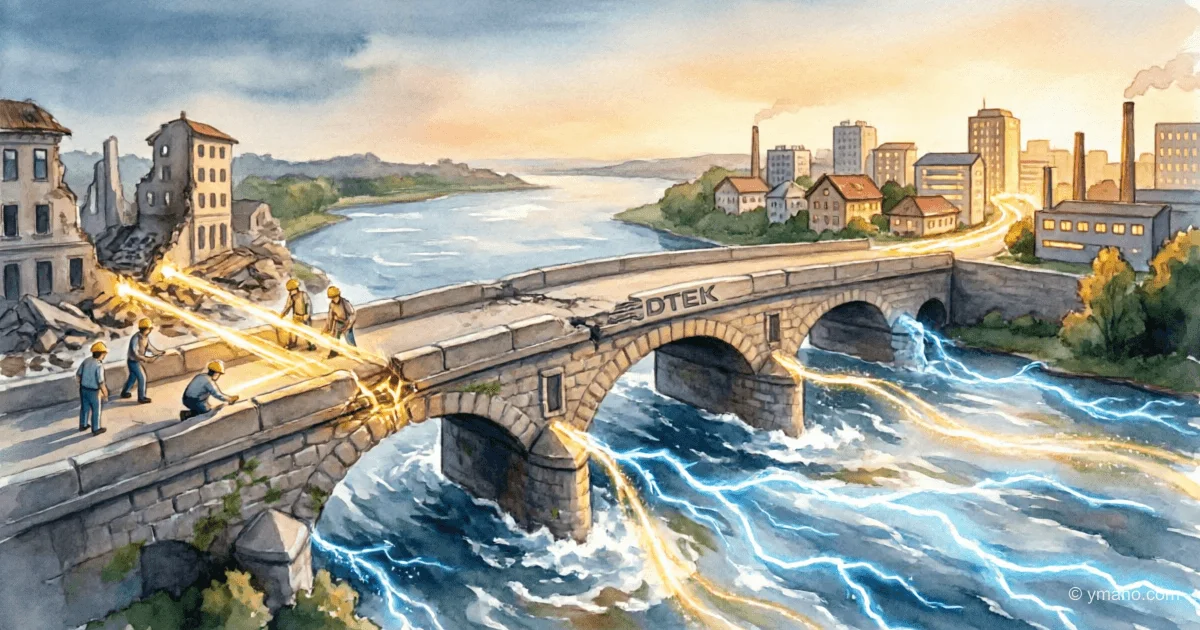
How the Energy “Bridge” Works Amid War
D.Trading isn’t just another corporation. It’s Ukraine’s largest private electricity supplier and part of Rinat Akhmetov’s DTEK energy holding. In 2025, its revenue surged to UAH 292.4 billion (roughly $7.5 billion)—a 35% increase from the previous year. Net profit hit UAH 5.89 billion, surpassing 2024 figures.
Think of it like your neighborhood supermarket suddenly doubling its sales during a siege. How? Ukraine’s energy market operates like a complex assembly line: power plants generate electricity, traders like D.Trading buy it wholesale and resell it downstream—to homes, factories, and neighboring countries. Even under missile strikes, this supply chain keeps running.
Why the Growth Isn’t Just Numbers
The company’s revenue jump wasn’t driven by higher sales volume, but by prices. Picture a gas station in a warzone: when fuel becomes scarce, its cost spikes even if fewer liters are sold. Electricity works the same way—the global energy crisis post-2022 drove up rates everywhere. For Ukraine, it’s a double-edged sword: consumers pay more, but companies collect more hryvnias for the exact same amount of energy.
Yet there’s a silver lining. D.Trading is part of a system that helps Ukraine export surplus power to Europe. Since May 2022, Ukraine has supplied up to 1.5 GW of capacity to EU nations via Moldova and Romania. It’s like a small pump feeding European grids during shortages.
- UAH 292.4 billion — record revenue for D.Trading in 2025
- +35% year-over-year revenue growth vs. 2024
- UAH 5.89 billion — net profit compared to UAH 5.6 billion the prior year
- No. 1 among all Ukrainian firms for sales volume for two consecutive years
What This Means for European Energy Security
Europe is currently like someone who just quit smoking: it has sharply cut Russian gas imports but is scrambling for alternatives. Ukraine is evolving from a mere transit corridor into a potential partner for green energy. Its solar and wind farms could eventually supply clean power to the EU—if the infrastructure survives.
D.Trading’s success proves that even amid conflict, Ukraine’s energy sector can adapt. When Russia targeted the power grid in December 2023, companies quickly pivoted to domestic sources and imports from Poland. It’s akin to your household switching to a generator during a hurricane—but on a national scale.
Key Takeaways
- D.Trading is a cornerstone of Ukraine’s energy balance, ensuring reliable supply stability
- Revenue growth mirrors a global trend: energy has become a scarce commodity following severed ties with Russia
- Ukraine is already exporting electricity to the EU, reducing Europe’s reliance on Russian supplies
- Financial resilience of such firms is critical for post-war infrastructure reconstruction
- Crisis-era performance demonstrates that energy markets can adapt even to extreme scenarios
So what does this mean for everyday people? For Europeans, it offers hope for alternative energy sources to replace Russian gas. For Ukrainians, it means a chance at stable lighting in their homes even during air raid sirens. And for the world, it’s a lesson: critically vital systems can be fortified even in chaos, provided resources are allocated wisely. Energy doesn’t disappear—it just needs to be rerouted effectively.
— Editorial Team









