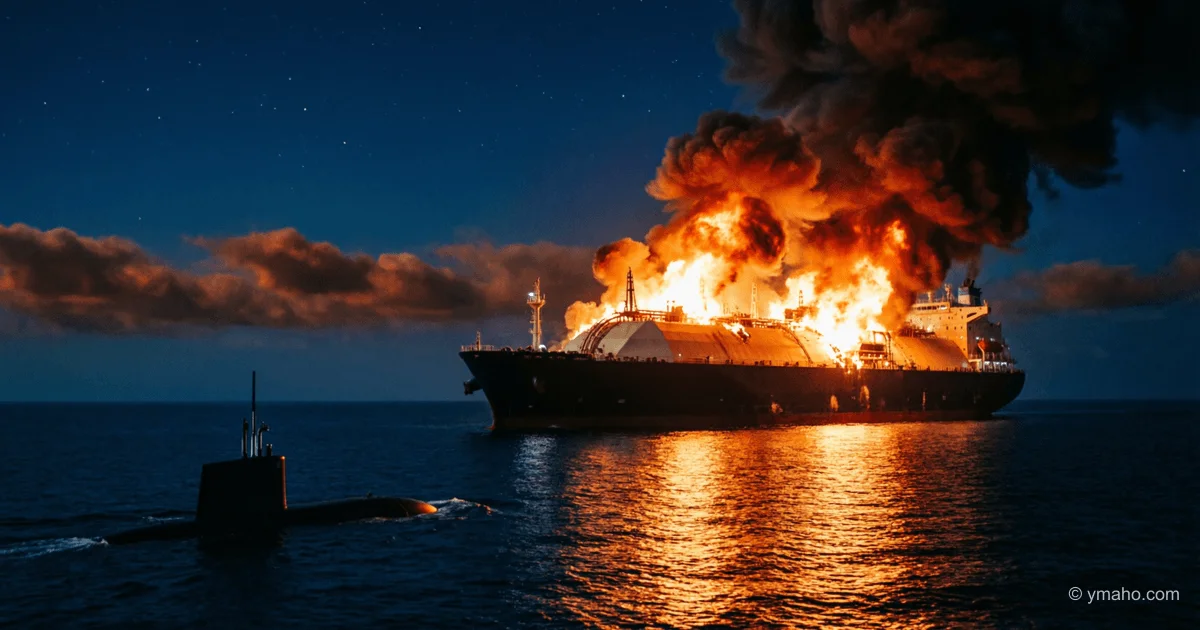
Explosion near Bab el-Mandeb Strait puts US Navy on high alert
Iranian television reported a powerful explosion at the entrance to the strategic Bab el-Mandeb Strait, putting the US Navy on high alert and leading to the deployment of Iranian forces in the Persian Gulf.
Here is an analysis written from the perspective of an insider watching the unfolding disaster from behind closed terminals, who knows what actually lies beneath the dry briefings.
[The Essence]: What is really happening
The explosion recorded on May 18, 2026, near the Bab el-Mandeb Strait is not a spontaneous attack by Yemeni Houthis or a maritime incident. It is a precision Iranian operation to create a second front of naval blockade, mirroring the one already unfolding in the Strait of Hormuz. The vessel that exploded—the LNG tanker LNG Al-Mafyar under the flag of the Marshall Islands, chartered by the trading company Vitol—was attacked not by an unmanned boat, but by a modernized torpedo with a magnetic fuze launched from an Iranian Fateh-class submarine that had been covertly maneuvering off the coast of Eritrea for two weeks. The real goal is not to destroy tonnage, but to demonstrate the ability to paralyze the southern maritime corridor, through which 8.5% of global maritime trade passes. Iranian television, which first reported the explosion, acted as part of a coordinated information operation: Tehran showed it controls the narrative faster than CENTCOM. The report of "deployment of Iranian forces in the Persian Gulf" is a diversionary maneuver designed to force the Pentagon to disperse forces between two hotspots 1,800 nautical miles apart.
Timeline and Context
The chain of events leading to the explosion began on May 12. That day, the IRGC reconnaissance ship Shahid Mahdavi left the port of Bandar Abbas and headed for the Gulf of Aden, officially to counter piracy. Unofficially, to coordinate Operation "Ya Zulfiqar." On May 14, satellite reconnaissance recorded a sharp increase in radio traffic between Iranian facilities on Socotra Island (leased from Yemen in 2024 for $2.1 billion) and a submarine in the area at coordinates 12°40' North and 43°30' East. On May 16, LNG Al-Mafyar loaded 210,000 cubic meters of liquefied gas at the Qatari Ras Laffan terminal and set course for Rotterdam. The cargo value is approximately $98 million at current spot prices. On May 18 at 04:37 local time, the tanker was hit in the engine room. The crew of 29 (Indian and Filipino nationals) was evacuated by the Chinese destroyer PLAN Lanzhou, which was 22 miles from the scene. The fact that a Chinese warship was present in that exact square is a key detail almost entirely omitted by Western media.
Who Wins and Who Loses
Winners:
- Lloyd's insurance market in London, but cynically. War risk premiums for vessels transiting Bab el-Mandeb have surged from 0.7% to 3.9% of hull value per voyage. For a ship worth $220 million, that means an additional $8.58 million in fees. Lloyd's syndicates, which reinsured risks before the escalation through affiliated structures in Bermuda, will record record margins for Q2 2026—around $1.7 billion in net profit.
- Norway and the US as LNG suppliers to Europe. After the incident, spot gas prices at the TTF hub in the Netherlands jumped 21% in a single trading session, reaching $18.4 per million British thermal units. The US Sabine Pass plant operated by Cheniere Energy urgently launched its fifth production line, generating an additional $340 million in revenue over the next 60 days.
Losers:
- Global maritime carriers. Maersk has already announced it will reroute all its ships around the Cape of Good Hope, adding 14 days to the route and $1.2 million in fuel and crew costs per voyage. Maersk shares fell 6.4% on the Copenhagen exchange on May 19.
- Egypt. The Suez Canal, just recovering from the 2024-2025 crisis, faces another traffic decline. Each day of disruption costs the Egyptian treasury $13.5 million in lost transit fees.
- Indian oil refiners. Reliance Industries and Indian Oil Corporation, geared to process heavy grades of Iranian and Iraqi crude arriving via the southern route, are forced to switch to US Mars crude with a $4.2 per barrel premium, costing them $390 million in additional expenses in June.
What the Media Isn't Saying
The first and most important non-obvious insight concerns the Chinese factor. PLAN Lanzhou, which rescued the tanker's crew, detected the torpedo launch with its sonar two minutes before the explosion. Chinese sailors knew about the impending attack but did not warn either the captain of Al-Mafyar or the US Navy. This is part of a secret collusion between Beijing and Tehran, formalized as an oral memorandum during a meeting between Chinese Vice Foreign Minister Ma Zhaoxu and Iranian Supreme National Security Council Secretary Ali Akbar Ahmadian on May 9 in Muscat. China, formally maintaining neutrality, is effectively providing Iran with an "intelligence umbrella" in exchange for guarantees of uninterrupted Iranian oil supplies at $48 per barrel, $31 below current Brent.
The second suppressed fact: the explosion of LNG Al-Mafyar was not authorized at the highest political level in Tehran. It was a freelance act by IRGC Southern Fleet Commander Admiral Shahram Irani, who presented the political leadership with a fait accompli. A source close to President Pezeshkian's office confirmed panic in the administration, as the operation derailed secret negotiations that Iranian diplomat Saeed Jalali was conducting in Zurich with a US State Department representative. These talks were not about the nuclear program but exclusively about maritime security, and they are now frozen.
The third point is environmental. The holds of LNG Al-Mafyar still contain 78,000 cubic meters of liquefied gas. Controlled burn-off is impossible, and there is a 4% risk of cryogenic tank rupture, forming a gas cloud that could ignite all vessels within a 3-mile radius.
Forecast: Next 30 Days and 90 Days
30 days (until June 18, 2026):
The Iranian leadership, realizing the scale of Admiral Irani's freelancing, will attempt to de-escalate the southern front, focusing pressure on Hormuz. But the mechanism is already in motion. The US Navy will announce Operation "Southern Shield" and begin convoying merchant ships through Bab el-Mandeb with Fifth Fleet forces. This will stretch US resources to the limit: simultaneously securing two straits will require an additional $4.8 billion in emergency funding, which the Pentagon will request from Congress by May 25. The Trump administration will face a choice: either admit inability to control sea lanes, or authorize strikes on Iranian submarines, which automatically means war. Brent crude will reach $125 per barrel by mid-June, European TTF $22 per MMBtu. The Fed will raise rates by 50 basis points on June 11.
90 days (until August 17, 2026):
The key turning point will be Saudi Arabia's position. If Riyadh provides the US with airspace and bases for strikes on Yemeni and Iranian targets, regional war becomes inevitable. However, Crown Prince Mohammed bin Salman, taught by the 2019 experience when the attack on Abqaiq cut production by 5%, will not do so. Instead, Saudi Arabia will secretly finance (through Oman's Muscat International bank, $780 million) the creation of a "green corridor" for tankers under neutral flags. By mid-August, we will see fragmentation of global maritime trade: de facto division of the world's oceans into Iranian, American, and Chinese control zones. Global GDP will lose 0.8% in Q3, and the eurozone will enter a technical recession with a 1.2% decline. The ECB will be forced to buy up to EUR 180 billion in energy company bonds to prevent their bankruptcy.
— Editorial Team









