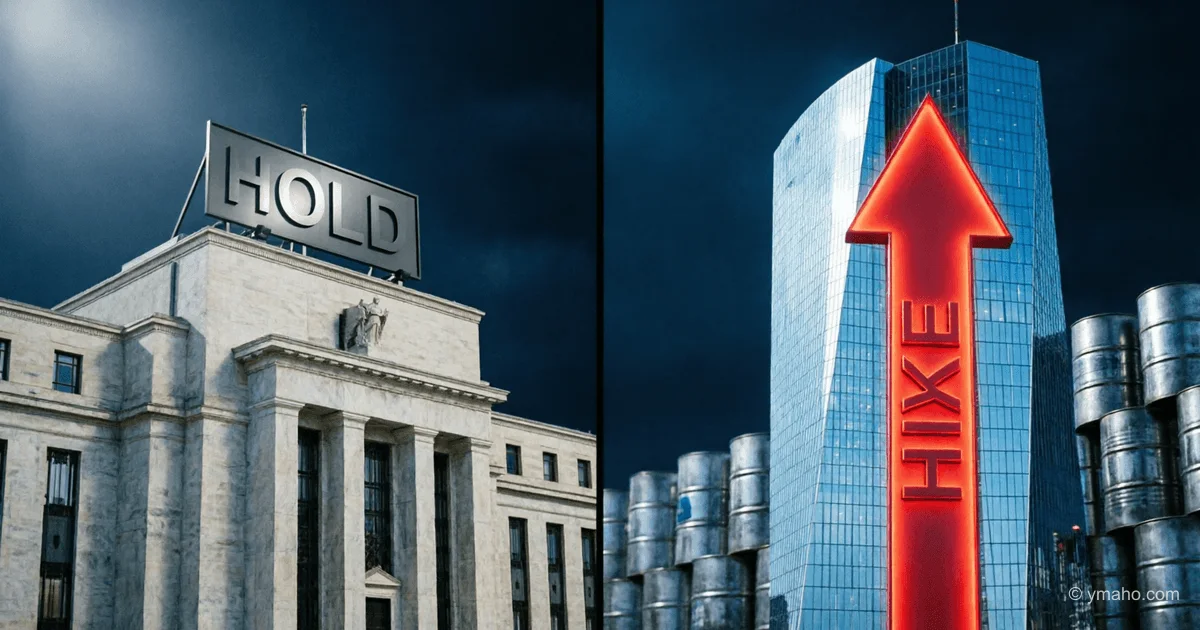
Fed Delays Rate Cuts as Inflation Accelerates on Expensive Oil, While ECB Prepares to Hike
The surge in energy prices amid the war is fueling inflation on both sides of the Atlantic. Markets have virtually ruled out a Fed rate cut in 2026, pushing expectations further out, while the European Central Bank, on the contrary, may raise rates as early as June to curb prices.
Analysis: "180-Degree Turn" — Why the Fed and ECB Are Moving in Opposite Directions in the Same Crisis
At the start of 2026, most analysts were forecasting a near-consensus: both the U.S. Federal Reserve (Fed) and the European Central Bank (ECB) would begin a cycle of interest rate cuts to support a weakening economy after several years of high rates. The war in the Persian Gulf and the blockade of the Strait of Hormuz shattered those plans. The jump in energy prices to $106 per barrel and above is stoking inflation on both sides of the Atlantic, but the central banks are reacting to the same shock in diametrically opposite ways. Markets have virtually ruled out a Fed rate cut in 2026, shifting expectations to 2027, while the ECB, on the contrary, may raise rates as early as June. This monetary asynchrony promises currency wars, divergent capital flows, and even greater fragmentation of the global economy.
Event Details and Timeline
Before the war in the Persian Gulf began in March 2026, markets were pricing in three Fed rate cuts in 2026 — 25 basis points each, which would have lowered the benchmark rate from the current 5.25–5.50% to 4.50–4.75% by year-end. The ECB, at its peak rate of 4.00% (after hikes from 2022–2025), was expected to start a gradual easing in the second half of the year.
The war and the blockade of the strait upended these calculations:
- Oil shock, March–April 2026: Brent crude surged from $75–80 to $106+ per barrel. This immediately impacted consumer prices. U.S. inflation, which had slowed to 2.8% in February, jumped to 3.9% in March, and according to preliminary April data, to 4.5–5.0%. In the eurozone, where the economy is more energy-intensive (especially in Germany and Italy), inflation soared from 2.4% to 4.2% in one month.
- Fed statement (April): At its April meeting, the FOMC (Federal Open Market Committee) adopted a "hawkish pause." The language shifted from "we see progress in fighting inflation" to "inflation risks remain elevated, we will act as circumstances warrant." Markets immediately repriced expectations: the probability of a cut at the June meeting fell from 70% to 5%. The next "window of opportunity" is November–December, but even that is uncertain.
- Signal from the ECB (late April): ECB President Christine Lagarde, in an interview with the Financial Times, allowed that "if inflation expectations become anchored above the 2% target, the Governing Council will consider all instruments, including further rate hikes." This was the first hint of a "dovish reversal" (actually a reverse reversal, back to hawkish policy) since the start of the year. Analysts at Barclays and Deutsche Bank are seriously discussing a June hike of 25 basis points to 4.25%.
Impact and Significance
For the global economy: Divergent monetary policy from the world's two largest central banks is rare. Usually, they move in unison with a lag of 3–6 months. Now, the Fed is frozen (neither up nor down), while the ECB prepares to hike. This means the U.S. dollar should weaken against the euro (all else equal), as euro yields rise, attracting capital. But in reality, the dollar will likely strengthen due to "flight to quality" (the U.S. is seen as a safe haven in crises). A complex and contradictory dynamic will emerge.
For financial markets: Tech stocks (highly sensitive to rates) are hit by a double blow. In the U.S., rates remain high, keeping valuations under pressure. In Europe, rising rates will hurt already weak European tech giants (ASML, SAP, Spotify). Stock indices show heightened volatility: the S&P 500 oscillates between 4800 and 5200 points, the Euro Stoxx 50 between 4200 and 4600.
For consumers and businesses: High rates in the U.S. mean mortgages (at 6.5–7.5%) and car loans remain unaffordable for the middle class. In Europe, another hike will worsen the recession, especially in manufacturing (Germany, Poland, Czech Republic). European businesses, already facing expensive energy, will also get expensive credit — a deadly combination.
Reactions from Key Players
- U.S. Fed: A growing rift within the committee. The "dove" group, led by Chicago Fed President Austan Goolsbee, argues that the oil shock is temporary (a supply shock) and should be ignored, otherwise the Fed will kill the economy. The "hawks" (Minneapolis Fed President Neel Kashkari) insist that secondary effects (wage growth, inflation expectations) have already been triggered, and rate hikes are unavoidable. For now, the balance leans toward a "pause" without a hike, but also without a cut.
- ECB: The situation is more complex. Southern Europe (Italy, Spain, Greece) is sharply opposed to a hike — their debt burdens are high, and high rates would trigger a sovereign bond crisis. Northern Europe (Germany, Netherlands, Finland) supports the "hawkish" stance, fearing uncontrolled inflation. Lagarde, as usual, seeks a compromise, but time is running out: inflation expectations in Germany have already exceeded 3% for five years ahead.
- Markets and investors: Hedge funds are actively shorting long-term U.S. and European bonds (rates will rise, bond prices will fall). The EUR/USD pair trades in a wide range of 1.05–1.10, pressured alternately by a strong euro (due to expected ECB hikes) and a strong dollar (as a safe haven).
Forecast and Conclusions
We face an unprecedented monetary experiment. Two central banks look at the same shock and see different threats.
Forecast for Q2–Q3 2026:
- Fed will keep the rate at 5.25–5.50% at least until September. No rate cut in 2026 is on the table. Only a deep recession (unemployment above 5%) could make the Fed reconsider.
- ECB has a 60% probability of raising rates by 25 basis points in June. If eurozone inflation exceeds 4.5% in May, the hike will happen. This would make the ECB the only major central bank in the developed world raising rates during a war and economic downturn — practically "monetary suicide," but from the ECB's perspective, "fighting entrenched inflation."
- Markets will remain turbulent. The yield on 10-year U.S. Treasuries will rise to 4.8–5.0%, German Bunds to 2.8–3.0%.
Conclusion: Policymakers are trapped with no clean exit. If they do not respond to the oil shock, inflation spirals out of control. If they respond (raise rates), they destroy an already fragile economy. The Fed has chosen a "wait and see" stance, risking being late if inflation proves persistent. The ECB is preparing to hike, risking a double-dip recession (downturn + high rates). For investors, the only option is to prepare for high volatility and seek refuge in short-term bonds, gold, and commodity currencies (CAD, AUD). The era of cheap money is not just over — the era of high rates is becoming permanent.
— Editorial Team









