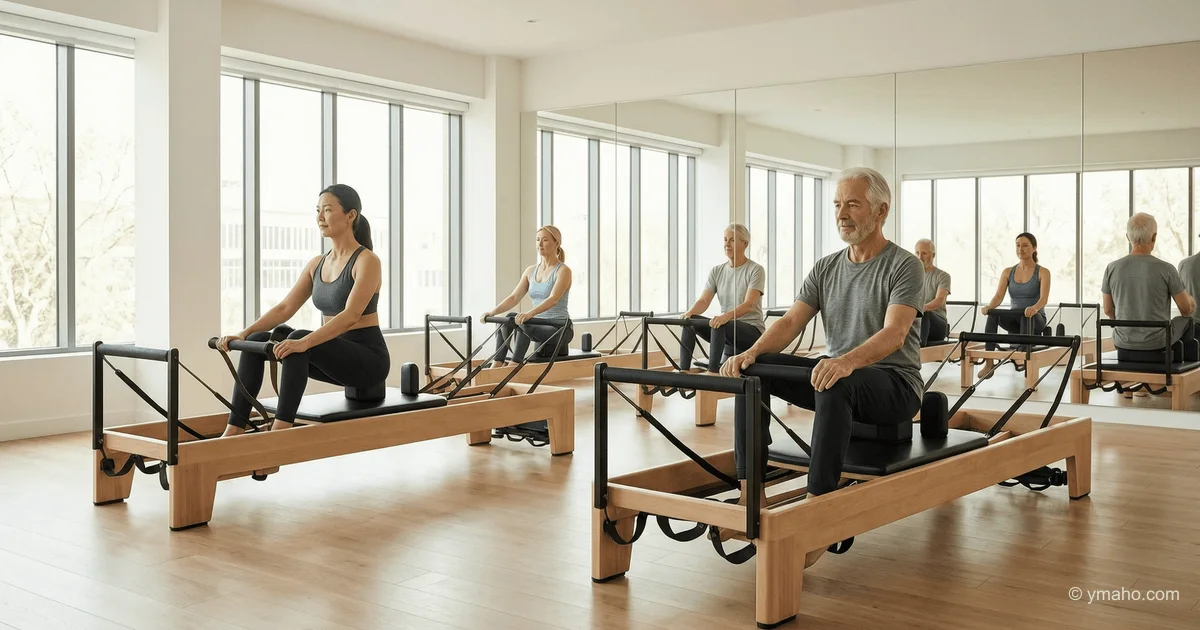
Fitness in 2026: 71% of New Studios Bet on 'Soft' Practices
The popularity of yoga, Pilates, and myofascial release is growing. Workouts are increasingly adapted to clients' energy levels and psychological state, abandoning pressure and a results-at-all-costs mindset.
Softness against burnout: why 71% of new studios bet on 'quiet' fitness — and who's making money from it
The gist: what's really happening
The news that 71% of new fitness studios are betting on 'soft' practices — yoga, Pilates, myofascial release — is presented as the humanization of the industry: a rejection of toxic productivity, pressure-free workouts, and care for clients' mental state. It sounds noble. But dig deeper, and we're dealing not with philanthropy but with cold business calculation based on a fundamental structural shift.
The main driver of 'soft' fitness is not a desire to be kinder to the client, but the emergence of two new audiences that didn't exist in the traditional fitness industry of the 2010s. The first is users of GLP-1 drugs (Ozempic, Wegovy), who, losing up to 15-20% of body weight, enter fitness with weakened muscle corsets and low tolerance for load. HIIT is contraindicated for them, but they need work on muscle mass. Pilates and functional training are the ideal entry ticket. The second audience is the aging but active 50+ generation, which focuses not on aesthetics and performance but on mobility, longevity, and injury prevention.
71% of new studios choose 'soft' practices not out of idealism, but because these are the two fastest-growing and most solvent segments. Longevity has become the main word in the industry — and it's not a marketing shell but an economic necessity.
Timeline and context
The shift has been building for several years but became institutionalized precisely by 2026.
Before 2020. HIIT and high-intensity training dominated. Studios like Barry's and CrossFit grew on the promise of transformation in 8 weeks. Recovery was considered a secondary option — 'stretching optional.'
2021–2023. The pandemic experience changed attitudes toward health: people discovered home practices — yoga, wall Pilates, myofascial release with foam rollers. It turned out that 'soft' fitness doesn't mean ineffective. Simultaneously, the GLP-1 boom began: by 2023, Ozempic had become a household term.
2024–2025. Data began to confirm the shift. Dynata's 2026 study recorded that interest in strength and cardio training remains dominant (71% and 70% of respondents), but yoga and Pilates already account for 35% — not a niche but a comparable magnitude. The Pilates and yoga market reached $196.8 billion globally in 2025, with a forecast of $392 billion by 2034 at a CAGR of 7.72%.
May 2026. The German fitness market hits records: 12.4 million members across 9,600 studios. Operators note that 'cardio is out of fashion,' and floor space is being reallocated to strength and functional training. Pvolve, a US chain of low-impact studios, expands from 32 to 38 locations, focusing on high-income communities with a demand for joint health. In Jacksonville, Florida, the number of Pilates studios has exceeded 1,000 statewide and continues to grow — new ones are opening not only in wealthy areas but also in residential neighborhoods. Key observation from JETSET Pilates operator: 'Clients are becoming much more conscious about how they train. They want results, but also longevity.'
Who wins and who loses
Winners:
Boutique yoga and Pilates studios. The market is growing at 7.72% annually and will reach $392 billion by 2034. Studios using reformers and infrared heating are expanding the premium segment: clients pay $35–$50 per class versus $10–$15 in a regular gym. With properly designed schedules, operating profit is achieved within 6–18 months after opening.
Manufacturers of low-impact training equipment. Reformers, Cadillacs, infrared panels, proprioceptive machines — this segment is growing explosively, especially in Asia where production is localized. Infrared studios (e.g., GoodGood Studio in London) convert the 'conscious consumer': a client who understands physiology is willing to pay more for a workout that simultaneously develops strength, mobility, and regulates the nervous system.
Investors in wellness real estate. The market targets two fast-growing demographic segments: GLP-1 users and affluent 50+. Both have high disposable income and long-term motivation to train. As Pvolve's operator puts it, these clients 'enter fitness with different needs — lower starting fitness, reduced muscle mass, and a focus on sustainable, supportive training.'
Losers:
Chains with large cardio zones. When German operators say 'Cardio ist out,' it means writing off millions of euros in equipment. Treadmills and steppers are expensive assets with low turnover in the current trend. Floor space is being reallocated to strength and functional zones.
Trainers whose qualifications are limited to HIIT formats. Demand is shifting toward instructors who understand anatomy, biomechanics, and rehabilitation protocols. Simply 'motivating for results' is not enough — clients seek a trainer who adapts the load to their energy level on a given day.
Budget gyms without a personal approach. The trend toward 'smart gyms' without staff is a double-edged sword: Fitomat in Germany opened 91 studios in 2025, with another 106 planned for 2026. But such gyms primarily serve self-directed exercisers. A client seeking 'soft practices' wants not just access to equipment — they pay for the environment, community, and an instructor who corrects technique. This demand is not met by a budget, staff-free gym.
What the media isn't saying
First non-obvious insight: 'soft' fitness is economically more profitable for studios than intense fitness because it reduces client churn. The HIIT client is a cycle: enthusiasm, injury, break, guilt, return. The average lifespan of such a membership is 8–12 months. A low-impact client trains for years: Pilates scales load without increasing impact force, making it suitable for both beginners and athletes. This fundamentally changes studio unit economics: customer acquisition cost is amortized over a longer horizon, and LTV (lifetime value) is radically higher.
Second insight: the Pilates explosion is not a fad but a response to a structural health problem. According to an IMARC study, the key market driver is the rise of sedentary lifestyles and related diseases. When the average office worker spends 9–10 hours sitting, their body develops a specific pattern of imbalances: weakened glutes, overstressed lower back, rounded shoulders. Pilates addresses exactly these problems — it doesn't burn calories but restores functional anatomy. This is not fitness in the traditional sense; it's a rehabilitative necessity packaged as a group class.
Third insight — the deepest: 'abandoning pressure and a results-at-all-costs mindset' is not humanization but a product shift. HIIT sold a promise: 'come 3 times a week — get the body.' That's a transformation model with a measurable KPI. Low-impact fitness sells something else: 'come 3 times a week — preserve the ability to move without pain at 60.' That's a longevity model. Marketing-wise, it's more honest, but business-wise, it's more complex: results are less visible, progress is slower, and the client needs to be educated. Studios that will win in this transition are those that build a retention system not on the 'mirror' but on educational content around joint health, posture, and movement quality.
Fourth insight — about data. ACSM has ranked wearable technology as the top fitness trend for several years. Devices measure HRV, sleep quality, readiness to train. This data stream makes 'adapting the workout to energy level and psychological state' possible. An instructor seeing a client's low HRV can offer not a strength workout but myofascial release and breathing exercises. This keeps the client in a long-term routine because the workout ceases to be an obligation and becomes a support system.
Forecast: next 30 days and 90 days
30 days (by June 7, 2026). A wave of publications about 'soft' fitness will be picked up by lifestyle media, which will start producing content in the 'why HIIT no longer works' format. Major chains will announce the launch of Pilates reformer zones in premium locations. Pvolve will solidify its US expansion, announcing the next 6–8 cities. Expect at least two European fitness operators to announce rebranding of some spaces into low-impact format.
The yoga and Pilates market will continue to grow at 7–8% annually, and summer demand for outdoor versions of these practices will boost seasonal growth.
90 days (by August 7, 2026). By the end of summer, we'll see the first attempts at market consolidation. Major chains will start buying successful boutique Pilates studios to quickly enter the segment. In Germany, where the market has reached an all-time high of 12.4 million members, aggregator platforms (Urban Sports Club and similar) will continue expanding, blurring the line between 'hard' and 'soft' memberships. A client with access to hundreds of studios through one app will migrate between HIIT and Pilates depending on the day.
A key risk for boutique studios is oversaturation. Florida already has over 1,000 Pilates studios statewide. When the market reaches such density, a price war begins. Studios that fail to build a strong community and educational content around longevity and health will be forced to undercut.
Final takeaway: 71% of new studios betting on 'soft' practices is not a trend but a structural shift of the entire industry from a model of selling transformation to a model of selling longevity. The winners will be those who understand that their client has changed: no longer a 22-year-old enthusiast ready to train to failure, but a 40-year-old GLP-1 user and a 55-year-old professional who want to move without pain for the next 20 years. 'Pressure and results at all costs' died not for ethical reasons — they stopped being profitable.
— Editorial Team









