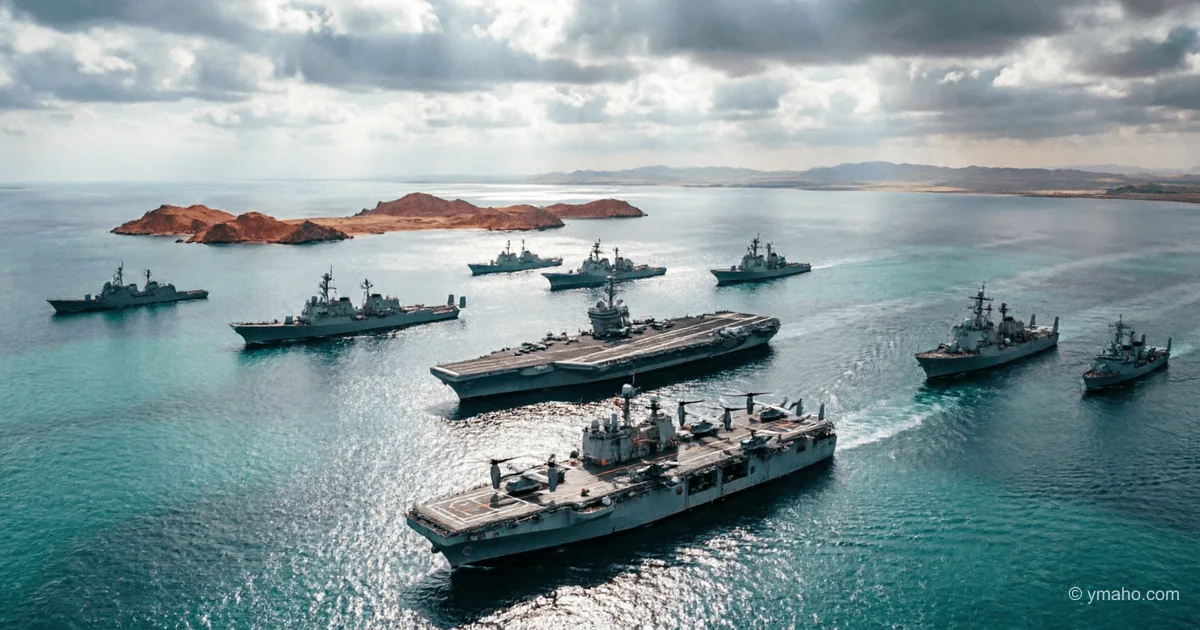
US Ramps Up Military Presence in the Middle East Amid Preparations for Ground Operation Against Iran
The Trump administration is working on a scenario to deploy thousands of troops to the Persian Gulf region to protect shipping in the Strait of Hormuz.
From 'Pirates' to 'Graveyard': US Troop Buildup and the Specter of Ground War with Iran
Introduction
In April-May 2026, the concentration of US military forces in the Persian Gulf reached levels unseen since the 2003 invasion of Iraq. Two carrier strike groups, elite SEAL and Delta Force units, thousands of Marines and paratroopers—all massed off the coast of Iran.
Officially, Washington speaks of 'protecting shipping' and 'breaking the blockade of the Strait of Hormuz.' However, the scale of forces being deployed, including the 82nd Airborne Division and special operations units, suggests more serious intentions. Tehran, in turn, responds with direct threats: 'Your ships and troops will end up in a graveyard.'
Analysts increasingly speak of 'mission creep' and the possibility that the US could become embroiled in a full-scale ground war contrary to initial plans.
Event Details and Timeline
The conflict entered a hot phase on February 28, 2026, with the start of Operation Epic Fury—a joint US-Israeli air and naval campaign against Iran. By late April, the situation had changed dramatically: Iran effectively closed the Strait of Hormuz, through which about 20% of the world's oil supply passes.
In response, Washington began an unprecedented buildup:
- Carrier groups: USS Abraham Lincoln and USS Gerald R. Ford are deployed in the region.
- Marines: The 11th and 31st Marine Expeditionary Units (totaling about 4,500 personnel) are heading to Iranian shores aboard USS Boxer and USS Tripoli.
- Rapid reaction forces: Elements of the 82nd Airborne Division (3,000-4,000 troops) are being moved.
- Special forces: Presence of SEAL Team 6, Delta Force's 5th Group, and Rangers of the 75th Regiment has been confirmed.
By early May, the total number of US military personnel in the region exceeded 50,000-60,000. Simultaneously, the US imposed a naval blockade on Iranian ports, intercepting merchant vessels.
Impact and Significance (for the World / Industry / Society)
The deployment of ground forces changes the very nature of the conflict. While until April strikes were only conducted from air and sea, the arrival of amphibious assault units indicates preparation for a 'limited ground operation.'
Experts highlight three possible invasion objectives:
- Capture of Kharg Island. 90% of Iran's oil exports pass through this island. Physical seizure would cut off Tehran's revenues without destroying infrastructure.
- Breaking the blockade of the Strait of Hormuz. This would require clearing missile launchers from Abu Musa, Qeshm, and Larak islands—a complex amphibious operation.
- Raid on nuclear facilities. Removal of enriched uranium or destruction of underground centrifuges by special forces.
Any of these scenarios carries enormous risks. Iran is a country of 90 million people, with mountainous terrain and a powerful network of proxy forces. Even a 'limited' landing could escalate into a long-term occupation.
Reactions of Key Players
Iran responds with a policy of 'open doors' for escalation. Supreme Leader's military adviser Mohsen Rezaei threatened to turn US ships into 'wreckage' and send troops to a 'graveyard.' Parliament is discussing a 12-point plan for managing the strait, which includes imposing 'war reparations' on US and allied vessels.
Israel coordinates actions with Washington. The IDF has been put on high alert, though officially it states that no ground invasion of Iran is planned.
The analytical community is divided. Some (Ali Vaez, International Crisis Group) consider a ground operation 'highly likely,' noting that Trump never leaves deployed forces idle. Others (Modern War Institute) remind that regime change in Iran would require 300,000-500,000 troops, which is politically impossible.
Forecast and Conclusions
Currently, the US denies plans for a full-scale invasion. Chairman of the Joint Chiefs of Staff Dan Caine stated: 'There is no plan to roll in 200,000 people and stay for 20 years.'
However, the buildup of special forces and Marines suggests otherwise: Washington is preparing for tactical ground operations. The most likely scenario remains a landing on Kharg Island—a surgical operation to strangle Iran's economy without advancing deep into the continent.
Nevertheless, miscalculations are inevitable. Iran possesses powerful coastal missile systems and experience in asymmetric warfare. Any amphibious operation risks turning into a bloody meat grinder. The world stands on the brink of the most dangerous phase of the conflict—the transition from air and naval war to ground war, where losses will be counted not in dozens but in thousands.
— Editorial Team









