Stock Markets Close at Record Highs, Ignoring Inflation Risks, but Rising Oil Weighs on Oil and Gas Sector
The S&P 500 and Nasdaq Composite hit record highs thanks to strong tech earnings, but Asian markets showed mixed performance, and Hong Kong oil and gas stocks fell amid fuel price volatility.
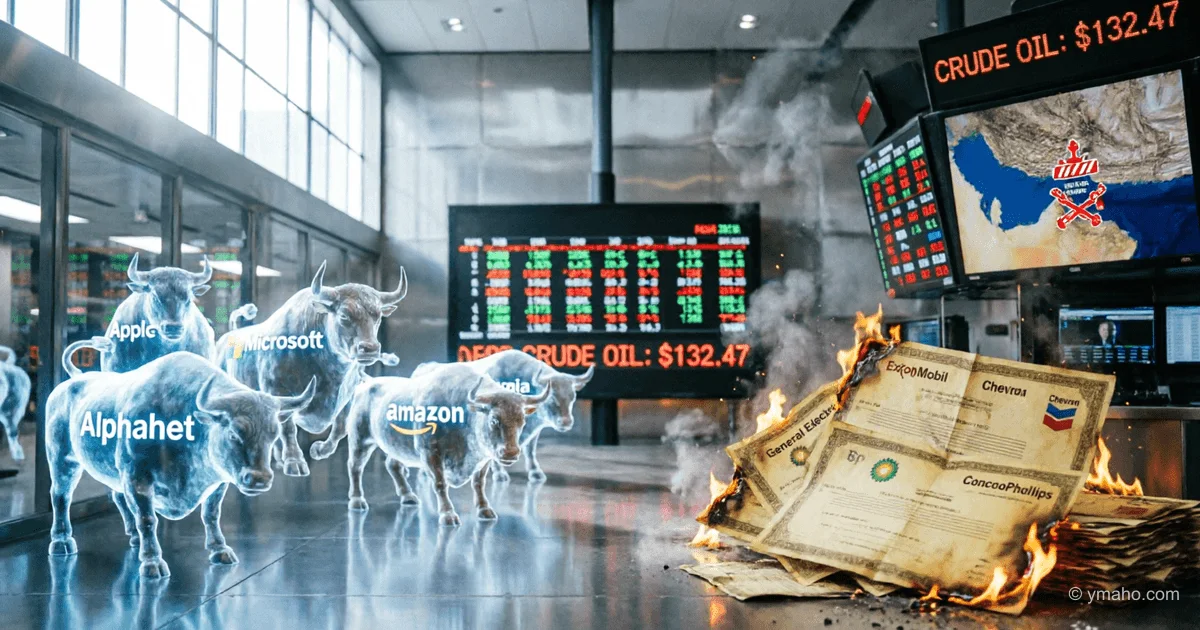
The S&P 500 and Nasdaq Composite hitting record highs while the world teeters on the brink of a full-scale war in the Middle East and US inflation accelerates to 3.5% is not a sign of market health, but a dangerous symptom of its complete dissociation from reality. We are witnessing the most concentrated and fragile rally in history, disguised as a broad advance. Investors buying the index right now don't realize they are purchasing not a diversified portfolio, but an overheated bet on artificial intelligence mixed with hidden currency risk.
The Core: What's Really Happening
The S&P and Nasdaq records are not the achievement of 500 or 100 companies, but literally five names: Apple, Microsoft, Nvidia, Alphabet, and Amazon. Their Q1 2026 earnings beat expectations thanks to aggressive cost-cutting and the AI-driven cloud computing boom. But strip away this 15-20% of index capitalization, and the so-called S&P 493 has been treading water or declining for months. We are dealing with a twin market: a tech bubble on top of a bear market for everything else.
Why is this happening now? Because global capital, frightened by the blockade of the Strait of Hormuz and attacks on the UAE, is fleeing not risk assets in general, but specifically European, Asian, and commodity markets into the 'safe haven' of US tech mega-caps. The paradox is that investors perceive Nvidia and Microsoft as 'defensive assets' comparable to gold. The logic is simple: these companies have $350 billion in cash on their balance sheets, they don't depend on physical supply chains in the Persian Gulf, and their business models (software, cloud, licensing) are low-cost and high-margin. When an oil tanker can't pass through Hormuz, software code still compiles. But this logic ignores that all these companies are tied to global consumers, whose wallets are now shrinking due to inflation.
Timeline and Context
The rally began after Nvidia's earnings release on April 30, 2026, which showed data center revenue growth of 180% YoY. This overshadowed everything: the acceleration in PCE, the raging bombings in the UAE, and the Fed's internal divisions. Algorithmic traders, accounting for up to 70% of daily volume, react to earnings reports, not geopolitics.
Then came Apple's earnings on May 1, showing record services revenue. The market instantly surged, ignoring Tim Cook's warning that a strengthening dollar creates 'significant headwinds' for international revenue. This is a classic case of cognitive dissonance: the market hears only what it wants to hear. It priced companies at forward P/E ratios of 28-30, assuming ideal conditions and future Fed rate cuts, while the Fed itself hints at possible hikes.
Contrasting with this rally is the situation in the Asian oil and gas sector. Shares of PetroChina and Sinopec in Hong Kong fell sharply despite expensive oil. Why? Because a stronger dollar and fuel price volatility are crushing their refining margins. They buy oil in expensive dollars and sell gasoline and diesel in China's domestic market for yuan, which is weakening. This is a microcosm of what awaits the entire real economy: rising costs and exchange rate losses eating into nominal revenue.
Winners and Losers
The most obvious winner is Big Tech top management, whose option packages are tied to stock prices. Their paper wealth rose by a combined $20-25 billion in the first week of May. But there is also a less obvious winner: hedge funds using the Long Magnificent 7 / Short Everything Else strategy. According to Goldman Sachs, this strategy has been the most crowded since early 2025. They profit by shorting regional bank and industrial stocks suffering from high rates and expensive oil, while buying tech giants. They are now reaping the rewards of this divergence.
The biggest loser is the average household investor, whose 401(k) or IRA passively tracks indices. They see their account 'at highs' and don't realize that their real purchasing power, adjusted for inflation, is declining, and risks are concentrated in 5 stocks that could be revalued at any moment with a narrative shift. When risk-free 6-month Treasury bills yield 5.0% and the S&P 500 dividend yield is a paltry 1.2%, holding stocks only makes sense if you expect constant capital appreciation, which in spring 2026 depends on geopolitical luck.
What the Media Isn't Saying
Major business channels show index charts soaring and talk about a 'bull market.' They don't show the chart of Big Tech's market cap relative to US GDP. That ratio has already exceeded 150%, surpassing the dot-com bubble peak in 2000. Operating profits at these companies are still growing, but they are growing through aggressive job destruction in all other sectors via AI adoption. Every new chatbot and AI agent generating record revenue for Microsoft and Alphabet simultaneously destroys thousands of jobs in call centers, marketing, translation agencies, and entry-level programming. The stock market celebrates productivity-driven profits, while the labor market and consumer stability bury future demand. It's a feast during a plague.
Moreover, the role of leverage is downplayed. Margin debt on FINRA investor accounts hit a new record of $1.2 trillion in April. This means a significant portion of the record highs is bought with borrowed money. If an oil shock or Fed decision triggers just a 5% S&P correction, a wave of margin calls could turn 5% into 15% in days due to forced liquidations. Risk managers at major brokers (Charles Schwab, Fidelity) have already raised margin requirements on tech stocks, but informed clients 'quietly' via account notifications, not public press releases.
Forecast: Next 30 Days and 90 Days
30-day horizon (by early June 2026).
The euphoria from Big Tech earnings will begin to fade. The market will hit a ceiling when it realizes the Fed is serious about raising rates. Indices will stop rising but won't crash yet, as companies continue $350 billion quarterly buyback programs, creating artificial demand. Asia will keep falling: Hong Kong oil and gas stocks could lose another 10-15% on expectations of a Chinese recession and a stronger dollar.
90-day horizon (by August 2026).
The divergence will burst. When Brent settles above $130 and it becomes clear that war in the Persian Gulf is unavoidable, an aggressive rotation will begin from overbought growth stocks into real commodity assets and gold. Nvidia and Apple will face reality: their multiples are incompatible with a risk-free rate of 4.5% or higher. The S&P 500 will fall below 5500 (a 15-20% correction from current record highs). Traders trapped in the Long Tech strategy will face a stampede for the exit. Then it will become obvious that the 'party at record highs' was just an echo of the last gasps of dovish expectations, crushed by the harsh reality of geopolitics and inflation. Markets ignoring reality today will pay for it many times over tomorrow.
— Editorial Team









