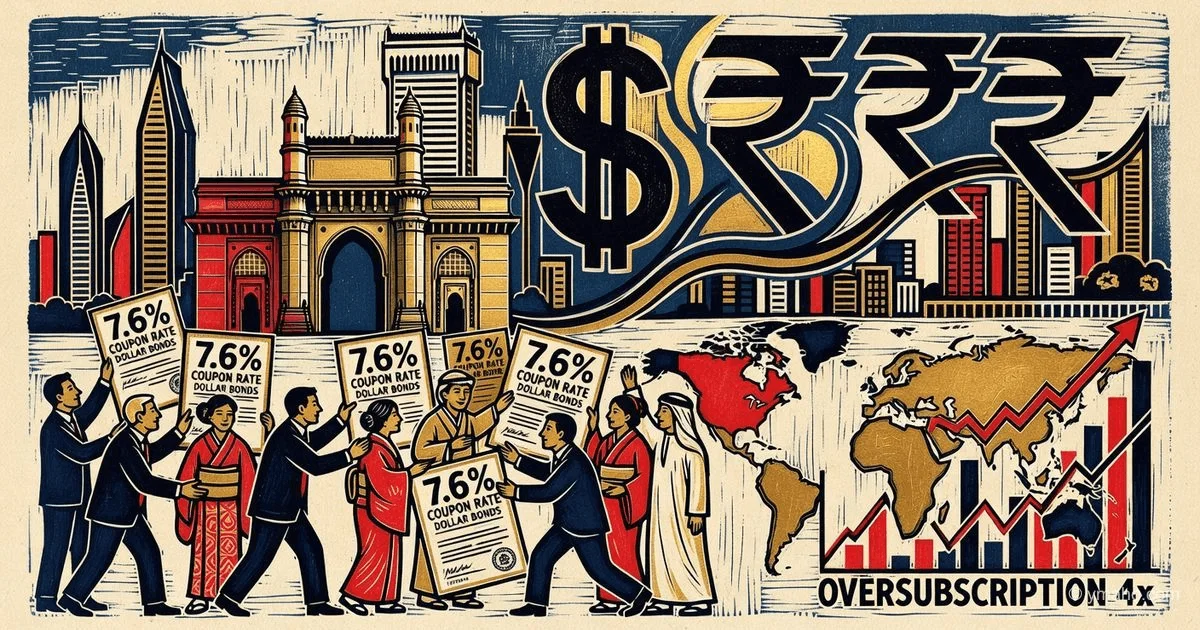
IIFL Finance Raises $500M in Dollar Bonds, First for Indian Issuers Since January
The company placed 3.25-year Eurobonds at 7.6%, receiving bids worth $2 billion. The successful issue signals the return of Indian corporations to the international debt market.
IIFL Finance: How an Indian Lender Opened the Dollar Tap Amid a Global Crisis
The Bottom Line: What's Really Happening
On June 3, 2026, IIFL Finance, an Indian non-banking financial company, accomplished what seemed impossible just three months ago. It raised $500 million through a 3.25-year dollar bond issue with a 7.6% coupon, attracting bids of nearly $2 billion. Formally, this is just a successful placement. In reality, it is the first indicator that the Indian debt market is thawing after a five-month freeze triggered by the war in the Middle East.
Why is this deal more important than it seems at first glance? Because the last time Indian corporations tapped the international debt market was in January 2026, when ReNew Energy raised $600 million. Then came the February US-Israel strike on Iran, the closure of the Strait of Hormuz, and oil surging above $95. The dollar bond market for emerging markets virtually ground to a halt. Indian companies, accustomed to refinancing about $12 billion in external debt annually, found themselves trapped: domestic loans were cheaper but rationed, while the external market became too expensive and uncertain.
Second, this is the first social bond for IIFL Finance—the proceeds will go toward lending to micro and small businesses, gold loans, and mortgages for economically weaker sections of the population. This is not just marketing packaging. In a world where ESG investors control trillions of dollars, the "social" label broadens the pool of potential buyers and lowers the cost of borrowing. The company used this feature masterfully, managing to tighten the spread from 7.9% to 7.6%.
Third, the deal was executed through IFSC Gift City, India's offshore financial center in the state of Gujarat. This is a strategic choice that news headlines overlook. Issuing through Gift City offers tax advantages: investors do not pay withholding tax on interest income under certain structures. IIFL became one of the first major borrowers to use this route, and now other Indian companies will look at Gift City as an alternative to Singapore and Dubai.
Timeline and Context
The timeline of this deal began long before June 3, 2026. As early as December 2025, analysts at S&P and BNP Paribas predicted a recovery of the Indian offshore debt market in 2026, expecting issuances of $10-12 billion. The main driver was refinancing: about $12-13 billion of Indian companies' dollar bonds were due to mature in 2026.
Then came February 2026, and the forecasts collapsed. The attack on Iran, the closure of Hormuz, oil above $100, global uncertainty. The Indian dollar bond market froze. IIFL Finance, however, continued its preparations. On June 2, 2026, the company announced a book build, initially targeting a coupon of 7.9%. Demand was so strong—$1.7 billion in bids by the evening of the first day—that the company was able to tighten the rate to 7.6%.
On June 3, the deal was officially closed. The order book reached $2 billion. The lead managers were HSBC, Standard Chartered, JP Morgan, and Emirates NBD. The placement was conducted under Regulation S (for investors outside the US) and Rule 144A (for qualified institutional investors in the US). The notes are secured by a first lien on certain current and future assets of the company.
On June 5, 2026, IIFL Finance shares rose 6.32% to ₹530.30, against a general Indian market rise of just 0.05%.
Who Wins and Who Loses
Winners:
- IIFL Finance. Obviously. The company secured $500 million at 7.6% per annum—cheaper than its previous issue in January 2025 at 8.3%. Moreover, it's a "social" bond, boosting its ESG rating and reputation. Company founder Nirmal Jain called the deal "a defining moment not only for IIFL Finance but for the entire Indian capital market."
- Fairfax Financial Holdings. Prem Watsa's Canadian company recently invested ₹2,000 crore ($240 million) in IIFL Finance for a majority stake. The successful dollar placement increases the value of this asset and validates the investment.
- Other Indian corporations needing refinancing. Muthoot Finance, ReNew, EXIM Bank, State Bank of India London branch, Delhi International Airport—all were watching IIFL as a trailblazer. If the market is open, they will follow. IFR had predicted a "revival" in Q1 2026, but reality was delayed by five months due to geopolitics. Now a wave may come.
- International investors seeking yield. With 10-year Treasuries yielding around 4.5%, 7.6% on debt from an Indian B+ rated issuer is a tasty risk premium. Investors voted with their money: $2 billion in bids for a $500 million issue is a 4x oversubscription.
Losers:
- India's domestic debt market. If large borrowers go offshore, banks and domestic institutional investors (insurers, pension funds) lose high-yielding assets. However, the domestic market was flush with liquidity in 2024-25, so the loss is not critical.
- IIFL Finance's competitors who didn't go to market first. Muthoot Finance placed a bond in January 2026 at 5.75%—much cheaper than IIFL now. But IIFL sets a record not with the rate but with timing. Companies that wait another month or two may find that liquidity dries up or geopolitics tightens again.
- The Reserve Bank of India (RBI). On one hand, the regulator supports external market access as a way to attract foreign currency. On the other, each such issue increases India's external debt and puts pressure on the rupee in the short term (though the money goes to domestic lending, not foreign asset purchases).
What the Media Isn't Saying
Insight #1: IIFL Finance didn't just place bonds—it "tested" the invisible barriers of the new geopolitical regime.
Note the context: the deal went through IFSC Gift City, but that's not just tax optimization. The US has imposed secondary sanctions on countries doing business with Iran. India, which continues to buy Iranian oil through complex schemes, is in a "gray zone." The lead banks (HSBC, StanChart, JP Morgan) had to conduct due diligence to ensure IIFL Finance's funds would not go to pay for Iranian oil or related transactions. The fact that the deal went through means IIFL's legal structures are deemed "clean" by Western regulators. This signals to other Indian companies: you can continue working with Iran through certain "Chinese walls," but you need to be careful.
Insight #2: The 7.6% coupon is not expensive—it's the "new normal" for Indian issuers.
S&P analysts in December 2025 spoke of a spread between onshore and offshore financing of 100-150 basis points, which was expected to narrow to 50-75 bps as the Fed cut rates. But the Fed didn't cut rates as much as expected (the rate at 3.50-3.75% vs. 3.25% in S&P's forecast). Moreover, the oil shock added a risk premium.
7.6% for a 3.25-year bond is a premium of about 300 bps over the 10-year Treasury yield (currently around 4.5%). In January, Muthoot Finance placed a 4.5-year bond at 5.75%. The 185 bps difference over five months is the price of geopolitical uncertainty. The new "normal" for Indian corporate dollar bonds is 7-8%, not 5-6% as in early 2026. Investors waiting for a return to old rates may be disappointed.
Insight #3: The $2 billion in bids is not just about faith in IIFL, but also about desperation to find dollar-denominated yield in a world with oil at $95.
This week, the OECD warned of a global recession risk and cut its growth forecast to 2.8%. European corporate bonds yield 3.5-4.5%, US investment grade 4.5-5.5%. Indian B+ at 7.6% looks like an oasis in the desert.
But behind those $2 billion are not only global funds but also specific investors from the UAE and Gulf states seeking alternatives for their petrodollars. As long as the conflict continues, this money will not go into US or European assets—it will go into "friendly" jurisdictions like India and Asian markets. IIFL Finance has ridden this trend successfully.
Forecast: Next 30 Days and 90 Days
30 days (until July 5):
We will see at least 2-3 new dollar issues from Indian issuers. Most likely candidates: ReNew Energy (needs to refinance its January bond, though technically not yet matured), EXIM Bank India, and State Bank of India London branch. Also possible is an issue from Muthoot Finance—they have experience and know the market.
Rates on new issues will be in the range of 7.25-7.9% depending on credit quality and tenor. If geopolitics does not escalate, spreads may tighten slightly, but no more than 25-50 bps.
IIFL Finance shares will continue to trade at a premium to the sector. After the 6.32% rise on June 5, a correction to ₹510-515 is possible, but fundamental support remains: the company has just proven access to cheap (relatively) dollars.
90 days (until September):
A more important horizon—September 2029 (the maturity of these bonds) is irrelevant for traders, but macroeconomic dynamics matter. If by September the Middle East conflict enters a protracted phase (likely given Hezbollah and Iran's stance), oil will stay above $90-95, and the dollar will continue to strengthen. In this scenario, Indian companies will tap the external market even more aggressively to replace expensive domestic loans.
If a miracle happens and Hormuz reopens, oil could fall to $70-75, the dollar weaken, and dollar bond rates for emerging markets decline. But I don't believe it: the OECD has already factored a prolonged conflict into its alternative scenario, and the negotiation process offers no grounds for optimism.
More likely, IIFL Finance will be the "first swallow," followed by a flock. New issuance volume by Indian issuers in 2026 could reach $8-10 billion, still below the $12 billion in maturities, but significantly above the zero in February-May.
Editorial Forecast
Asset: IIFL Finance shares (Indian market) / Direction: Consolidation in the ₹515-535 range within 48-72 hours after the 6.32% rise on June 5.
Key levels: Current level around ₹530. Support at ₹515 (psychological level after pullback), resistance at ₹545 (2026 high). Daily RSI above 70 indicates overbought conditions, so a correction is likely in the coming days.
Confidence: High (75%). The fundamental driver (successful placement) has already been priced in, and the market needs time to assess the company's next steps. Institutional investors who missed the bond issue may increase equity positions as a "substitute" for bonds.
Main risk: If the RBI makes an unexpected announcement in the coming days about restrictions on external borrowing for NBFCs (non-banking financial companies), it could cool enthusiasm. However, the RBI is likely to support opening the channel—the country needs foreign currency to support the rupee. A more realistic risk is a deterioration in the geopolitical situation, triggering a risk-off move and selling of Indian assets regardless of IIFL Finance's success. Watch for news from Tehran and Doha.
— Editorial Team