Japanese Yen Breaks 160 Against Dollar Again, Entering Intervention Zone
Weakening of the national currency to a two-month low raises market concerns. Traders anticipate possible currency interventions by the Bank of Japan.
Yen at 160: Why Intervention Isn't Working and Oil Sets the Rules
The Gist: What's Really Happening
On June 5, 2026, the Japanese yen broke through the psychological level of 160 against the US dollar for the third time in three days. The formal reason is rising geopolitical tensions in the Persian Gulf, which push up oil prices and drive investors into the dollar as a safe haven. But the real mechanics of this move are far more alarming for those hoping for a quick yen strengthening.
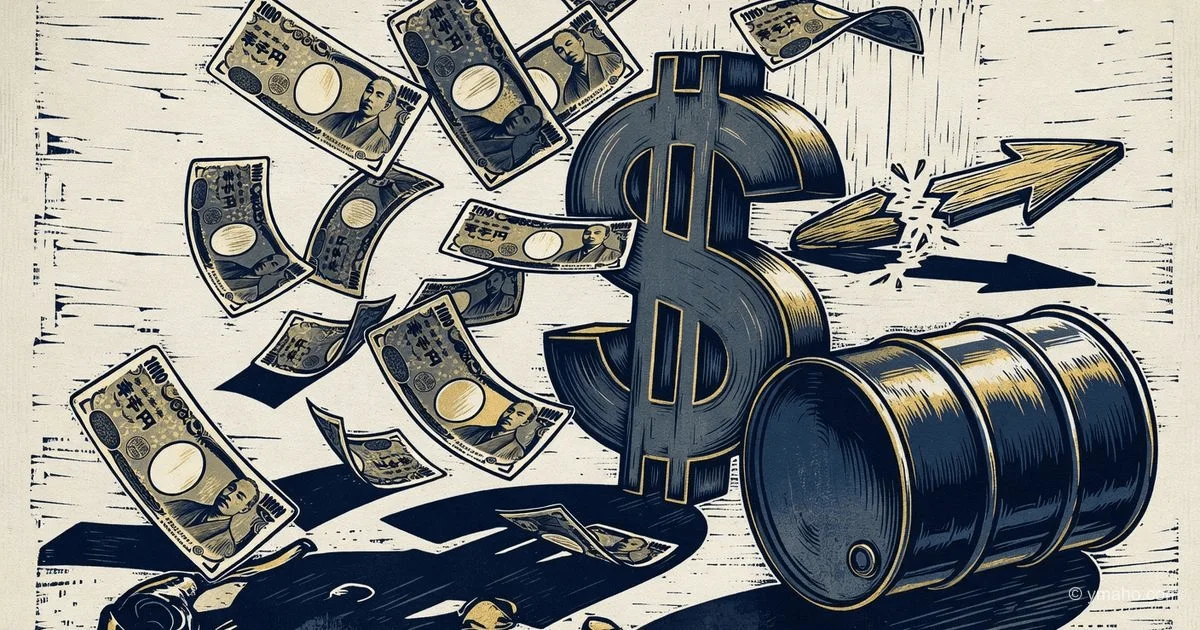
First, over the past four weeks, the Japanese government has spent $73 billion on currency interventions to support the yen. This is the largest intervention since 2004. The result? The yen has erased all its gains and returned to 160—the level where the intervention started a month ago. Four weeks, $73 billion, and zero progress. This is not just a failure—it's a diagnosis: the market is stronger than the central bank.
Second, Japan's Finance Minister Satsuki Katayama again issued a verbal warning, stating readiness for "decisive action" against excessive volatility. But the market no longer reacts to words. After three interventions in two months, traders know: Japanese authorities can buy yen worth $70 billion, but if fundamental factors haven't changed, the exchange rate will return to where it started within a month.
Third, Bank of Japan Governor Kazuo Ueda this week gave the clearest signal yet of a possible rate hike on June 16. He stated that even with the uncertain situation in the Middle East, the BOJ must "carefully discuss the pros and cons of a rate hike" if inflation risks outweigh risks to the economy. The market has priced in a rate hike of 19 basis points. But the yen continues to fall. This signals that one hike is not enough.
Timeline and Context
Key events unfolded rapidly. On February 28, 2026, the US and Israel began a war against Iran. Since then, Brent crude has risen nearly 48% year-to-date and is currently hovering around $96 per barrel. For Japan, which imports almost 90% of its energy, this is a disaster: expensive oil directly worsens the trade balance and weakens the yen.
In April, the Bank of Japan recorded a 6:3 vote to keep the rate at 0.75%. Three committee members already advocated for a hike to 1.0%, citing growing inflation risks. Tokyo inflation (a leading indicator for national prices) slowed to 1.3% in May from 1.5% in April, remaining below the 2% target for the fourth consecutive month. But "core-core" inflation (excluding food and fuel), which the BOJ considers the best trend indicator, stood at 1.9% in April. This is dangerously close to the 2% target.
On June 3, Ueda delivered a keynote speech effectively warning: if the BOJ is late in reacting to price increases, it may be forced to implement a "substantial rate hike," which would "impose a heavy burden not only on the economy but also on financial markets and the banking system." This is a classic hawkish signal from a central banker, usually preceding real action.
On June 4-5, the yen tested 160 three times. The USD/JPY pair is trading around 159.80-159.85, slightly below the psychological level, but pressure persists. Finance Minister Katayama on Friday reaffirmed the government's right to "decisive action." But the market knows: in a month of interventions, Japan spent $73 billion—roughly 1.5% of GDP. Such a pace cannot be sustained indefinitely.
Who Wins and Who Loses
Winners:
- Exporters: Toyota, Sony, Honda, and others. The yen at 160 is the best gift for Japanese export corporations in the last 30 years. Every car or smartphone sold abroad yields 60% more yen when converting revenue at this rate. Toyota is likely to post record profits in Q2 2026.
- Foreign tourists in Japan. A rate of 160 means the dollar buys 60% more yen than in 2021. A $200 hotel in Tokyo becomes 32,000 yen—savings for tourists' budgets and a boom for Japan's tourism industry.
- Traders with short yen positions. The carry trade—borrowing at low rates in Japan (0.75%) and investing in high-yield assets—remains one of the most profitable strategies of the year. The gap between the Fed rate (3.50-3.75%) and the BOJ rate (0.75%) is about 3 percentage points. This is too strong an incentive to sell the yen.
Losers:
- Japanese households. Import inflation hits wallets. Prices of imported food, fuel, and clothing are rising, and although real wages grew 1.9% in April, this growth could be offset by further yen weakening and rising energy costs.
- Small and medium-sized enterprises in Japan dependent on imports. For them, a weaker yen means higher costs. Purchasing raw materials, components, and equipment abroad becomes significantly more expensive, and raising prices for domestic consumers amid stagnant incomes is difficult.
- Bank of Japan and Ministry of Finance. Their policy has failed. $73 billion spent, and the yen is back to square one. If intervention didn't work at a cost of 1.5% of GDP, what can they do if the rate goes to 170 or 180? The reputational damage is enormous.
What the Media Isn't Saying
Insight #1: $73 billion in interventions is not defending the yen, but a "tactical retreat" before the inevitable.
ING analysts warn: the market has stopped pricing intervention risk into USD/JPY volatility. Traders understand that Japan cannot sustain a pace of $70 billion per month. Moreover, the International Monetary Fund recommends no more than three intervention episodes in any rolling six-month window to maintain "freely floating" currency status.
The true goal of the April-May intervention was not to reverse the trend (impossible without changing interest rates) but to slow the pace of decline. Japanese officials know that oil at $100 and a 3% rate differential make yen strengthening nearly impossible. They were simply trying to buy time until the June meeting, hoping a rate hike would do the job.
Insight #2: The June 16 rate hike is already priced in, but the problem isn't the rate—it's the neutral level.
The market expects a rate hike to 1.0%. But what next? If Ueda signals that 1.0% is the "ceiling" for 2026, the yen will crash to 170. If he says the BOJ is ready to go to 1.5-2.0% in 2027, the yen could strengthen to 145-150.
The key question journalists aren't asking: what interest rate differential with the US is needed to stop the yen's fall? With oil at $100 and Japan's trade deficit, the differential needs to be not 3% but 4-5%. That means the BOJ rate must be 2.5-3.0% to make the carry trade unprofitable. But such a rate would kill Japan's economy with a 260% debt-to-GDP ratio. It's a trap with no easy way out.
Insight #3: Japan's real interest rate is still negative—that's the main reason for the yen's weakness.
Inflation in Japan is around 2.5-3.0% according to the BOJ's 2026 fiscal year forecast. With a rate of 0.75%, the real interest rate (rate minus inflation) is roughly -1.75% to -2.25%. That means yen holders lose purchasing power every month.
In the US, the real rate is positive: inflation around 3.8%, rate 3.50-3.75%—real rate near zero or slightly negative. But the real rate differential between the US and Japan is about 2 percentage points in favor of the dollar. As long as Japan's real rate is negative and the US rate is near zero, capital will flow from yen to dollar. This is a fundamental financial law that no intervention can repeal.
Forecast: Next 30 Days and 90 Days
30 days (until July 5):
The yen will remain under pressure. June 16 is the BOJ meeting. A rate hike to 1.0% is almost guaranteed—the market has already priced in 19 basis points. The question is the tone of the accompanying statement. If Ueda sounds hawkish and hints at further hikes in the second half of the year, USD/JPY could retreat to 155-156. If the signal is dovish, the yen will break through 162-163.
Oil remains the main factor. As long as Brent is above $90 and the conflict in the Strait of Hormuz is unresolved, Japan will suffer from deteriorating terms of trade. US-Iran negotiations are deadlocked, and no breakthrough is expected in the next 30 days.
Potential intervention: if USD/JPY breaks 162, Japanese authorities will likely step in again. But effectiveness will be limited, as in April-May.
90 days (until September):
The more important horizon is Q3 2026. By then, it will become clear whether the BOJ will raise rates further. If inflation continues to accelerate due to expensive oil, Ueda will have to choose: either tolerate high inflation and a weak yen, or raise rates to a level that starts choking the economy.
I lean toward the first scenario. The BOJ will hike to 1.0% in June and then pause until year-end. The yen will trade in a range of 155-170. The lower bound is if oil falls to $80 (unlikely). The upper bound is if the Middle East conflict expands (likely).
Long-term investors who believe in normalization of Japan's monetary policy may start buying yen at levels of 160-165. But this is a patient bet with a 12-24 month horizon, not a speculative one for the next two weeks.
Editorial Forecast
Asset: USD/JPY / Direction: Rise to 162-163 within 48-72 hours, then correction to 158-159 after the BOJ meeting on June 16.
Key Levels: Current level ~159.80. Immediate resistance at 160.50 (previous intervention level). Psychological barrier at 162-163, where ING expects a new intervention threshold. Support at 158.40 (Bollinger middle band).
Confidence: High (70%). Fundamental factors—oil above $95, rate differential around 3%, negative real rate in Japan—remain bearish for the yen. The technical picture also indicates a continuing uptrend.
Main Risk: If the BOJ on June 16 raises the rate to 1.0% and gives an unexpectedly hawkish signal about further tightening (e.g., a target of 1.5% by end of 2026), USD/JPY could crash to 155 within days. I estimate the probability of this scenario at 25-30%, but it cannot be ruled out—Ueda has already indicated that a delayed reaction is dangerous. Watch the statement wording and the press conference on June 16.
— Editorial Team