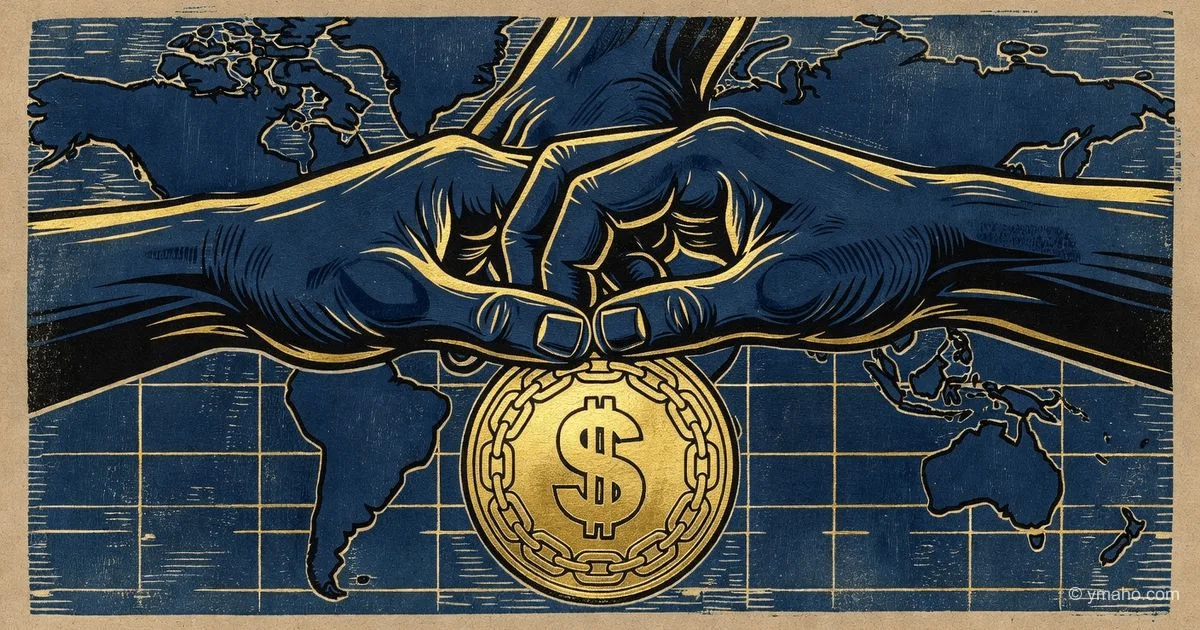
Stripe, Visa, and Mastercard Create Joint Stablecoin Platform
Payment giants join forces to develop digital dollar infrastructure. The partnership aims to create new solutions for international transfers and crypto settlements.
The Payment Giants' Conspiracy: Why Stablecoins from Visa, Mastercard, and Stripe Will Change Everything
[The Gist]: What's Really Happening
On June 3, 2026, news agencies broke a story that traditional media buried under headlines about Bitcoin's drop. Visa, Mastercard, and Stripe are forming a consortium to launch their own stablecoin platform, with Coinbase considering joining. At first glance, it's just another corporate crypto initiative. In reality, it's the most aggressive market grab since the dollar itself emerged.
Why does this change the game? Because these three companies collectively process the majority of global card transactions. Their networks span over 200 countries, and Stripe serves millions of online stores worldwide. This isn't a startup begging merchants to accept its token. It's infrastructure that says, "Starting tomorrow, you'll accept our stablecoins because you have no choice."
The stablecoin market is currently valued at around $325 billion, with Tether and Circle controlling about 80% of that pie. USDT dominates offshore exchanges, while USDC leads in regulated US payments. The new consortium isn't attacking from the expected side (crypto exchanges) but from real-world payments—where trillions of dollars flow daily.
Most importantly, retail investors miss this: the move was years in the making. Stripe spent $1.1 billion acquiring infrastructure company Bridge in late 2024, and Mastercard absorbed BVNK in 2026. This isn't an improvisation—it's a planned operation to seize control of the digital dollar.
Timeline and Context
To grasp the scale, look at the preparation timeline. In late 2024, Stripe closed its $1.1 billion acquisition of Bridge—a company providing corporate infrastructure for issuing and processing stablecoin payments. At the time, it seemed like a costly but logical bet on the future.
In early 2026, Mastercard announced the purchase of BVNK—another key player in stablecoin infrastructure. Visa, meanwhile, expanded its stablecoin settlement pilot to nine blockchain networks, including Solana, Ethereum, Avalanche, and new additions like Base and Polygon.
On June 3, 2026, information about the consortium leaked to the press via anonymous sources. CoinDesk reported that the three payment giants were in an "advanced stage" of launching a shared platform. Coinbase, the largest US crypto exchange, is considering participation but has not yet made a final decision.
Interestingly, the market reaction was immediate and non-obvious. Shares of Circle and Coinbase fell. Paradox: good news for the industry overall turned out bad for current stablecoin market leaders. Investors correctly understood: if the consortium launches, USDC and USDT will lose their monopoly on corporate payments.
Who Wins and Who Loses
Winners:
- Visa, Mastercard, and Stripe. They gain control over the next generation of payment infrastructure. Instead of losing fees on blockchain transactions, they'll collect them. Analysts estimate the stablecoin network processed about $33 trillion in transactions last year—comparable to card network volumes.
- Large multinational corporations. B2B transfers that currently cost 1.5–3% of the amount and take days will happen for cents and seconds. Cross-border supply chain companies are the main beneficiaries.
- Mid-tier merchant acquirers and payment providers. Those who quickly integrate the new platform will gain a competitive edge over those stuck on old SWIFT rails and card interchange fees.
Losers:
- Tether and Circle. Their duopoly in the stablecoin market ($325 billion combined market cap) is under direct threat. USDC is especially vulnerable because Coinbase, its largest distributor, is now considering joining a competitor.
- Traditional correspondent banks. The network of intermediary banks profiting from international transfers will gradually erode. Sending money from the US to Africa or Asia will no longer require three intermediary banks and five days of waiting.
- Small crypto projects launching their own stablecoins. They desperately need liquidity and real-world integration. When merchants can choose between a Visa-Mastercard consortium token and a no-name token, the choice is obvious.
Coinbase—a gray area. If the exchange joins the consortium, it gains access to the giants' payment flows but jeopardizes its relationship with Circle, from which it derives a significant portion of USDC-related revenue. If it doesn't join, it risks being left out of the decade's main payment innovation. Coinbase's stock price fell on the news, reflecting this dilemma.
What the Media Isn't Saying
Insight #1: Facebook Libra (Diem) is back, but under a different name and without the dumb mistakes.
In 2019, Facebook announced Libra—a stablecoin project involving payment giants including Visa, Mastercard, and Stripe. The project immediately faced fierce regulatory backlash, partners fled in panic, and Libra died, morphing into the pale shadow Diem, which was sold for pennies.
What changed? By 2026, the US regulatory environment for stablecoins had become much more favorable. The Trump administration pushed the CLARITY Act and other laws legalizing digital dollars. Moreover, consortium members spent $1.1 billion (Stripe) and billions on acquiring BVNK and other assets before announcing the collaboration. Facebook's mistake was announcing plans before building infrastructure. Visa and Mastercard built the infrastructure and are only now announcing.
Insight #2: The war won't be over technology, but over the "last mile"—access to the merchant's checkout.
Technically, any developer can create a stablecoin over a weekend. The problem is getting millions of stores worldwide to accept it. Visa and Mastercard are already in every POS terminal on the planet. Stripe is already integrated into every serious online store.
When the consortium launches the platform, merchants won't need to change anything—they'll keep using the same terminals and APIs, but behind the scenes, settlements will run through stablecoins. This is called a "stealth revolution," and it's the most powerful way to deploy new technology. No educational campaign, no adoption struggle—just a firmware update.
Insight #3: The third player nobody notices is the bank consortium through the Regulated Liability Network (RLN) project.
Parallel to Visa and Mastercard, the world's largest banks (JPMorgan, Citi, Goldman Sachs) are developing the RLN—a universal platform for central bank digital currencies and tokenized deposits. The Visa-Mastercard consortium attacks from the card network and merchant side. RLN attacks from the custodian bank and wholesale settlement side.
In the next 12–24 months, we'll witness a battle of two paradigms: "payment networks vs. bank consortia" for the right to become the digital dollar standard. The winner will be the one that first connects the largest corporate clients to its network. For now, the card consortium looks stronger because it already has merchants. Banks only have other banks.
Forecast: Next 30 Days and 90 Days
30 days (until July 5):
In the coming weeks, we'll see official confirmation of the consortium's formation. The three companies are waiting for Coinbase's decision and final legal documents. When confirmation comes (likely by end of June), the market will react with a sharp drop in Circle's stock and a short-term decline in USDC's market cap.
For the crypto market overall, the news is neutral to positive—it legitimizes stablecoins as an asset class at the level of the world's three largest payment systems. Bitcoin may get indirect support from institutional enthusiasm, but no direct effect is expected.
USDC's price may temporarily drop 1–3% on spot markets if holders fear liquidity outflow to the new platform. However, until the product launches, panic will be limited.
90 days (until September):
A more important horizon is September 2026. August is set for a review of the revenue-sharing agreement between Coinbase and Circle. If by then Coinbase has officially joined the consortium, negotiations with Circle will become extremely tense. Coinbase may either exit the Circle partnership (losing revenue but gaining a stake in the new project) or maintain dual membership, creating a conflict of interest.
Also in Q3, we may see the first pilot integration of the platform—likely via Stripe for online payments in a few Latin American or Southeast Asian countries where traditional card fees are particularly high.
The main risk over the 90-day horizon is regulatory. Although the environment has become friendlier, nothing prevents Congress or the US Treasury from questioning whether three companies controlling 80% of the card market should create another concentration tool. Antitrust authorities may take interest. And if we recall the Libra story—regulators can kill such projects with a single letter.
Editorial Forecast
Asset: Coinbase shares (COIN) / Direction: Down 5–8% within 48–72 hours upon official confirmation of consortium participation.
Key Levels: Current level—we'll refrain from exact figures. Upon participation confirmation—expect testing of monthly lows. Support at early June 2026 levels.
Confidence: Medium (55%). The market has already reacted to the leak, but the full amplitude will only appear with an official announcement detailing the participation structure.
Main Risk: If Coinbase announces it will stay with Circle and not join the consortium, COIN shares could rise 10–15% on uncertainty removal. However, this is unlikely—the stakes in the battle for corporate payments are too high, and Coinbase cannot afford to be on the losing side.
— Editorial Team