Japan's 'Edible' Beauty Trend: Bananas and Food Waste in Cosmetics
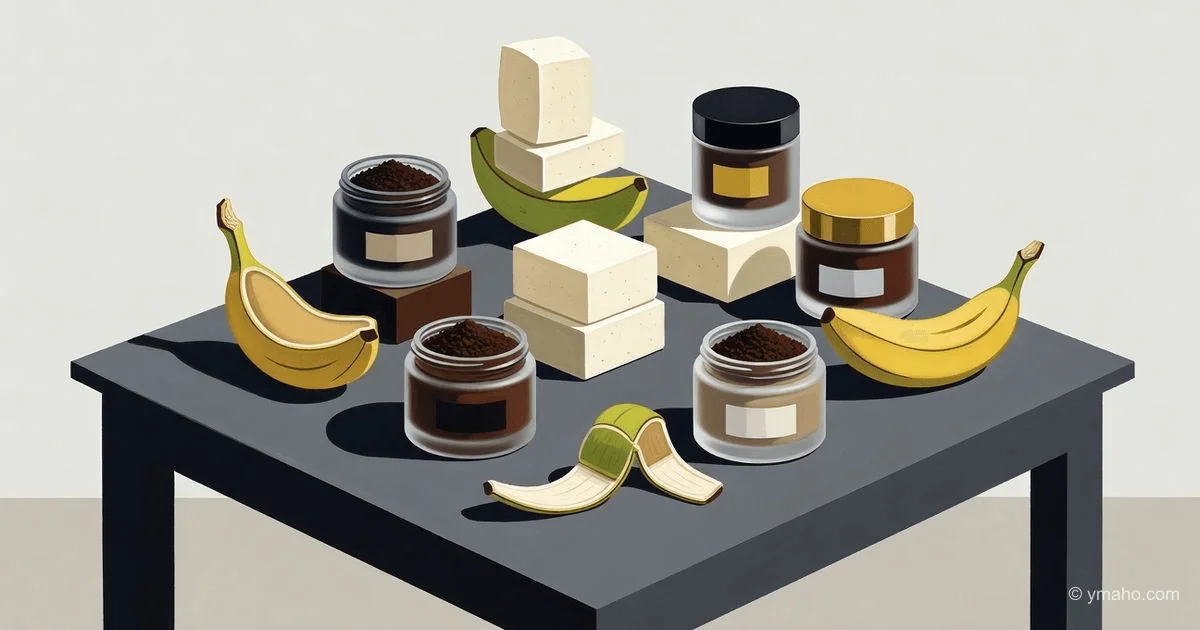
Korean and Western media are discussing the new wave of upcycling in the beauty industry. Brands have begun actively using food waste, including banana peels and coffee grounds, to create effective enzyme masks and scrubs, reducing the environmental burden.
An analytical article written from an insider's perspective, revealing the true mechanisms behind the growth of the upcycled ingredients market in Japan and the non-obvious risks that Korean and Western publications are silent about.
'Food for the Face': Why Banana Peels and Soybean Meal Have Become the Top Beauty Raw Material of 2026, and Pharma Giants Are Quietly Buying Up Waste
Insider of the Week: Korean and Western media are touting upcycling in cosmetics as a 'brilliant eco-move.' But the truth is, this trend isn't about ecology. It's about the new economics of raw materials. While glossy magazines rave about 'edible beauty,' biochemical corporations (BASF, Givaudan, Symrise) are quietly buying up patents for processing food waste, because this waste contains the same active molecules as wild plants but costs 10 times less. The Japanese market for upcycled cosmetic ingredients, which was a modest $12.4 million in 2025, will grow to $20.3 million by 2035. But the global market, according to Research and Markets, is already valued at $301.3 million and will reach $634.6 million by 2035. 'Eco-friendliness' is just a pretty wrapper for hard business logic: cheap raw materials, high prices, endless marketing.
[The Essence]: What's Really Happening
It didn't start with banana peels. The pioneers were Japanese companies that had worked with food industry waste for decades due to the cultural concept of 'mottainai' (a sense of regret over waste). In 2015–2020, the process was artisanal: small startups made soap from coffee grounds and sold it at farmers' markets. But in 2024, a tectonic shift occurred: global players realized that food waste is not 'trash' but 'cheap raw material with high active content.'
The true essence of upcycling in 2026 is the industrialization of the 'waste' economy. Today, when Japanese retailer Lumine holds its 'ethicarnival' (a festival of ethical consumption) and collects 445 kg of unwanted cosmetics for recycling into paint pigments, it's not charity. It's a test of a reverse logistics model that will allow giants like Shiseido and L'Oréal to close the loop completely in 3-5 years. Food waste currently accounts for 41% of all sources of upcycled ingredients in Japan. Behind this are not farmers, but agro-industrial holdings that sell their 'waste' at a higher price than their main products.
The second layer is technological. In March 2026, UK scientists published a study in Nature Sustainability on converting plastic PET bottles into L-DOPA (a Parkinson's disease drug) using modified E. coli bacteria. This bio-upcycling method is already being tested for the cosmetics industry. Imagine: your facial toner tomorrow could be made from a plastic bottle thrown away last week. This is not futurism—it's the current R&D track of Givaudan and Symrise. When the media write about 'bananas in cosmetics,' they divert attention from the real revolution: bacteria that eat trash and excrete collagen.
The third layer is economic. Consumers pay a premium for 'eco-friendliness.' GlobalData reports that 47% of buyers worldwide make purchasing decisions based on ethical and environmental considerations. But the cost of upcycled ingredients is 3-5 times lower than that of traditional 'natural' extracts. A brand buys coffee grounds for pennies, processes them, calls it an 'eco-innovation,' and sells the scrub for $45. Margins reach 70-80%. 'Eco-friendliness' has become the most profitable marketing tool of the decade.
Timeline and Context
The history of upcycling in Japanese cosmetics began long before Harper's Bazaar talked about it. In 2022, ICHIMARU PHARCOS, together with Hirosaki University, developed a technology to extract proteoglycan from salmon nasal cartilage—a byproduct of fish processing. This ingredient won the BSB Innovation Award 2025 in the 'Ecology' category. Salmon heads, which were thrown away for centuries, are now turned into anti-aging creams. The tradition of turning waste into value has always existed, but the industrialization of this process began precisely in 2022–2023.
In January 2025, the first high-profile cross-industry collaboration project took place: Mizkan Holdings (a seasoning giant known for the Ajipon brand) teamed up with biotech startup Fermenstation and cosmetics brand BCL Company. Together, they released a limited edition of Saborino Mezama Sheet morning masks, which contained a fermented extract from soy sauce production waste—so-called soybean meal. This was the first time a major food producer directly supplied its industrial waste to a cosmetics brand. The deal set a precedent.
Throughout 2025, the market exploded. Research and Markets published a report stating that the agro-food byproducts segment accounts for 32% of the entire upcycled ingredients market and is growing at a CAGR of 7.8%. The key driver was that large corporations realized: waste is a predictable, stable, and cheap source of raw materials. Unlike wild plants that depend on season and harvest, food waste is produced 365 days a year. Do you know how many tons of coffee grounds Starbucks produces in Tokyo alone in a day? It can be calculated to the kilogram.
By June 2026, when Korean and Western media wrote about the trend, the market was already in an active scaling phase. But the media, as usual, were late. They describe a 'fad' where insiders see a 'shift in production paradigm.' A December 2025 report from Future Market Insights clearly states: Kyushu & Okinawa are the regions with the highest CAGR (6.3%) in Japan for demand for upcycled ingredients. That's where the main agricultural waste processing facilities are located. The trend has already moved from the 'new idea' category to the 'scalable business' category.
Who Wins and Who Loses
Absolute winners: global chemical concerns: Givaudan, BASF, Symrise, Croda International.
These companies, along with L'Oréal, have been working with upcycled ingredients for years, but only now has this factor become a driver of their stock growth. They are buying up patents on extraction methods, signing long-term contracts with food giants (Mizkan, Ajinomoto) for waste supply, and creating 'laboratory' versions of natural actives. Their advantage is scale. A small brand cannot afford a 12-month formula stability analysis, but they can. The result: by 2035, these companies will control 60-70% of the upcycled ingredients market.
Second-tier winners: Japanese retailers and circular model integrators.
The Lumine chain has been holding the 'ethicarnival' festival for the third year, collecting unwanted cosmetics and recycling them into pigments using SminkArt technology from MANGATA. In 2026, they expanded the program to 13 locations and launched 'Lumi-ne Gacha'—toy capsules made from recycled cosmetics. This is not just PR. It's testing a 'closed-loop' business model in retail that will become the standard for all retail in Japan in 5 years.
Direct winners: tech startups like Fermenstation.
This company specializes in fermenting food waste for cosmetic applications. Their technology turned Mizkan's soybean meal into a highly active extract for BCL Company's masks. Fermenstation is an example of how a small business can carve a niche between a food giant and a cosmetics manufacturer. Their 'packaged' technology costs millions, but it pays off in 1-2 years through licensing fees from every product sold.
Biggest losers: natural cosmetics manufacturers that didn't invest in R&D.
Brands that built their reputation on 'pure ingredients from the Amazon jungle' or 'rare herbs from the Himalayas' have found themselves in a trap. First, their raw materials are becoming more expensive due to logistics and climate change. Second, upcycled ingredients offer the same actives (antioxidants, vitamins, fatty acids) at 3-5 times lower cost. A consumer choosing between a 'rare extract from Brazil for $80' and an 'upcycled extract from coffee grounds for $45' increasingly chooses the latter because the 'eco-narrative' is more convincing than 'exotic.'
Specific loser: traditional waste processing (incineration plants and landfills).
When food waste goes into cosmetics, it is not burned or buried. For Japan, where waste disposal is a critical issue due to land scarcity, upcycling into cosmetics is a salvation. But for waste processing monopolies, it means a loss of raw material. They lose a free input stream (waste) and are forced to raise tariffs on the remaining trash. In 2026, Tokyo is already seeing a 7-9% increase in waste disposal tariffs—an indirect effect of beauty upcycling.
What the Media Aren't Saying
Point one: quality and stability are the main headache.
GlobalData directly states: variability in harvests and processing conditions affects the composition, color, smell, and active content of upcycled ingredients. A banana grown in the sun has a different antioxidant profile than one grown in the shade. The processor cannot control this. To release a batch of cream with consistent color and smell, the manufacturer must either add synthetic stabilizers (contradicting 'naturalness') or discard huge batches. The media don't write about this because it shatters the fairy tale of 'simple eco-friendliness.'
Second non-obvious insight: scaling is not eco-friendly.
When a small startup processes coffee grounds from a nearby coffee shop, it's eco-friendly. But when Givaudan orders a container of coffee grounds from Vietnam, ships it to Switzerland (10,000 km), processes it in a factory consuming electricity, and ships the finished extract to Korea—the carbon footprint of such a product is higher than that of a traditional synthetic ingredient. Upcycling on a global scale is not always a 'green' choice. Sometimes it's a choice to reduce raw material costs through logistics. But they stay silent because 'carbon footprint of upcycled ingredients' is too complex for a glossy headline.
Third hidden factor: microbial safety.
Food waste is an ideal environment for bacteria and mold. To turn it into a cosmetic ingredient, harsh sterilization is needed, which often destroys the very active components the whole process is about. There's an unspoken rule in the industry: the 'dirtier' the raw material, the more aggressive the treatment, and the lower the final bioavailability. Some companies solve this by adding high doses of synthetic preservatives to the final product. The label will say 'upcycled banana peel,' but in reality, it's a jar with sodium benzoate. The consumer won't see it; the regulator won't check.
Fourth point: greenwashing 2.0.
Many brands call 'upcycled' what is actually just 'recycled' or even 'recovered' from secondary raw materials with added primary material. The difference is huge. Upcycling means turning waste into a product of higher quality. Recycling means remelting with loss of quality. Most 'upcycled' products on the market are actually just recycling, but the word 'upcycled' sells better. Regulators in Europe are already introducing standards for 'upcycled claims' (Green Claims Directive), but in Asia and the US, this is not yet the case. The media don't understand these nuances and tout any 'eco-product' as a 'breakthrough.'
Forecast: Next 30 Days and 90 Days
30 days (July 2026):
L'Oréal will announce the launch of a global initiative to purchase upcycled ingredients from food waste in the Asia-Pacific region. Contracts signed with three Japanese food corporations. Official wording: 'commitment to circular economy principles.' Reality: L'Oréal reduces raw material costs by 25-30% and gets a marketing 'green' label. The company's shares will rise by 3-5% on this news.
90 days (September 2026):
Japan will host the first 'Upcycled Beauty Summit' conference in Osaka. Key speaker: a representative of Japan's Ministry of Agriculture, Forestry and Fisheries, who will announce government subsidies for companies processing food waste into cosmetics. This officially turns upcycling from a trend into state policy. Immediately after, BASF and Symrise will announce the opening of joint R&D centers in Kyushu (the region with the highest CAGR of 6.3%).
Strategic forecast (12-18 months):
The upcycled cosmetics market will reach a saturation point. The first 'scandals' will emerge: independent labs will find that some 'upcycled' creams have near-zero active content but contain dangerous preservatives. Consumers will become disillusioned. The industry will respond by creating certification standards (like 'Upcycled Certified Beauty' analogous to COSMOS). Only brands that can prove not only the origin of raw materials from waste but also their efficacy in clinical trials will survive. By 2027, upcycling will cease to be a marketing word and become an engineering reality. But until then, there will be chaos that marketers will exploit.
Most important strategic forecast:
By 2027, bio-upcycling (processing plastic and other synthetic waste through bacteria) will catch up with food upcycling. The method described in Nature Sustainability in March 2026 (converting PET bottles into L-DOPA) will be adapted for producing cosmetic actives. Squalane and glycerin will be first. This will mark the end of the 'natural cosmetics' era as we know it. The future is cosmetics made from trash, synthesized by bacteria. Vogue will write about it as 'new eco-glamour,' omitting that it has nothing to do with 'naturalness.' Welcome to circular economy 2.0.
— Editorial Team