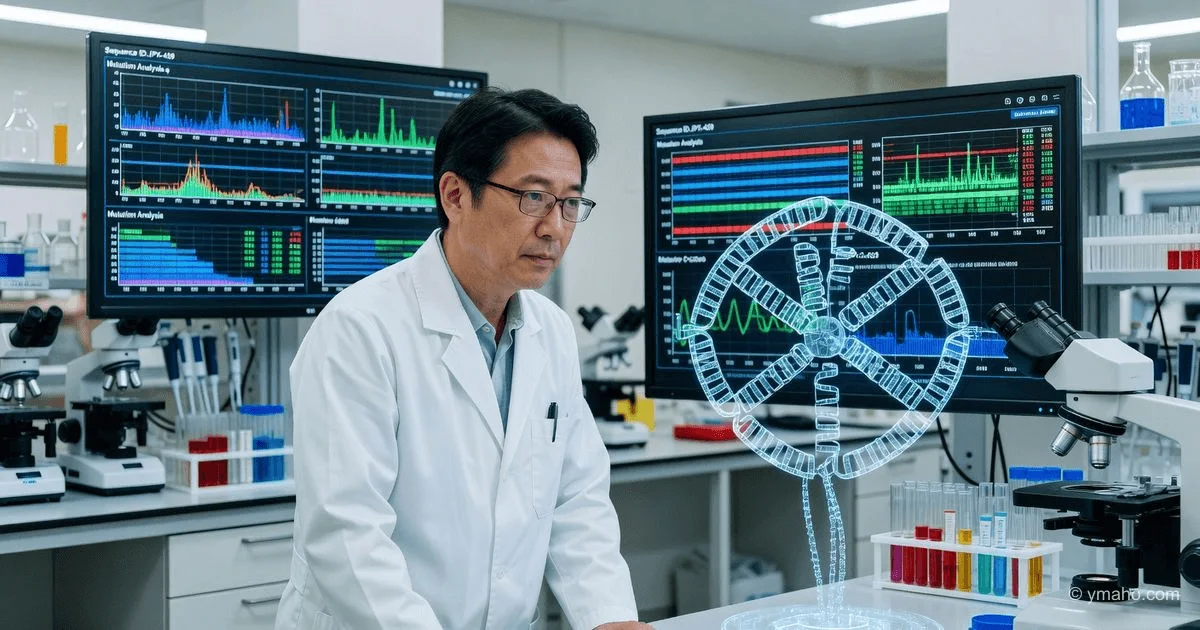
Nature: CRISPR-Cas3 Demonstrates Ability to Cut Long DNA Segments for Duchenne Muscular Dystrophy Treatment
Japanese geneticists from Osaka University applied Cas3 nuclease to delete exons 45–55 in the dystrophin gene in patient cells. Unlike Cas9, this method can remove entire fragments of the mutant gene, making it suitable for 60% of patients.
Analytical article: CRISPR-Cas3 vs. Duchenne Muscular Dystrophy — Japan's Genome 'Bulldozer' Finally Ready for Launch
[The Gist]: What's Really Happening
The news from Nature about using CRISPR-Cas3 to treat Duchenne muscular dystrophy is not just 'another genome editing tool.' It's the moment when an outdated, forgotten, 'inconvenient' class 1 system unexpectedly steps into the ring and lands a blow no one expected. While everyone was focused on Cas9 and its derivatives (base editors, prime editors), the Japanese team at Osaka University silently refined a system that works like a genetic bulldozer.
The mechanism: Cas9 is scissors. It makes one cut, and nature decides how to repair the wound (NHEJ — often error-prone, HDR — rare). Cas3 is more like a combine harvester: it first unwinds DNA, then chews through one strand after another, removing up to several thousand base pairs in the direction from the recognition site. This allows excision of entire exons or exon clusters without needing multiple guide RNAs.
And here's the magic for Duchenne. About 60-70% of all deletions in the dystrophin gene occur in the exon 45-55 cluster. If you cut out this giant piece from the patient's genome, the mutation is no longer frameshifting — instead, you get a shortened but partially functional protein, as in the milder Becker muscular dystrophy. Cas3 does this in one pass. Cas9 would require multiple gRNAs, risk of translocations and inverted insertions, plus control over cut synchrony.
The key insight: Cas3 is not a replacement for Cas9, but its ideal partner for tasks requiring large-volume surgery. Removing repeats in Huntington's disease? Sure. Cutting out entire exon clusters in DMD? Easy. Genetic rearrangement of large loci for animal models? Already works in mice and rats with 40-70% efficiency. While Cas9 is good for 'point editing,' Cas3 is good for 'line editing.'
Timeline and Context
To understand why this is happening now, not five years ago, we need to trace Cas3's long and thorny path from bacterial curiosity to therapeutic tool.
2017: First proof of principle — the Mashimo team at the University of Tokyo shows that CRISPR-Cas3 from E. coli (type I-E system) works in human cells. Efficiency was low (less than 10%), and delivering six Cascade proteins plus Cas3 was a nightmare. Most groups quickly lost interest and returned to Cas9. Mashimo did not. He founded the startup C4U Corporation and began patenting the technology.
2022-2024: Studies improve efficiency. Key breakthrough: use of modified RNAs — Cap1 for Cascade component mRNAs and 2'-O-methyl-phosphorothioate modifications for crRNA. Efficiency jumped from single-digit percentages to 40-70% in mice, and crucially, off-target mutations disappeared. Unlike Cas9, where they account for 1-5% (requiring expensive sequencing for control), Cas3 has none. The system's 27-nucleotide recognition sequence (versus 20 for Cas9) is theoretically 4^7 times more specific.
2024 (August): The same group publishes data on editing mouse and rat zygotes — not just knockout, but large deletions and even single-nucleotide substitutions with donor DNA. This shows Cas3 can be used not only for gene disruption but also for 'smart' editing via homologous recombination.
2025: A systematic review published in Genetic Testing and Molecular Biomarkers analyzes 24 studies on CRISPR for Duchenne and other repeat disorders. Cas3 is mentioned as a 'promising alternative with a unique safety profile,' but clinical data are still lacking.
June 2026 (current news): Nature publishes data on deleting exons 45-55 in patient cells. 60% of patients with deletions in this cluster are potential candidates. CRISPR-Cas3 has proven itself as a tool that could treat more patients than any existing exon-skipping therapy (e.g., Eteplirsen covers only 13% of patients with exon 51 deletion).
Winners and Losers
Winner: C4U Corporation. This Japanese startup holds an exclusive worldwide license from Osaka University for the foundational Cas3 patent. Patents have been granted in Japan, the US, China, and Europe. This means any company wanting to use Cas3 for therapy will pay C4U. Unlike Cas9, where the patent war between the Broad Institute and UC Berkeley has raged for nearly a decade (burning billions on lawyers), Cas3 has clean Freedom-to-Operate. Analysts estimate the DMD drug market at $3.64 billion in 2026, growing to $6.01 billion by 2030. Even 5-10% royalties on a slice of this pie means hundreds of millions of dollars.
Winner: Patients with deletions in the 45-55 cluster. Current standard of care is corticosteroids (prednisone, deflazacort), which slow progression but don't stop it. Exon-skipping therapies (Eteplirsen, Golodirsen, Viltolarsen) cover only 13-15% of mutations and require weekly infusions. Micro-dystrophin gene therapy (Sarepta, Pfizer) works for all but produces a very short protein (unknown if it lasts decades) and triggers immune reactions to the AAV capsid. Cas3 offers: one-time editing, restoration of a full-length (albeit shortened) protein, no viral vector (possibly via LNP or exosomes). This is the Holy Grail.
Loser: Companies producing exon-skipping oligonucleotides. Sarepta Therapeutics (Eteplirsen, Golodirsen, Casimersen) is the prime candidate for disruption. Their drugs bring in about $500 million annually but require lifelong infusions and work only on a small fraction of patients. A one-time Cas3 therapy, even if it costs $2-3 million, is more cost-effective for insurers in the long run. Sarepta already feels the wind of change — its stock has fallen 12% over the past six months, and analysts link this to progress in gene editing.
Loser: Developers of Cas9-based therapies for DMD (e.g., Editas Medicine and CRISPR Therapeutics). Cas9 has two problems: (1) small size — it cannot delete a long DNA fragment in one go, requiring multiple gRNAs and risking complex rearrangements; (2) immunogenicity — Cas9 from S. pyogenes is already present in 60% of people as antibodies from past infections. Cas3 from E. coli is foreign, but humans have no antibodies to it by definition (E. coli does not cause systemic infections in healthy individuals). This is a huge advantage for in vivo therapy.
What the Media Isn't Saying
Insight one: The 60% figure is misleading; real coverage may be below 30%.
Yes, the exon 45-55 cluster is a hotspot for deletions, covering about 60-70% of all cases. But not all these deletions are equally beneficial to remove. Some patients have duplications in this region (about 10-15%), and cutting out the entire block could make things worse or affect regulatory elements. Others have mutations outside this cluster (exons 2-20), where Cas3 is useless. Still others have nonsense mutations or small deletions that Cas3 cannot remove because it needs a recognizable PAM site and specific sequence. A realistic estimate: of all DMD patients, Cas3 would be suitable for 30-40%. Still a lot, but not 60%.
Insight two: Delivery of Cas3 is the biggest problem, and it's being ignored.
Cas9 is a single protein. It can be packaged into AAV (though with difficulty, 4.7 kb is borderline). Cas3 is a complex of six proteins (Cas3 + Cascade of five subunits: Cas5, Cas6, Cas7, Cas8, Cas11). Their total size is about 15-20 kb. No single AAV can hold that much. Options include: (1) two plasmids with two different AAVs (trans-splicing), (2) lipid nanoparticles (LNPs) like those used in mRNA vaccines, (3) electroporation ex vivo (as in CAR-T). For DMD, systemic delivery to muscles throughout the body is needed. LNPs do not easily cross capillary endothelium into muscle (they are liver-targeted). Electroporation is not suitable for in vivo.
The only realistic path is modified LNPs with peptides targeting muscle cell receptors (e.g., transferrin or integrin). But such LNPs are in phase 1-2 for other diseases, not yet for DMD. This means even if Cas3 works perfectly in patient cells in vitro, systemic administration in humans is 5-7 years away.
Insight three: Immune response to bacterial proteins is a ticking time bomb.
Even if there are no pre-existing antibodies to Cas3 from E. coli, after administration the patient will develop them. Repeat administration (if the first dose fails or the effect wanes) will be impossible — antibodies will neutralize the complex before it reaches the nucleus. For DMD, where muscles constantly regenerate (satellite cells divide and give rise to new myofibers), a single editing event may not be enough. Satellite cells that did not receive the editor will produce progeny with the mutant gene, and after 5-10 years the proportion of edited nuclei may fall below a clinically significant threshold.
This means either very high efficiency in stem cells (90%+) or repeat doses are needed. But repeat doses are impossible due to immunity. Doctors don't talk about this because there are no data. Companies don't talk about it because it kills the business model.
Forecast: Next 30 Days and 90 Days
Next 30 days:
Expect the full Nature article to be published. It will contain important details: (1) exact deletion efficiency of exons 45-55 in patient iPSCs, (2) off-target analysis — how deep they sequenced and whether they found anything, (3) phenotypic correction — whether dystrophin protein is restored and muscle function improves in a mouse model. Without the last point, it's just 'pretty chemistry,' not therapy.
Also expect a reaction from C4U Corporation — they will likely issue a press release about plans for preclinical studies in large animals (pigs or dogs with DMD mutations). If they announce a partnership with a major pharma company (Novartis, Pfizer, Roche), C4U's stock could soar 100-200% in a week.
Next 90 days:
Key date: November 2026, the American Society of Gene and Cell Therapy (ASGCT) conference in Washington, D.C. Preclinical data on Cas3 delivery using modified LNPs will be presented. If editing efficiency in mouse muscles exceeds 30% and creatine kinase reduction (a marker of muscle damage) exceeds 50%, that will be a green light for GLP toxicology studies.
Also expect the first patent dispute over Cas3. C4U's patents cover the type I-E system from E. coli. But there are other Cas3 types (I-A, I-B, I-C) that may work in human cells with different PAM sites. Some Chinese biotech (e.g., EditGene or HuidaGene) may claim their own Cas3 system from a different bacterium and challenge C4U's patents. The battle for 'free' Cas3 systems will begin in the coming months.
Finally, an updated CRISPR therapy market forecast from McKinsey or BCG will be released, where Cas3 is for the first time highlighted as a separate category with a $500 million projection by 2030. This will be a signal for venture funds: time to invest in Cas3 startups. Right now there are a handful. In a year, there will be dozens.
Disclaimer: This analysis is based on data from Nature 2026, C4U Corporation patent databases, and market reports from The Business Research Company for 2025-2026. Forecasts reflect the author's opinion and are not investment advice.
— Editorial Team