Biden Imposes New Sanctions on Russian Arctic LNG 2 Project
The restrictions target vessels involved in liquefied natural gas transshipment, in an attempt to finally halt the project ahead of winter.
Headline: Biden Tightens Sanctions on Arctic LNG 2: Why It Won't Stop Russia but Will Reshape the Global Gas Market
Author: Independent Financial Analyst (Partner, Energy Markets and Sanctions Compliance Consulting Group)
When the Biden administration announced new sanctions on June 3, 2026, targeting vessels involved in transshipment of liquefied natural gas from Russia's Arctic LNG 2 project, markets reacted predictably: European gas prices (TTF) jumped 5%, shares of European energy companies dipped slightly, and analysts began talking about "Putin's gas weapon."
But behind this seemingly "routine round of sanctions" lies a much deeper and more contradictory reality. The new restrictions are not an attempt to "finally halt the project," as headlines suggest, but an acknowledgment that previous sanctions have failed. Russia has not only found ways to circumvent the restrictions but is also building a new "shadow fleet" for LNG that could shift the balance of power in the global gas market. Let's break down what is actually happening with Arctic LNG 2 and what financial consequences it entails.
[The Core]: What Is Really Happening
On the surface, these are new sanctions against vessels involved in transshipping Russian LNG. This is an attempt by the US to cut off the last logistics chain allowing Arctic LNG 2 to export gas. But the reality is that the project is already operational, supplying gas to Asia via a "shadow fleet" of at least 20 tankers.
A non-obvious insight that most analysts miss: US sanctions on Arctic LNG 2 are effectively stimulating the creation of a new market—a "gray" LNG market where Russian gas is sold at a discount, and intermediaries (often from China, the UAE, and Turkey) reap superprofits. This market has already formed and continues to grow despite all restrictions.
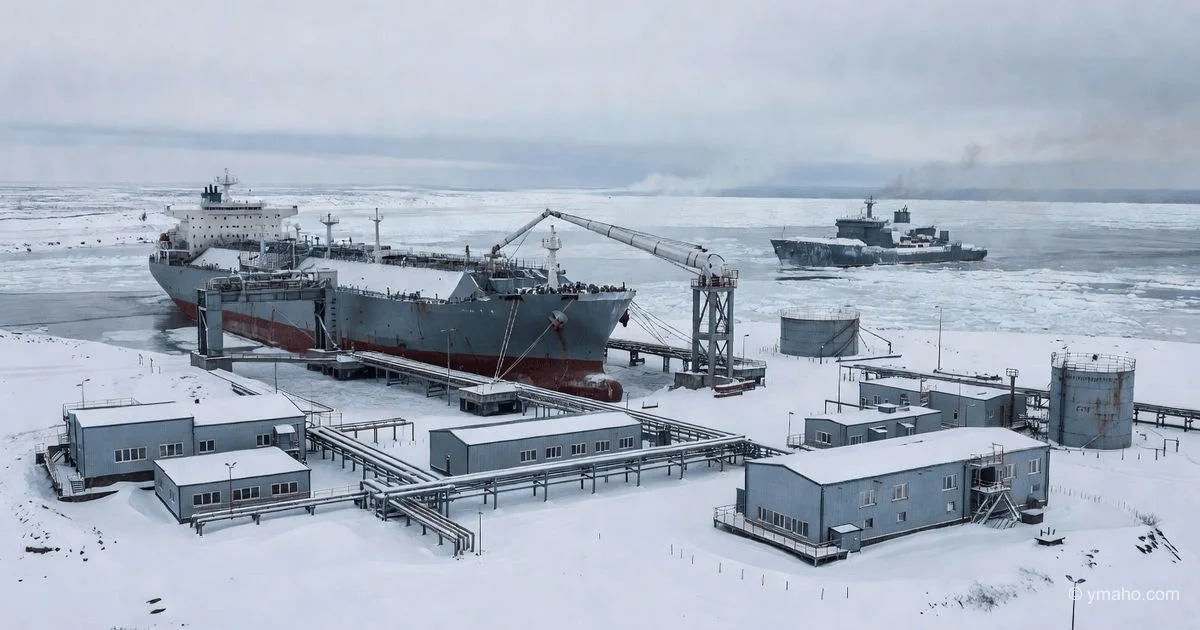
Look at the numbers. In early January 2026, Russia used the only icebreaker, Christophe De Margerie, to send a third batch of gas from the plant, operating at about 25% of design capacity. But by May, the "shadow fleet" had been bolstered by four former Omani tankers—Kosmos, Merkuriy, Orion, and Luch. These vessels were reflagged to Russia through little-known companies in Hong Kong and Russia, and now transport gas from the floating storage unit Saam near Murmansk.
Why does this work? Because sanctions have "blind spots." The US cannot impose secondary sanctions on every buyer of Russian gas—that would alienate China and India, key trading partners. Instead, Washington tries to stop supplies at the shipping level, but Russia finds new vessels and new schemes every time.
Timeline and Context
The history of sanctions against Arctic LNG 2 began long before June 2026. The project, which was to become the flagship of Russia's gas industry (capacity 19.8 million tons of LNG per year), came under US restrictions after the start of the full-scale war in Ukraine.
The first serious problem arose with the supply of specialized Arc7 ice-class gas carriers. Japan's Mitsui OSK Lines, which was to provide three such vessels, announced it could not do so due to sanctions. Without these icebreakers, Arctic LNG 2 cannot operate in winter when the ice becomes too thick for ordinary ships.
In the winter of 2024-2025, the plant was forced to significantly reduce production precisely because of the shortage of icebreakers. But Russia began to solve the problem. In December 2025, the first Russian ice-class tanker, Aleksey Kosygin, was built. And in May 2026, Russia completed construction and conversion of four more vessels capable of operating in Arctic conditions.
A key turning point was the attack on Qatar's Ras Laffan LNG plant in March 2026, which knocked out about 20% of global LNG production. This created a market deficit and drove up prices. In these conditions, China and other Asian buyers became less picky about suppliers. Russian gas, even at a discount, became more in demand than ever.
On June 3, 2026, a day before the described events, Vladimir Putin signed a decree allowing France's TotalEnergies to sell its 10% stake in the project. Total, which could not receive dividends due to sanctions, finally exits the project, making way for a Russian buyer. This is a symbolic but important step: Arctic LNG 2 becomes fully controlled by Russia, simplifying management and avoiding conflicts of interest with Western shareholders.
Who Wins and Who Loses
Winners:
- China (CNPC, CNOOC). Chinese companies have retained their stakes in the project (10% each). Gaining access to discounted Russian gas, they solve their energy problems. According to Bloomberg, Russia offers gas from Arctic LNG 2 at a discount to spot prices, allowing China to save billions of dollars on imports.
- The new "shadow" fleet and intermediaries. Companies that transport Russian LNG via transshipment points in Murmansk (the Saam floating storage unit) profit from rising freight rates. Due to sanctions and vessel shortages, Arctic shipping rates have multiplied. The transshipment scheme allows the use of conventional tankers, which are cheaper and more available.
- The US (paradoxically). Yes, American LNG producers also benefit. Qatari gas is partially out of play due to the Ras Laffan attack, European demand remains high, and the US fills the vacuum. Europe pays 2-3 times more for American LNG than for Russian pipeline gas before the war, bringing US exporters superprofits.
Losers:
- Europe (EU, national governments). European buyers continued to import Russian LNG (in Q1 2026, imports rose 16%), but now they will have to pay more. Sanctions on Arctic LNG 2 do not reduce Russian export volumes; they merely redirect them to Asia. Europe is forced to buy more expensive American and Qatari gas (once Qatar restores production).
- Japan (Mitsui, JOGMEC). Japanese companies holding a 10% stake in the project find themselves in a difficult position. They cannot receive their share of gas due to sanctions, but exiting the project without permission from Russia and the US is problematic. TotalEnergies' exit approval may help the Japanese, but for now they remain in limbo.
- TotalEnergies. The French company lost $4-5 billion in project investments, which likely will not be recovered. Even after the sale approval, the terms are undisclosed, and Total will probably sell its stake at a huge discount.
What the Media Leaves Out
The most important omission is the role of transshipment points and the "shadow fleet" as a "black box" for sanctions. The scheme is simple: Russian Arc7 icebreakers deliver gas from the plant to Murmansk or Kamchatka, where it is reloaded onto conventional tankers (which are not subject to sanctions because they did not call at Russian ports). These conventional tankers can then go anywhere, changing flags and names along the way. The US tries to counter this by adding specific vessels to sanctions lists, but there are hundreds of them. It's a game of tag where Russia is always one step ahead.
A second point is internal US disagreements. As reported by Semafor (citing sources), the Biden administration, simultaneously with imposing sanctions, is negotiating with the US Polar LNG project in Alaska, which wants to use equipment originally intended for Arctic LNG 2. In essence, the US blocks the Russian project but "intercepts" its technology for its own development. Cynical, but effective.
A third point is sanctions as a political tool, not an economic one. Claims that sanctions "halt the project" are far from reality. Arctic LNG 2 is operating and will continue to operate, albeit not at full capacity. China needs gas and is willing to buy it from Russia despite sanctions. Europe needs gas and buys it from the US. The new sanctions are a signal to Biden's voters ahead of the elections: "We are fighting Putin." They have almost no economic effect.
Forecast: Next 30 Days and 90 Days
30 days (June to early July 2026):
I expect Russia to formally complete the purchase of TotalEnergies' stake. This will remove the last Western shareholder from the project and allow Novatek to manage it without regard for anyone else's interests. Also, new LNG supply contracts with China and possibly India are likely to be announced. Demand for LNG remains high due to the deficit caused by the Qatar attack, so the discount Russia offers to Asian buyers will narrow.
European gas prices (TTF) will remain in the range of €45-55 per MWh. Any escalation in the Middle East or new sanctions will add 5-10% upside, but gas will not fall below €40—demand is too high and supply constrained.
90 days (September 2026):
The key moment is the recovery of Qatari exports. If the Ras Laffan plant returns to full capacity by September, gas prices could fall 15-20%. This would reduce Russia's export revenues but will not stop Arctic LNG 2, as the project has long-term contracts with China.
As for sanctions, the US may tighten further: add more vessels to the list, attempt to block insurance and financing for the "shadow fleet." But without support from China and India, these measures will be largely ineffective. Most likely, by autumn the conflict around Arctic LNG 2 will enter a "low-intensity" phase: Russia exports, the US imposes sanctions, Europe pays more, China gets a discount.
Editorial Forecast
Asset: European natural gas (TTF — Dutch Title Transfer Facility).
Direction: Up in the next 24–72 hours, then moderate correction.
Key levels: Current level around €48-50 per MWh. I expect a test of €53-55 on the back of sanctions news and winter supply concerns. Support at €45.
Confidence level: High (70%).
Main risk: A sudden recovery of Qatari exports or a breakthrough in ceasefire negotiations in the Middle East (which would unblock the Strait of Hormuz) could crash gas prices to €35-38 per MWh within days. Watch for statements from QatarEnergy and news from the Gulf region.
— Editorial Team