European Central Banks May Return to Rate Hikes as Inflation Surges to 3%
The European Central Bank may be forced to raise rates mid-year due to rising imported energy prices, despite the risk of a eurozone economic slowdown.
Headline: ECB Does a 180: Why a 2.25% Rate Is Just the Beginning
Author: Independent Financial Analyst (Partner at a Macro Hedge Fund, Specializing in Monetary Policy and Rates)
When the ECB ended its rate hike cycle at 2% a year ago, everyone breathed a sigh of relief. "Inflation is defeated, let's start thinking about cuts," analysts sang in unison. The idyll was short-lived. Today, June 4, 2026, we stand on the brink of a completely different reality: the ECB will not only return to raising rates on June 11 but will likely launch a full-blown tightening cycle that could stretch through all of 2026.
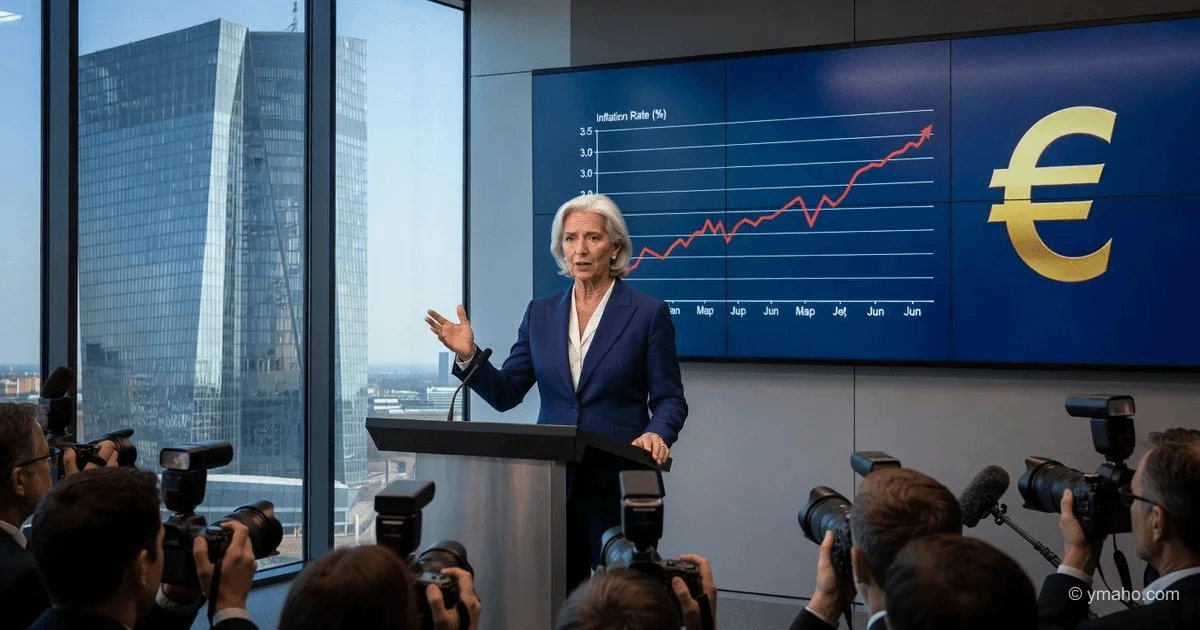
Eurozone inflation accelerated to 3.2% in May, surpassing forecasts and hitting its highest level since summer 2023. Core inflation jumped to 2.5%, the highest in a year. And this is not an "energy shock" as some try to portray. It is a structural shift that markets have not yet fully grasped. Let's break down why the ECB will be forced to act more aggressively than expected, and who will profit from it.
[The Core]: What's Really Happening
A superficial view sees May's inflation as a simple acceleration: +3.2% vs. 3.0% in April. But the devil is in the details. The services sector rose to 3.5% from 3.0% a month earlier. This is the "stickiest" component of inflation—it does not respond to oil prices and won't disappear with the opening of the Strait of Hormuz. Services prices are rising because wages are rising. And wages are rising because Europe's labor market remains record-tight.
A non-obvious insight that most analysts miss: inflation in the services sector is now more important than energy inflation, and it will force the ECB to raise rates not twice, but likely four times in 2026. Nordea, one of the most conservative forecasters, has already stated: they expect four rate hikes before a pause. Four. This means the deposit rate could rise from the current 2% to 3% by year-end.
Look at the country-level data. In Italy, inflation jumped to 3.3% from 2.8%; in Spain, to 3.6% from 3.5%. Even in France, which has always been an "anchor" of low inflation, price growth accelerated to 2.8% from 2.5%. The only major economy showing a slowdown is Germany (2.7% vs. 2.9%), but this is a statistical effect: a year ago, energy prices in Germany surged sharply, providing a high base for comparison. In month-on-month terms, prices in Germany are still rising.
Timeline and Context
The path to today's reversal did not begin in April or even March. The key milestone was February 26, 2026, when Houthi rebels blocked the Strait of Hormuz. Back then, markets still hoped it was a "temporary shock." In its March forecast, the ECB projected average annual inflation of 2.6% for 2026. That was already an increase from December estimates, but no one took it seriously.
Then came April: inflation accelerated to 3.0%, and the ECB began to get nervous. At the April 30, 2026 meeting, Christine Lagarde spoke about "vigilance" for the first time in a long while. Governing Council members Isabel Schnabel and Philip Lane hinted in their speeches that rates could go up.
And now, May: inflation at 3.2%, core inflation at 2.5%. This is no longer a "shock." It's a trend. A Reuters poll conducted in late May showed that 74 out of 80 economists expect a rate hike on June 11 to 2.25%. But more importantly, 49 out of 80 now forecast two additional hikes in 2026 (up from 34 out of 70 in the May poll).
UBS, which also expects a June hike, warns that markets may be underestimating the risk of further tightening. Citing "ECB sources," UBS reports that the bank could raise rates "at least twice" this year—implying the possibility of three hikes. It's not that the ECB "wants" to raise rates. It's that it is forced to: inflation expectations are starting to become unanchored, and if they are not anchored now, it will be too late later.
Who Wins and Who Loses
Winners:
- European banks with high deposit shares (Santander, BNP Paribas, UniCredit). Rate hikes increase net interest margins. With each 0.25% hike, the largest eurozone banks earn an additional €400-600 million in net profit per year. This will be a driver for bank stock growth in the coming quarters.
- Hedge funds playing on rising volatility (long vol strategies). A shift in monetary trend from "dovish" to "hawkish" is a golden age for options traders. The expectation of an unpredictable rate path (two, three, or four hikes?) creates ideal conditions for profiting from volatility contracts (VStoxx).
- Large insurance companies (Allianz, AXA). They are net buyers of fixed-income bonds. Rising yields on Treasuries and Bunds improve their investment portfolios and allow them to offer more attractive annuities to clients.
Losers:
- Private equity funds with high debt loads. The "buy, borrow, grow" model only works with low rates. Each rate hike increases the cost of debt servicing for portfolio companies. Some large deals from recent years may become underwater if rates stay high longer than expected.
- Eurozone construction sector and real estate market (Vonovia, Deutsche Wohnen shares, construction contractors). Mortgage rates in Germany have already jumped to 4.2% from 3.5% at the start of the year. Each ECB rate hike delays the recovery of the housing market, which is already in deep depression.
- Consumers with floating-rate loans (indirectly, through consumer demand). Rising rates on credit cards and auto loans reduce disposable income. This will negatively impact discretionary retail stocks (Zalando, H&M, Inditex), which are already struggling with margin compression.
What the Media Isn't Saying
The most important omission in current news is Germany's role as a "brake" on policy tightening. The German economy, the largest in the eurozone, has been in stagnation for four consecutive quarters. The ECB is expected to lower its 2026 eurozone GDP growth forecast from 0.9% to 0.7% at the June meeting. But the Bundesbank, traditionally a "hawkish" voice on the ECB Governing Council, paradoxically supports rate hikes. Why? Because Germans are terrified of a repeat of the 1970s, when inflation spiraled into double digits. For Berlin, "a little recession" is better than "a little inflation."
The second point is the divergence between market expectations and ECB rhetoric. Markets (via rate futures) are pricing in about 56 basis points of tightening by end-2026. That's roughly two and a half hikes. But if you listen to Schnabel or read Societe Generale's analysis, it becomes clear: the ECB could go further. Headline inflation in early 2027 could reach 3.8%, and core inflation 2.8%, due to "indirect effects" of the energy shock and supply chain disruptions.
Finally, on politics: Societe Generale mentions that the EU may allow governments to allocate an additional 0.3% of GDP for energy support. This fiscal stimulus is a safety net for the population, but for the ECB, it's an additional headache. Any fiscal injections into the economy (even targeted ones) are potentially inflationary. If governments start spending, the ECB will have to tighten even more. This is a conflict between fiscal and monetary policy that we already saw in 2022.
Forecast: Next 30 Days and 90 Days
30 days (June – early July 2026):
The ECB meeting on June 11 will almost certainly deliver a rate hike to 2.25%. Attention will be on Lagarde's press conference. If she uses a phrase like "we are at the beginning of a new tightening cycle" or something similar, markets will price in a second hike as early as the July meeting (July 23) instead of September.
I expect the euro to get a short-term boost: EUR/USD could test the 1.1750-1.1800 level. But this rally will be short-lived, as the eurozone economy is fundamentally weak. Sell the euro on rallies—the "sell the rally" strategy remains relevant.
90 days (September 2026):
The key moment will be the June and July inflation data. If core inflation remains above 2.3-2.4%, the ECB will be forced to raise rates in September (the third hike in 2026) and possibly in December (the fourth). The deposit rate could reach 3% by year-end.
This would mean the gap between ECB and Fed rates (the Fed rate is currently 3.5-3.75%) narrows from 150 to 50-75 basis points. This would support the euro in the long term but also deepen the eurozone recession. Stocks of European companies focused on the domestic market (retail, real estate, construction) will be under pressure. Bank stocks and exporters (which benefit from a weak euro) will continue to rise.
Editorial Forecast
Asset: Euro (EUR/USD).
Direction: Up in the next 24–72 hours, then a correction.
Key Levels: Current level around 1.1620. I expect a test of 1.1700–1.1750 on expectations of the June hike. Resistance at 1.1800. Support at 1.1550 and 1.1500.
Confidence Level: Medium (65%).
Main Risk: If Lagarde is unexpectedly "dovish" at the June 11 press conference (e.g., says "this hike is one-off"), the euro could crash to 1.1400 in a single day. Also, watch the May eurozone PMI data—weak numbers could limit euro gains.
— Editorial Team