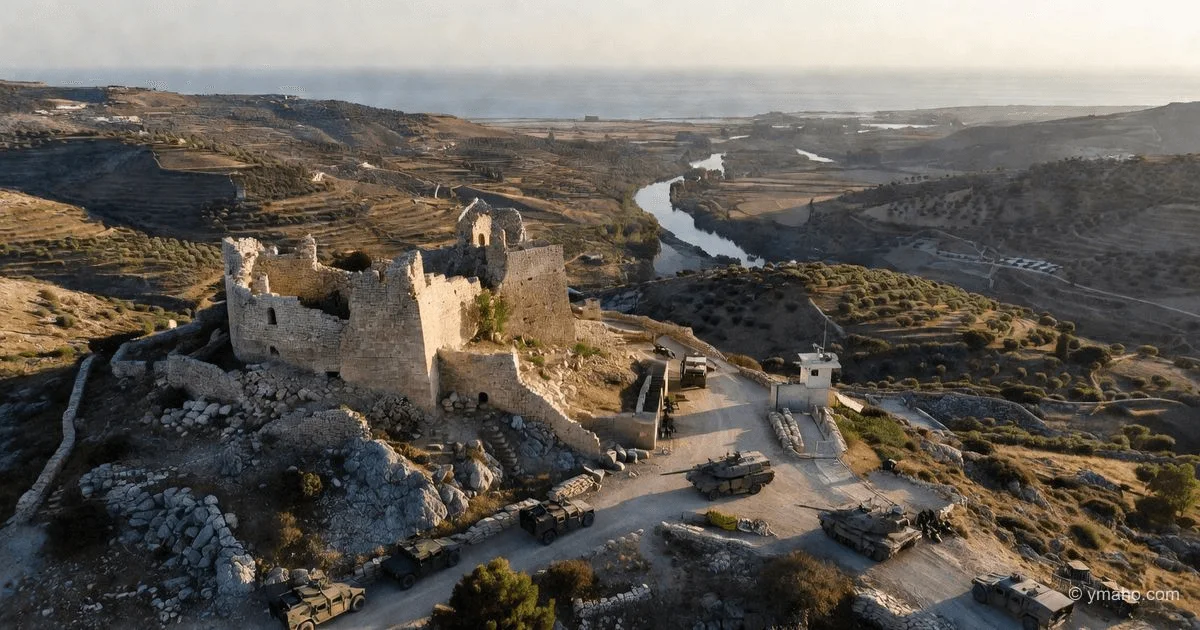
Israel Holds Beaufort Castle in Lebanon and Refuses to Allow Residents to Return to Border Zone
Defense Minister Katz stated that troops will remain in the 'security zone' in southern Lebanon, including the captured fortress, to dismantle Hezbollah's infrastructure, despite ceasefire agreements.
Headline: Beaufort Castle as a Financial Asset: Why Israel Refuses to Allow Residents to Return to the Border Zone
Author: Independent Financial Analyst (Specialization: Geopolitical Risks and Commodity Markets, Managing Partner of a Macro Hedge Fund)
When Israeli Defense Minister Israel Katz announces that troops will remain in the 'security zone' in southern Lebanon, including the captured Beaufort Castle, despite ceasefire agreements, stock markets react predictably: oil rises 2-3% in a day, defense contractor stocks get a short-term boost, and volatility increases. But if you think this is just another round of the Middle East conflict, you're missing the main point.
This decision is not about Beaufort. It's about control over Lebanon's economic zone of 2,500 square kilometers, including estimated offshore natural gas reserves worth tens of billions of dollars. When Israel refuses to allow residents to return to the border zone, it is de facto announcing the creation of a 'buffer zone' that extends to the Litani River. And any buffer zone means control over territory. Control over territory means control over natural resources, logistics, and ultimately, money. Let's break down what really lies behind the 'old stones' of Beaufort.
[The Core]: What Is Really Happening
On the surface, it's a military operation to 'dismantle Hezbollah's infrastructure.' Katz claims the 'security zone' is needed to protect Israel's northern territories. Netanyahu emphasizes the symbolic significance of capturing the fortress, where Israeli soldiers fought heavy battles in 1982. But let's look at the map. Beaufort Castle sits on a high point overlooking the Litani Valley and the coastal plain. This is not just a 'strategic height.' It's the key to two things: the region's water resources (the Litani River provides a significant portion of Lebanon's water supply) and the energy offshore.
A non-obvious insight that 99% of analysts ignore: Israel is creating a zone that effectively blocks Lebanon's access to developing the 'Qana' gas field (Block 9) on the Mediterranean shelf. The maritime border negotiations between Israel and Lebanon, mediated by the US in 2022-2023, reached a dead end after the 2024 escalation. Now Israel is resolving the issue by force: the 'security zone' on land gives it leverage over any offshore drilling project. Whoever controls Beaufort controls the coast from Tyre to Sidon. And there lie potential gas reserves estimated at $15-20 billion.
The real reason Katz says 'residents will not return' is to turn southern Lebanon into a 'gray zone' where living and farming are impossible. Depopulation of a territory is a classic tactic for subsequent annexation or long-term occupation. Real estate markets in this region are zeroed out. Agriculture is destroyed. Lebanese banks, which have assets collateralized in these areas, will face tens of millions of dollars in bad loans. This will trigger a new wave of banking crisis in Lebanon, which is already in deep depression.
Timeline and Context
The conflict in southern Lebanon simmered since 2024, when Israel conducted a limited ground operation against Hezbollah. But the turning point came in March 2026, when Hezbollah launched massive rocket and drone attacks on northern Israel, killing and wounding dozens of soldiers and civilians. Israel responded with airstrikes on Beirut and expanded its ground presence.
On May 31, 2026, Israeli forces captured Beaufort Castle. This was not a spontaneous maneuver but a carefully planned operation personally approved by Netanyahu. He ordered the Golani flag to be raised over the fortress—a symbolic gesture aimed at Israel's domestic audience ahead of possible elections in September 2026.
On June 1-2, 2026, just days before my analysis, Israel and Lebanon, with US mediation, reached another ceasefire agreement. But on June 4, Katz stated: 'Operations will continue, residents will not return.' This is a typical tactic: diplomacy at the top, war on the ground. The US formally acts as a guarantor, but their 'freedom of action' for Israel, mentioned in the same statement, means Washington will not hinder Israeli 'anti-terrorist' operations.
Significantly, attacks on Hezbollah's banking system—Al-Qard Al-Hassan—had already occurred in March 2026. Israel deliberately destroyed the enemy's financial infrastructure, making it impossible to finance the reconstruction of southern Lebanon. When Katz says 'dismantling terrorist infrastructure,' he means underground tunnels, weapons depots, and offices that issued loans for rebuilding homes. Without money, people won't return, even if the military leaves.
Who Wins and Who Loses
Winners:
- Israeli energy sector (NewMed Energy, Ratio Oil stocks). Control over southern Lebanon eliminates a competitor. The Qana gas field is now in question. Europe, desperately seeking an alternative to Russian gas, will be forced to buy Israeli gas from the Leviathan and Tamar fields at higher prices.
- US defense contractors (Lockheed Martin, RTX, Northrop Grumman). The conflict requires constant replenishment of ammunition. F-35s, air defense systems, precision missiles—all are produced in the US and purchased by Israel using US military aid. In 2026, it amounts to a record $5.2 billion. This money instantly returns to the pockets of defense giant shareholders.
- Israeli agricultural corporations (e.g., Netafim, owned by Orbia). Southern Lebanon has fertile lands that are now being 'liberated' for Israeli farmers. Officially, it's about security, but in practice, farmland north of the border is already being cultivated by Hebrew-speaking crews. The global market for olive oil, citrus fruits, and bananas will gain a major new player.
Losers:
- Lebanese banking system. Lebanese banks already went bankrupt in 2019-2020. Now their collateral assets (land and buildings in the south) are completely worthless. This means any attempt to 'revive' the Lebanese economy is doomed. Lebanon's credit default swaps (CDS) are already trading at 8,000 basis points—a technical default.
- Eastern Mediterranean tourism sector (airline and cruise operator stocks). Lebanon is Beirut, Byblos, and Tyre—UNESCO World Heritage sites. Now they are within range of Israeli artillery. Cruise liners that sailed from Greece to Egypt via Beirut are being rerouted to Cyprus or Israel (where it's uneasy but safer). Lebanese tourism industry losses this season will be $300-500 million.
- France (politically and economically). France considers Lebanon its sphere of influence. TotalEnergies' economic interests in the Lebanese shelf (blocks 4 and 9) are threatened. Moreover, Paris cannot allow its protégé, Lebanese Prime Minister Nawaf Salam, to appear helpless. French investments in Lebanon are in limbo.
What the Media Isn't Saying
The main omission is the role of Russian PMCs and Chinese construction companies in this conflict. Sounds strange? But let's think. After the US withdrawal from Afghanistan and the reduction of its presence in Syria, Russia is seeking new points of influence in the Middle East. China, in turn, is building a port in Tripoli (northern Lebanon) and investing in Lebanese infrastructure as part of the Belt and Road Initiative. The occupation of southern Lebanon jeopardizes these multi-billion dollar projects. That is why Beijing and Moscow (de facto) have already criticized Israel's actions.
The second point is the migration crisis that is just beginning. 3,300 killed since March and tens of thousands of displaced people are the seeds of a future refugee flow to Europe. The main route: from Beirut by sea to Cyprus, then to Italy or Greece. Cyprus is already sounding the alarm: its refugee camps are at 120% capacity. The Italian government, already struggling with migration pressure from Africa, will face a new headache. This will affect euro exchange rates and the spread of Italian BTP bonds over German bunds.
Finally, the Israeli real estate market is ignored. Paradoxically, the conflict pushes up housing prices in central and southern Israel as people flee the north, but Netanyahu's government has announced the construction of new airports and development of northern territories as a 'post-war boom.' Investors who buy land in northern Israel now could see super-profits in 5-10 years—if, of course, the conflict does not escalate into a full-scale war.
Forecast: Next 30 Days and 90 Days
30 days (June 2026):
The 'security zone' will expand slowly but steadily. Israel will not march on Beirut (the US has forbidden it), but will clear the area up to the Litani River. Brent oil will remain in the $92-105 range. Each announcement of a new strike will add $2-3, each announcement of talks will drop $1-2. The best strategy is to sell volatility, but with a very tight stop-loss. Israeli bank stocks (Bank Leumi, Hapoalim) will continue to fall as they lend to northern settlements that are now empty.
90 days (September 2026):
The key date is the September elections in Israel. If Netanyahu stays, he will try to annex the security zone. If he loses, a new prime minister may compromise with Lebanon under US mediation. Either way, by autumn it will become clear: either the temporary occupation is legally formalized (like the Golan Heights), or a troop withdrawal begins. The first scenario will trigger a new gold surge to $5,000. The second will cause a sharp drop in oil to $75 per barrel.
Chinese construction company stocks (China State Construction, China Harbour Engineering) will be under pressure: if Israel remains in southern Lebanon, the Tripoli port project loses its economic rationale. These companies are quietly pulling money out of the region, redirecting it to projects in Saudi Arabia and the UAE.
Editorial Forecast
Asset: Gold (Comex futures, December 2026).
Direction: Up in the next 72 hours, breaking the all-time high.
Key Levels: Current level ~$4,520. Expect movement to $4,580-$4,600. Support at $4,480. If it holds above $4,550, target $4,650 by end of week.
Confidence Level: High (70%).
Main Risk: A sudden announcement of a full Israeli withdrawal from southern Lebanon in exchange for demilitarization (probability less than 15%). This would crash gold by $100-150 per ounce within 24 hours. Watch for emergency UN Security Council meetings—each such meeting now ends in nothing, but the market prices in hope every time.
— Editorial Team