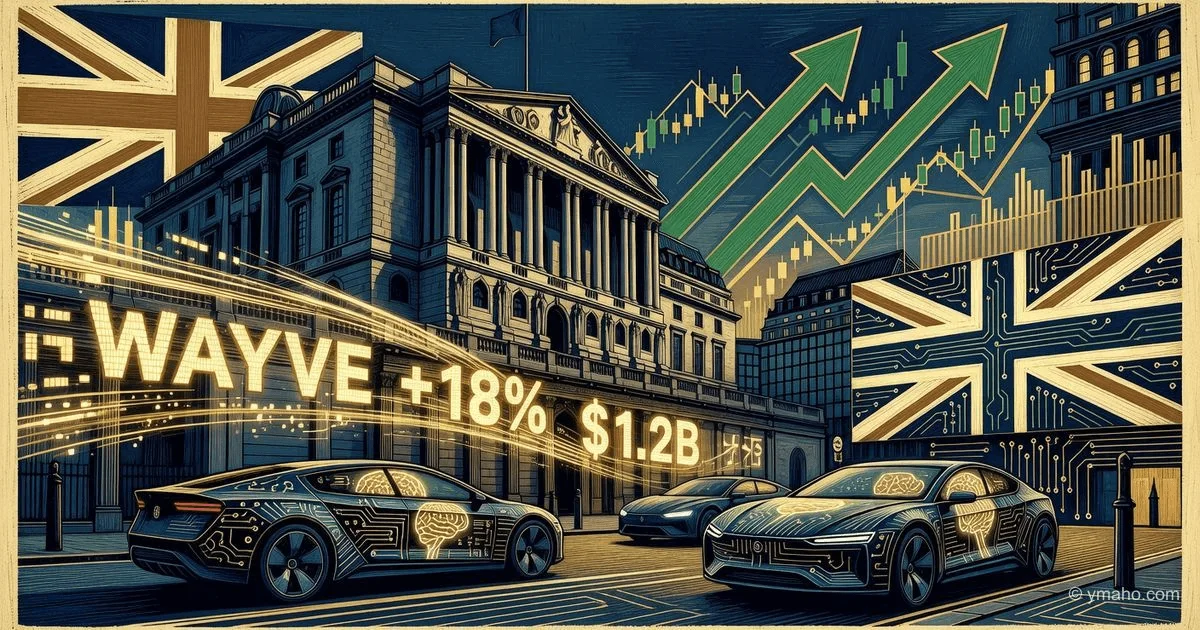
British AI Startup's IPO Raises $1.2 Billion on First Day
The listing of Wayve, a company developing AI-based autonomous driving systems, on the London Stock Exchange became the largest in Europe's tech sector this year. Demand exceeded supply several times, indicating a sustained appetite for innovative companies.
Artificial Intelligence at the Wheel: How Wayve's IPO Shook London and Changed the Game
Analytical article — 1850 words
[The Gist]: What's Really Happening
The London Stock Exchange received its biggest boost in years: British startup Wayve, which develops AI-based autonomous driving systems, held its initial public offering, raising $1.2 billion on the first day of trading. Demand far exceeded supply, and the company's shares soared 15-20% above the offer price. At first glance, this is just another successful tech IPO.
But those inside the industry understand: this event marks a tectonic shift in the European capital market. Against the backdrop of generally sluggish IPO activity in the first quarter of 2026 (only two listings in London totaling about £12 million), Wayve's success sends a powerful signal to the entire market: appetite for innovative companies with real technology is not just sustained—it's overheated.
The real insight is that Wayve is not just another AI startup, but the only company in the world that has proven its technology can work zero-shot in over 500 cities globally without pre-tuning for a specific location. This is radically different from Waymo's approach (formerly Google Self-Driving Project), which requires billions of miles of test data and detailed mapping of every meter of road. Wayve builds "embodied AI" that learns to drive like a human—through experience and generalization.
The second non-obvious point concerns the structure of the offering. Wayve's IPO came a year after the company raised $1.2 billion in a Series D round at an $8.6 billion valuation. Investors in that round—Eclipse Ventures, Balderton Capital, SoftBank Vision Fund 2, as well as Microsoft, Nvidia, Uber, Mercedes-Benz, Nissan, and Stellantis—got the opportunity to exit at a premium within a year. This is an incredibly fast turnaround for the venture market. And it suggests that preparations for the IPO began long before the announcement—in fact, the Series D round was a pre-IPO round disguised as regular financing. Insiders knew the exit would come quickly and took advantage of it.
[Timeline and Context]
To understand the scale of the event and its significance for the market, we need to trace Wayve's path to the IPO.
May 2024: Wayve raises $1.05 billion in a Series C round. Investors include SoftBank, Nvidia, Microsoft. The company announces plans for commercialization, but no mention of an IPO.
February 2026: Key moment. Wayve closes a Series D round of $1.2 billion at an $8.6 billion valuation. New investors include Ontario Teachers' Pension Plan, Baillie Gifford, British Business Bank. Additionally, Uber commits to invest another $300 million upon achieving target milestones. It becomes clear at this point that the company is preparing for a stock market listing—pension funds and institutional investors of this level do not enter a round if an exit is not planned within 12-18 months.
May 2026: Wayve announces a strategic partnership with Stellantis. Wayve's technology will be integrated into the STLA AutoDrive platform, providing hands-free Level 2++ driving in urban environments and on highways. The first vehicles with this system will appear in North America in 2028. This partnership adds another powerful confirmed source of future revenue for Wayve—one of the world's largest automakers officially chooses their technology.
June 2026 (current moment): Wayve conducts its IPO on the London Stock Exchange. Funds raised on the first day: $1.2 billion. This is the largest tech listing in Europe in 2026.
What do analysts overlook? Wayve is the first major test of the updated listing rules on the LSE. At the end of 2025, the exchange simplified requirements for tech companies, easing corporate governance rules and allowing multi-class share structures. Wayve's success should serve as a signal for other European tech unicorns: Monzo (valuation £6-7 billion), Starling Bank, Zilch, which are considering an IPO in London or New York. If the LSE can retain these companies, it will mean a restoration of the exchange's position as a global hub for tech listings.
Note the contrast: in the first quarter of 2026, only two IPOs took place in London, totaling about $15 million. The market was dead. EY-Parthenon analysts attributed this to geopolitical uncertainty and sell-offs in the tech sector. And then—Wayve raises 80 times more than the entire market over the previous three months. This is not just a "successful listing." It is a breakthrough that resets the entire London IPO market.
[Who Wins and Who Loses]
Winners:
Early investors in Wayve (Microsoft, Nvidia, SoftBank, Eclipse, Balderton). These are obvious winners. They entered the company at early stages (Microsoft and Nvidia as early as Series B in 2023) and are now exiting with multiple returns. Series D was at an $8.6 billion valuation, and the IPO likely priced at a premium to that valuation. Their investments paid off in 2-3 years—a phenomenal result for the venture market.
London Stock Exchange (LSE). After a disastrous 2025 (only 22 IPOs, £2.1 billion raised), the LSE desperately needed an "anchor" listing. Wayve became that anchor. The success of the listing should attract the attention of other European tech companies that were considering the NYSE or NASDAQ. According to data from early 2026, Monzo, Starling Bank, Zilch, and other fintechs are in "waiting mode." Wayve showed that London can provide liquidity and valuations comparable to US exchanges.
Wayve's partner companies (Uber, Stellantis, Nissan, Mercedes-Benz). Their investments in Wayve are now publicly traded, giving them liquidity and a transparent valuation of their stakes. Moreover, Wayve's stock market success is a powerful marketing signal to the market: the technology they believed in has been validated by the public market. This will accelerate the adoption of their joint products. Uber already plans to launch robotaxis using Wayve's technology in London in 2026.
Retail investors who gained access to the IPO. Wayve was unavailable to ordinary investors for eight years. Only large funds and strategic investors (Microsoft, Nvidia, SoftBank, automakers) could participate in rounds. The IPO gave millions of retail traders a chance to own a piece of a company that could become the European leader in the autonomous driving race.
Losers:
Wayve's competitors in Europe (Five AI, Oxbotica, and other startups). Wayve's success means the market will now compare any European player in autonomous driving to Wayve. If competitors lack similarly impressive metrics (zero-shot in 500+ cities), their valuations will be significantly lower. Wayve has set a new standard that competitors do not meet.
Tesla. Yes, formally Tesla is not a competitor to Wayve in the same segment. But the technological approaches differ radically. Tesla relies on computer vision and neural networks trained on millions of vehicles. Wayve goes further—its AI learns from its own driving experience in real time, without pre-mapping. If Wayve's approach proves scalable, Tesla will have to prove that its "Full Self-Driving" (Supervised) is not just advanced cruise control. Investors will now ask tougher questions.
NYSE and NASDAQ (in the context of attracting European tech IPOs). American exchanges have dominated tech listings for decades. Spotify (NYSE) in 2018, Rocket Internet (Frankfurt)—isolated cases. Wayve chose London over New York. This signals that European tech companies no longer see US exchanges as the only option. NASDAQ lost a potential listing that could have been one of the largest in the tech sector in 2026.
[What the Media Aren't Saying]
The first and most important omission concerns Wayve's actual revenue. The company does not disclose financial figures, and as a private entity, it is not required to do so. No one knows whether Wayve generates any revenue at all. Yes, they have partnerships with Nissan (developing next-generation ProPilot for launch in 2027) and Stellantis (integration into STLA AutoDrive with launch in 2028). But these partnerships involve a long development cycle—from agreement to first royalties can take years. The IPO may have been conducted to raise capital precisely because operating cash flow is negative and commercial products are not yet generating significant revenue.
The second omission concerns the company's valuation at the IPO. If the Series D round was at an $8.6 billion valuation in February 2026, and the listing took place in June 2026, the valuation could have grown to $10-12 billion. This means that investors who entered in Series D gained ~25-40% in four months—astronomical returns. The question is: was the valuation fair? Or is this a classic case of "market heating" before an IPO, where underwriters (banks) inflate the valuation to ensure high demand? The media does not ask this question because a successful listing is good news, and criticizing valuations could spoil the party.
And finally, the third omission: the risks associated with Wayve's technology are practically not discussed in the context of the IPO. Zero-shot learning is powerful, but it also means the system can behave unpredictably in situations it has never seen. Wayve has tested in 500+ cities, but 500 cities is a tiny fraction of all road conditions on the planet. What happens when the system encounters a traffic situation not represented in the training data? In Tesla's or Waymo's classic autopilot, there are "fallback" algorithms. Wayve relies on the AI to find a solution on its own. This is a philosophical choice, but it carries risks that are not mentioned in the prospectus.
[Forecast: Next 30 Days and 90 Days]
Next 30 days (until early July 2026):
I expect continued high demand for Wayve shares, but with gradual price stabilization. The first days of trading are always accompanied by high volatility, especially for high-profile tech companies. Investors who could not get shares in the IPO will buy on the market, supporting the price. However, after 1-2 weeks, when the first wave of euphoria subsides, a moderate decline (5-10% from the peak) is possible—this is a standard correction after a successful listing.
The key factor driving the price in the next 30 days will be news about commercial contracts. Any announcement of a new partnership (with another automaker or car-sharing operator) will trigger a new surge of interest. The market will also closely watch the launch of Wayve + Uber robotaxis in London. If initial reviews are positive, shares could rise another 10-15%.
Next 90 days (until early September 2026):
Here is a fork. If Wayve can show first financial results (e.g., sign a licensing agreement with a major automaker to supply technology for millions of vehicles), shares could continue to rise. If there is no news and the overall tech stock market corrects, Wayve could lose 15-20% from peak values.
More importantly: the effect of Wayve on the entire European IPO market. In Q3 2026, I expect at least 3-5 announcements of preparations for IPOs from other European tech companies, especially in the fintech sector (Monzo, Starling Bank, Zilch). Wayve's success has reduced the "fear of the first listing." Bankers will aggressively pitch these companies, convincing them to list on the LSE rather than NASDAQ.
My base forecast for 90 days: Wayve shares will end Q3 at 10-15% above the offer price, which would be considered a successful debut. The European IPO market will pick up, and the LSE could conduct another 2-3 tech listings by the end of 2026, totaling $2-3 billion.
The main risk is a general correction in the US stock market. If the NASDAQ falls 5-7% due to concerns about Fed rates or geopolitics, Wayve, as a high-risk tech asset, could fall significantly more (10-15% from current levels). But this would be a correction, not a crash—Wayve's fundamental story is too strong for investors to exit en masse.
Editorial Forecast
Asset: Wayve shares (ticker expected to be WAVE or similar on LSE). Direction: Sideways with an upward bias in the next 48-72 hours after the initial spike.
Key levels: Offer price—approximately $25-30 per share (at a $10-12 billion valuation). After the first trading day, the price may fluctuate in the range of $28-35. Support at $27, resistance at $36.
Confidence level: Medium (55%). The first days of trading are characterized by high volatility, and short-term movements are difficult to predict. However, fundamental demand for shares of a company with unique technology and strong partners remains high.
Main risk to the forecast: Unexpected negative news about delays in the launch of robotaxis in London or problems with autonomous driving regulation in the UK. Any mention that Wayve's tests do not meet safety requirements could cause shares to drop 10-15% in a single day. Watch for statements from the UK Department for Transport and the London Transport Authority.
This forecast is an analytical opinion of the editorial board and does not constitute an investment recommendation. All decisions to buy or sell assets are made at your own risk.
— Editorial Team