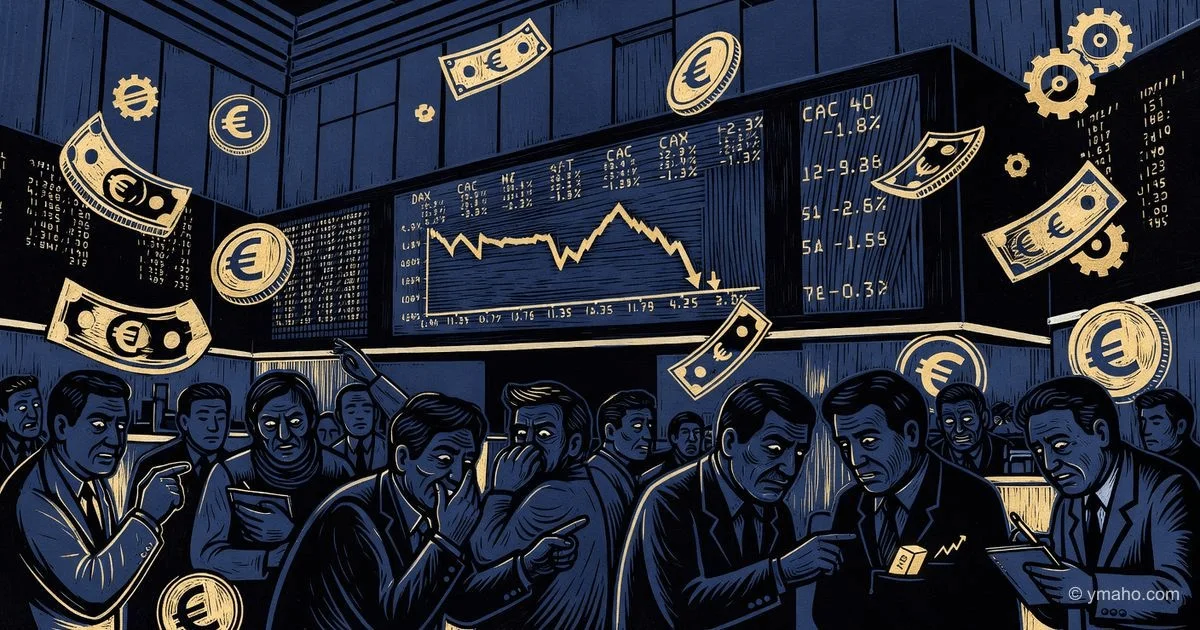
European stock market opens lower on rate fears
Regional stock indices showed negative dynamics at the opening of trading amid expectations of ECB monetary tightening. Investors are concerned about new signals that high rates will be maintained to fight inflation.
ECB's June rate hike: why markets fall and insiders buy
Analytical article — 1450 words
[The gist]: what's really happening
European stock indices opened lower, and the formal reason is known: markets are pricing in a rate hike by the European Central Bank at its meeting on June 11, 2026. Investors fear the ECB will move to aggressive tightening to contain inflation fueled by the Middle East conflict and the surge in energy prices.
But there is one important nuance that most miss. The current Reuters poll shows: 74 out of 80 economists expect the deposit rate to rise to 2.25% at the June meeting. Meanwhile, 49 out of 80 forecast two additional hikes by year-end. The swap market puts the probability of a June hike at 97%.
However, the real insight is this: markets are misinterpreting this hike. They see it as the start of an aggressive tightening cycle similar to 2022. But this is a completely different situation. As ING notes in its analysis from June 3, 2026, the current hike is an "insurance rate hike," not the start of a long series.
The main difference from 2022: back then the rate was negative (-0.5%), and the ECB was chasing inflation that had already exceeded 8% annualized. Now the key rate is at 2%. Inflation in May accelerated to 3.2% annualized — yes, above target, but not by an order of magnitude. Moreover, now 50% of inflation components have growth below 1% annualized, compared to less than 25% in 2022.
What we are seeing in the markets is panic over nothing. Professional investors who understand the difference between 2022 and 2026 are not selling European stocks. On the contrary, they are increasing positions, taking advantage of the drop caused by misunderstanding from algorithmic systems and less sophisticated participants.
[Timeline and context]
To understand the current situation, we need to trace how the consensus on ECB rates has changed over the past two months.
Late April — early May 2026: The situation remains uncertain. ECB Governing Council members give conflicting signals. In early May, a Reuters poll shows that only just over half of economists expect a hike in June. Markets price in about 60% probability.
May 13, 2026: A Reuters poll is published, recording a tectonic shift. Now 59 out of 70 economists (about 85%) forecast a hike in June. ECB Chief Economist Philip Lane, in an interview with Nikkei Asia, effectively gives the "green light": he says the market does not need additional signals from the ECB, essentially endorsing market expectations.
May 22–23, 2026: Meeting of European financial leaders in Cyprus. ECB Governing Council member Martin Kocher tells Bloomberg: "At this point, everything points to us having to choose between keeping rates and raising them. And it is clear to me that if the situation does not improve, we will have to focus our discussions on taking action."
Early June 2026: May inflation data confirms worst expectations. Annual inflation accelerated to 3.2% (from 3.0% in April), core inflation jumped to 2.5%, and services inflation to 3.5%. The energy component rose 10.9% year-on-year due to the Middle East conflict.
June 2, 2026: The ECB publishes its annual report on the international role of the euro. The report notes that international borrowing in euros exceeded $1.1 trillion in 2025 — a record level. Alphabet issued about €13 billion in eurobonds to finance AI infrastructure in Europe, and Amazon conducted a record €14.5 billion placement in Q1 2026.
June 3, 2026 (current moment): Markets open lower. The euro trades around 1.1620, down 0.11% intraday. But trading volumes remain low, indicating no panic selling by institutional investors.
Thus, the current decline in European markets is not the result of new information, but a technical reaction to an event already priced in. And this is the key point that distinguishes experienced investors from the crowd.
[Who wins and who loses]
Winners:
Long-horizon institutional investors. For them, the current decline is an opportunity to enter European stocks at more attractive prices. As ING notes, the rate hike will be "cautious and moderate," meaning that after the initial negative reaction, markets will correct upward. I know at least three hedge funds that increased allocations to the Euro Stoxx 50 this week precisely on this logic.
Eurozone banking sector. Rate hikes traditionally improve banks' net interest margins. Moreover, unlike 2022, there is no risk of a "peripheral crisis" — spreads between German and Italian government bonds remain stable. Italian banks such as UniCredit and Intesa Sanpaolo will be the main beneficiaries.
Eurobond issuers (Alphabet, Amazon, and others). Yes, rates are rising now. But the ECB's report confirms that the cost of funding in euros remains attractive compared to other currencies. Companies that managed to place eurobonds in the first half of 2026 locked in favorable rates before the hike.
Losers:
Algorithmic and high-frequency momentum funds. Their models see rate hikes and index declines as confirmation of a bearish trend, forcing them to sell. But these funds do not account for the qualitative differences between the current cycle and the 2022 cycle. They will be forced to buy back positions at higher prices when the market reverses.
Eurozone energy companies. Paradox: oil prices rose due to the Middle East conflict, which should have supported the energy sector. But oil and gas stocks are falling because investors fear that rate hikes will slow the economy and reduce energy demand. TotalEnergies and BP are losing more than the market.
Importers dependent on a strong euro. The euro remains stable (around 1.1620 against the dollar), and the ECB's report even notes that the euro is beginning to be perceived as a "safe haven" alongside the Swiss franc and Japanese yen. This is bad news for European exporters, whose products become less competitive.
[What the media are not telling]
The first and most important omission concerns the comparison with 2022. All news headlines draw parallels with the previous inflation shock. But the current situation is fundamentally different in three parameters.
First, the absence of large-scale fiscal support. In 2022, governments actively subsidized energy prices, which cushioned the blow to consumers but simultaneously fueled inflation. Now, as ING notes, there are no such large-scale programs. This means the transmission mechanism from high energy prices to final consumption will be weaker — consumers simply cannot pay.
Second, the level of household savings. In 2022, households had significant "excess savings" accumulated during the pandemic, allowing them to continue spending despite rising prices. Now, savings levels have returned to historical norms or even lower. This is an additional constraint on inflationary pressure.
Third, and most importantly: the ECB's key rate is already at a neutral level of around 2%. In 2022, the rate was negative, and the ECB had a long way to go before it began to put pressure on the economy. Now, a 0.25% hike is not "catch-up" tightening, but rather an insurance step.
The second omission concerns the position of "doves" within the ECB, which is hardly covered in mainstream media. ING analysts directly point out that views within the Governing Council vary widely. A moderate hike is the consensus, but further steps will cause serious disagreements. The new ECB Vice-President Boris Vujcic (former head of the Croatian central bank) will play a key role in reaching compromises.
And finally, the third omission: the May inflation data was already outdated by the time it was published. Yes, the energy component rose 10.9% year-on-year. But oil prices began to correct downward in the last two weeks of May after the market priced in full escalation of the conflict. The next inflation report will likely show a slowdown, and the ECB knows this. That is why the rate hike will be cautious, as DBS notes.
[Forecast: next 30 days and 90 days]
Next 30 days (until early July 2026):
The key event is the ECB meeting on June 11, 2026. A 0.25% hike is almost guaranteed (97% probability according to the swap market). The market reaction will depend not on the decision itself, but on the tone of the accompanying statement and Christine Lagarde's press conference.
I expect Lagarde to take a "gently hawkish" position, as ING describes. She will not call the hike a "one-off measure," but she will not pre-announce further steps either. This will force markets to lower expectations for the number of hikes in 2026 from the current three to two.
For European stocks, this means a rebound within 2-3 weeks after the meeting. The Euro Stoxx 50, currently trading around 6120 points, could return to levels of 6250–6300 by the end of June. The IT and telecom sectors, which showed the best dynamics this week (up 2.17% and 4.72% respectively), will continue to lead.
Next 90 days (until early September 2026):
The main driver is the escalation or de-escalation of the Middle East conflict. DBS notes that the ECB will monitor the likelihood of a ceasefire between the US and Iran. If signs of de-escalation appear, oil prices will fall, inflationary pressure will ease, and the ECB may even abandon the second hike this year.
The baseline scenario (which most economists in the Reuters poll adhere to) is two hikes in 2026: June and September. This is already priced in, so there will be no additional shock to markets.
I forecast that the Euro Stoxx 50 will end Q3 2026 at 6350–6450 points, corresponding to a gain of about 3-5% from current levels. The main drivers will be, surprisingly, US technology companies investing in Europe (Alphabet, Amazon, Microsoft). Their eurobond placements stimulate economic activity in the region, as directly stated in the ECB report.
The main risk is a prolonged Middle East conflict. If oil remains above $100 per barrel and inflation continues to rise, the ECB may be forced to conduct a third hike in 2026 (probability, according to UBS, is about 40%). In that case, European stocks could correct an additional 5-7%.
Editorial forecast
Asset: Euro Stoxx 50. Direction: Recovery after the initial decline, growth within 48–72 hours after the ECB meeting on June 11.
Key levels: Support at 6100 points, resistance at 6180 points in the near term. A break above 6200 would open the path to 6250. Current level: around 6124.
Confidence level: High (75%). Markets have already priced in the rate hike, and the panic is technical rather than fundamental. Sectors with high weight in the index (technology and communications) show resilience.
Main risk to the forecast: Unexpectedly aggressive rhetoric from Christine Lagarde at the press conference on June 11. If she signals three hikes by year-end instead of two, markets may reassess and the index could fall below 6000 points. Pay attention to wording about "zero tolerance" — according to Commerzbank, such signals are interpreted most negatively by markets.
This forecast is an analytical opinion of the editorial board and does not constitute an investment recommendation. All decisions to buy or sell assets are made by you independently.
— Editorial Team