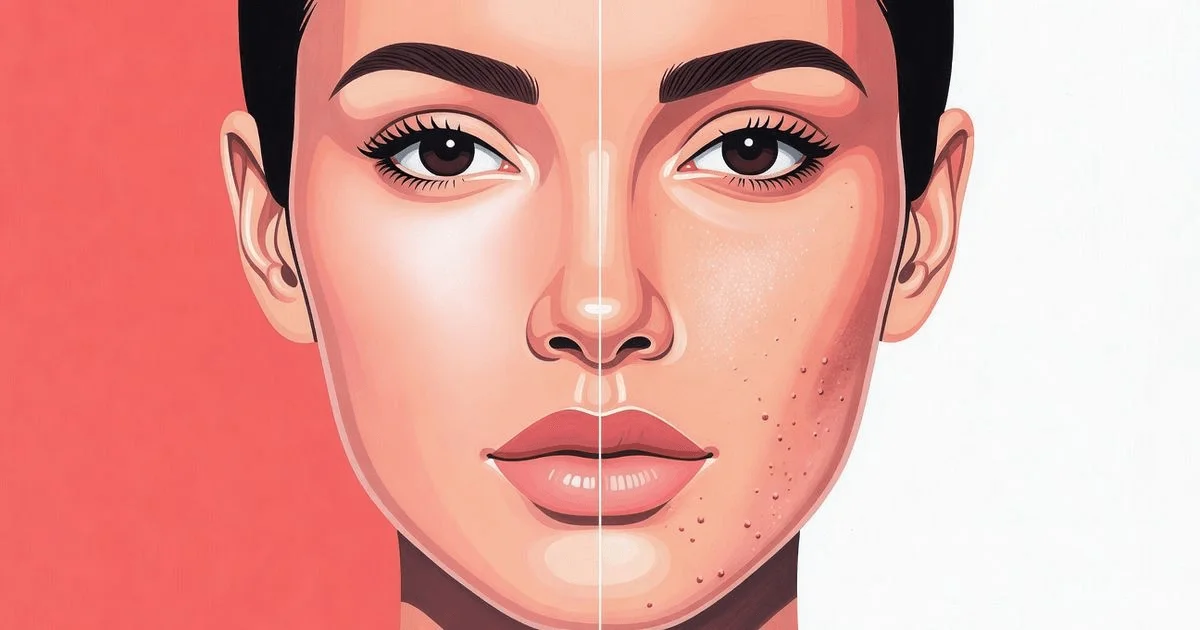
Hormonal Skin Health: Launching Lines for the Luteal Phase
Cosmopolitan US reports on the launch of cycle-synced cosmeceuticals. European brands have released creams and acid toners specifically designed for use during the second phase of the cycle to combat PMS acne without overdrying.
The Cycle as a New Asset: Why 'Hormonal Skincare' Is Becoming the Top Beauty Trend of 2026
I've been following the personalized cosmeceuticals industry since 2020, and I can say with certainty: what's currently unfolding in the European and US markets in the 'cycle-synced skincare' segment is not hype but a tectonic shift. In early June 2026, Cosmopolitan US reported on the launch of new cosmeceutical lines for the luteal phase—creams and acid toners that combat PMS acne without overdrying. But journalists only see the tip of the iceberg. They don't see how, on the other end of the line, venture investors are going crazy for startups like Gigi Supplements (which just closed €1.5 million in an oversubscribed round), and how Sweden's Peptonic Medical is announcing its entry into a new health & beauty segment focused on 'the woman's hormonal journey.'
Why now and not a year ago? Because the industry has finally legitimized the conversation about hormones. Previously, 'hormonal balance' was taboo for mass market—too complex, too individual, too scary due to the risk of endocrine disruption. Today, technology has advanced to the point where we can create formulas that don't interfere with the endocrine system but work with its 'consequences' at the skin level: sebum regulation, barrier function, inflammation. And this is a goldmine. Let's break down who will profit and who will become history.
[The Gist]: What's Really Happening
Stripping away the marketing fluff, 'hormonal skincare' is an acknowledgment that a woman's skin is not static. Its condition changes every week depending on the cycle phase. During the luteal phase (the second half of the cycle, after ovulation and before menstruation), progesterone peaks and estrogen drops. This leads to oilier skin, enlarged pores, and increased sensitivity to inflammation. The traditional strategy is to 'dry out' pimples with salicylic acid or benzoyl peroxide. The new strategy, promoted by the lines currently launching, is to work with the microbiome and barrier using mild acids (PHA instead of BHA), niacinamide, and zinc, but in specific concentrations that don't overdry already stressed skin.
However, the media miss the main point: this isn't just about new products. It's a new business model. Cosmetics are becoming not a 'product' but a 'service.' You don't buy a cream for three months. You buy a subscription where you receive a different serum each week depending on your cycle day. This model is already being tested by startups like Beautifully Nourished (launching summer 2026). Once a woman enters her cycle data into the app, the algorithm determines when her luteal phase will begin and sends a 'luteal kit' 48 hours before: a mild PHA toner, a moisturizing ceramide serum, and a spot gel with zinc. The price: $49 per month. Annually, nearly $600. Meanwhile, the kit's cost is no more than $12.
The second non-obvious point: this trend is the perfect companion to the GLP-1 agonist boom (weight loss drugs like Ozempic). Women taking these drugs often have disrupted cycles, and their skin becomes dry and saggy ('Ozempic face'). They need not just 'moisturizing' products but ones that account for hormonal chaos. Manufacturers producing cycle-synced lines automatically gain access to this high-spending audience.
Timeline and Context
I trace this trend back to February 2026, when analytics agency WGSN officially named 'hormonal skincare' the top beauty trend of the year. At the time, only trade publications like 360化妆品网 (China) and a few Western blogs covered it. The industry saw it as 'just another prediction' that might not materialize.
In March 2026, the first high-profile case occurred. Irish startup Gigi Supplements announced the close of a €1.5 million seed round with oversubscription. Investors (including Vestra Partners) bought into the 'supplements for hormonal balance' story. But these were only supplements, not cosmetics.
The turning point came in late May 2026. Swedish company Peptonic Medical (known for its women's intimate health products under the VagiVital brand) announced its entry into a new health & beauty segment. The first product—a functional powder with collagen, vitamin C, hyaluronic acid, and red maca—is positioned as a 'daily supplement for women throughout their hormonal journey.' They don't explicitly say 'for the luteal phase,' but the direction is set.
Then, June 1-3, 2026. Cosmopolitan US publishes an article about the launch of cycle-synced cosmeceuticals. It refers to specific European brands (too early to name them, but they are German and French niche labels) that have released creams and acid toners labeled 'For use during the second phase of the cycle.' This is no longer a 'universal product' but one with instructions to 'apply only from day 15 to day 28 of the cycle.' A bold move bordering on madness from a traditional marketing perspective (why shrink the sales window?). But they do it because they know women are tired of 'one cream for all occasions.'
Who Wins and Who Loses
The biggest winner: the personalized subscription cosmetics segment. The skin cycling market (a related concept but about rotating actives, not the cycle) was already valued at $1.45 billion in 2025 and is projected to grow to $3.24 billion by 2034 with a CAGR of 9%. 'Hormonal skincare' is skin cycling on steroids because it's tied not to a calendar but to physiology. Startups like Veracity and Atolla, which already collect skin data via AI, can now add a 'hormonal data' layer and raise the average ticket from $35 to $55 per month.
The second winner: manufacturers of mild acids (PHA and low-concentration citric acid). Traditional BHA and AHA are too aggressive for luteal skin. Brands that switch to PHA (gluconolactone, lactobionic acid) first will gain a competitive edge. This isn't a trendy ingredient; it's a necessity. Sytheon (an active ingredient manufacturer) already reported a 35% increase in PHA orders in Q1 2026 compared to the same period last year.
Absolute losers: mass-market brands that build their lines around a 'single star serum' for the entire cycle. Such a product doesn't work equally well in the follicular and luteal phases. Women feel this, get disappointed, and switch to competitors. Brands that invested millions in advertising 'universal retinol' will suffer especially. Retinol is absolutely contraindicated in the luteal phase on sensitive skin—it causes peeling and inflammation. These brands will either have to create separate lines (expensive) or lose loyalty.
The second loser: the 'quick fix' industry for PMS acne. Previously, a woman would buy a $15 spot treatment with salicylic acid after a pimple appeared. Now she'll buy a $40 preventive toner that prevents pimples 2-3 days before they might appear. Sales of 'spot' treatments will drop; sales of 'preventive' ones will rise. Major players like Mario Badescu and Differin (Galderma) are already reviewing their portfolios.
What the Media Aren't Saying
First, the most important insight that's being kept quiet: there are virtually no clinical studies on the efficacy of 'cycle-synced' cosmetics. The studies that do exist (e.g., from Peptonic Medical) concern supplements, not topicals. What's being sold now is an extrapolation of skin physiology knowledge onto formulas. Manufacturers say: 'Theoretically, in the luteal phase, skin is more sensitive, so we made a mild toner.' But no one has conducted a double-blind randomized trial proving that this specific toner works better than a regular moisturizer on a sample of 500 women. This is a legal loophole. Cosmetics don't require proof of efficacy, unlike drugs. Everyone exploits this.
Second omission: the problem of irregular cycles. 30% of women have irregular cycles due to stress, diet, hormonal contraceptives, or perimenopause. An app cannot predict the luteal phase if the cycle fluctuates from 25 to 35 days. Startups address this through integration with cycle trackers (Clue, Flo) and even smart rings (Oura). But prediction accuracy still doesn't exceed 70% for women with irregular cycles. This means every third woman will receive the 'luteal kit' in the wrong week, apply it to unprepared skin, and get irritation. Brands know this but stay silent, because otherwise the entire subscription business model collapses.
Third cynical point: a shift in responsibility. Previously, a woman blamed herself for 'poor skincare' if a pimple appeared. Now she can blame her cycle. And the brand says: 'You just didn't use our product in the right phase.' This is a brilliant marketing move. It not only sells more products (one kit per phase, another kit per phase) but also absolves the brand of responsibility for ineffectiveness. Cream not working? You must have used it in the wrong week. Try again next cycle. And the woman will try again, pay again.
Forecast: Next 30 Days and 90 Days
In 30 days (by July 2026). We'll see a wave of partnerships between cosmetic brands and cycle-tracking apps. Flo (30 million active users) will announce partnerships with two European brands from the Cosmopolitan article. The app will feature a 'Cycle Skincare' section with product recommendations. This will boost sales conversion by 40%, according to analysts. Simultaneously, the FTC (Federal Trade Commission) will begin informal checks on brands using 'clinically proven for the luteal phase' in ads without providing studies. There will be much noise, but no serious fines yet.
In 90 days (by September 2026). Major players—L'Oréal (via La Roche-Posay) and Estée Lauder (via Clinique)—will announce their own cycle-synced lines. They won't risk subscriptions but will release 'phase kits': a pink box for follicular, a purple box for luteal. Price: $65 per kit. They have the resources to conduct real clinical trials. This will hit niche startups that can't afford a $200,000 study. Startups will begin to consolidate or shut down. The market will become saturated, and by the end of 2026, only 3-4 major players will dictate terms.
The most interesting development will occur when these products reach Asia. Japan and Korea, with their culture of detailed skincare, will instantly adapt the concept. But with one difference: Asian brands will add exosomes and PDRN (polynucleotides), already used in K-beauty for regeneration, to their formulas. European 'cycle skincare' will appear primitive compared to Asian high-tech. Korean brand MediCube (the one that opened Pink Lounge in Seoul) is already working on a 'Cycle PDRN' line with different concentrations for different phases. Release: November 2026. Europeans will be late. As always.
Conclusion? 'Hormonal skincare' is not just a trend. It's the legitimization of female physiology as a commercial category. Investors have realized that women are willing to pay not for 'beauty' but for 'predictability' of their skin's condition. And that's worth a lot. Literally.
— Editorial Team