US Patent: ECG-Based AI Enables Early Diagnosis of Deadly Cardiac Amyloidosis
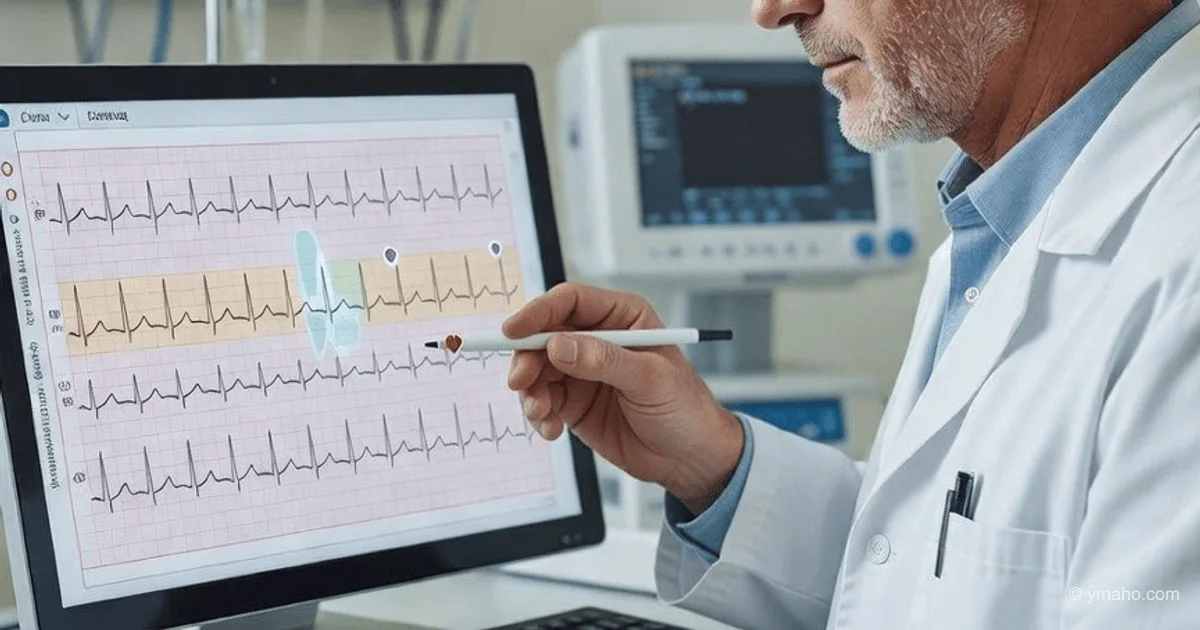
AccurKardia has received a patent for a machine learning system that detects cardiac amyloidosis from a standard ECG, turning a routine test into a screening tool. The technology is especially important because 13-15% of heart failure patients may have undiagnosed amyloidosis, and early detection directly impacts survival.
Diagnosing Ahead of the Disease: Why the AccurKardia Patent Changes Heart Failure Screening Rules
[The Core]: What Is Actually Happening
On June 1, 2026, the USPTO granted AccurKardia patent No. 12,620,488 for a machine learning system to detect cardiac amyloidosis from a standard 12-lead ECG. It sounds like just another routine AI diagnostics announcement. But in reality, this is the moment when a routine test performed millions of times a day becomes a screening tool for a disease cardiologists call the "invisible killer."
Cardiac amyloidosis is an infiltrative cardiomyopathy in which abnormal proteins (amyloid) deposit in the myocardium, making the heart stiff and unable to contract normally. The problem is that symptoms—shortness of breath, fatigue, leg swelling—are indistinguishable from ordinary heart failure. While doctors treat "typical" HF with standard medications (beta-blockers, ACE inhibitors), amyloid continues to destroy the heart. Patients receive the correct diagnosis only when the disease is already advanced—and the therapeutic window is lost.
But what is really happening? The AccurKardia patent is not just "another AI algorithm." It is recognition that the standard ECG, currently interpreted either by an automatic analyzer (with questionable accuracy) or an overloaded cardiologist, contains hidden signals the human eye cannot see. And the company has apparently found a way to extract those signals.
Timeline and Context
The problem of undiagnosed cardiac amyloidosis has only recently begun to be fully recognized. A 2026 systematic review and meta-analysis covering 28 studies and 7,393 heart failure patients showed a startling figure: the prevalence of amyloidosis among HF patients is about 10% (95% CI, 7%-13%). At the same time, wild-type transthyretin amyloidosis (ATTRwt-CA) accounts for 76% of all cases. About 24% of cases occur in women, challenging the old belief that the disease is "male-only." Regional variation is also telling: from 6% in North America to 15% in Asia. That means one in ten heart failure patients has undiagnosed amyloidosis.
Why has this disease stayed off the radar for so long? Because the gold standard for diagnosis is either endomyocardial biopsy (invasive, risky, labor-intensive) or technetium-99m-DPD scintigraphy (expensive, requires specialized equipment and radiopharmaceuticals). As a result, diagnosis occurs only at late stages, when the heart is already irreversibly damaged.
The situation began to change with the arrival of disease-modifying therapy. Transthyretin stabilizers such as tafamidis (Vyndamax) and RNA-interfering drugs (patisiran) can slow or even halt disease progression—but only if started early enough. The amyloidosis therapy market was already valued at $5.73 billion in 2025 and is growing at 9% CAGR, reaching $6.24 billion in 2026. Yet all this money is spent on patients whose disease has already been identified—and it has been identified in only a minority.
Now AccurKardia proposes to flip the model. Instead of waiting for symptoms to develop and the patient to reach a specialist (who may or may not suspect amyloidosis), they offer screening at the routine ECG stage. The cost is not thousands of dollars for additional scanning, but the price of adding the algorithm to existing ECG analysis.
Winners and Losers
Loser #1: Clinics that profit from late diagnosis. Cynical as it sounds, the modern healthcare system is structured so that complex, expensive diagnostic procedures (scintigraphy, cardiac MRI, biopsy) generate revenue. The later the diagnosis, the more tests are needed to confirm it, and the more complex and costly the treatment. ECG screening shifts detection to earlier stages, when confirmatory diagnostics may be less extensive. This means lost revenue for those who live off the "diagnostic pie."
Loser #2: Manufacturers of expensive imaging equipment. If millions of ECGs per year begin to rule out the vast majority of patients as "negative" for amyloidosis, referrals for scintigraphy and MRI will decline. Manufacturers of scanners—GE Healthcare, Siemens Healthineers, Canon—will lose part of the market. Estimated damage? In the US alone, 80-100 million ECGs are performed annually. Even if 1% of them test positive by the algorithm, that is one million referrals for confirmatory testing instead of perhaps 3-4 million under the current system, when doctors order scans only on clear suspicion.
Winner #1: AccurKardia. This New York-based company has operated in relative obscurity. Founded in 2019, it raised $500k in pre-seed in 2021 and $2.7 million in seed in June 2023. Investors include Popular Impact Fund. It already has two FDA Breakthrough Device designations: AK-AVS for aortic stenosis and AK+ Guard for hyperkalemia, plus the FDA-cleared AccurECG 2.0 automatic ECG interpretation platform (510(k) K252361). The amyloidosis detection patent is the third ace up its sleeve. It covers all major subtypes: AL amyloidosis, wild-type ATTR, and hereditary ATTR.
Winner #2: Patients with undiagnosed amyloidosis. They represent an estimated 10% to 15% of all heart failure patients in clinics. That is hundreds of thousands of people in the US alone and millions worldwide. For them, early diagnosis is the difference between living with a manageable chronic condition and dying from progressive heart failure within 2-4 years. Standard HF medications (beta-blockers, ACE inhibitors) can be not only ineffective but dangerous in amyloidosis—they lower blood pressure and may worsen the condition. Early detection avoids this therapeutic trap and allows timely initiation of tafamidis or newer agents.
Quiet winner: Pharmaceutical companies producing amyloidosis therapies. Pfizer (Vyndamax/Vyndaqel), Alnylam (Onpattro/Amvuttra), Ionis (Tegsedi)—for them the main market limiter has always been not drug price but low patient identification rates. ECG screening that can be deployed in any clinic will dramatically expand the pool of diagnosed patients ready for therapy. The specific amyloidosis therapy market is estimated at roughly $1.1 billion in 2026 with a forecast to reach $2.3 billion by 2033 (CAGR 11.2%). With successful screening, these figures could prove 2-3 times too low.
What the Media Is Not Saying
The first insight, and it is critical to understanding the real value of the patent: AccurKardia does not use a "black box" deep learning model that outputs a probability without explanation. It builds its technology on explainable, feature-based machine learning using annotated ECG parameters. This is a fundamental difference from many AI diagnostics that cannot explain the basis for their diagnosis. For regulators—FDA, EMA—this is a major plus. For clinicians too, because they can verify the algorithm's logic. And for competitors, it is a problem, because the patent describes not a specific neural network architecture (which could be circumvented) but a feature-extraction methodology that can be protected far more broadly.
Second insight. Look at the numbers from the Willem AI study published in Heart Rhythm in April 2026. This is independent work (not AccurKardia) that used a convolutional neural network on 20,754 ECGs from 2,901 individuals, of whom 585 had ATTR cardiomyopathy. Results: AUC 0.88, sensitivity 80.7%, specificity 78.5%. What does this mean? This is the reference level AccurKardia must aim for. 80% sensitivity means the algorithm will miss 20% of amyloidosis cases. For screening this is acceptable—better than 0% under the current system. But it is not ideal. In addition, the Willem algorithm had 68.4% sensitivity in asymptomatic patients—meaning early forms are harder to catch. AccurKardia's task is the same, but the patent points to a different technical approach. Whether it will be better remains unknown—its algorithm has not yet undergone validation on an independent cohort, has not appeared in peer-reviewed literature, and still carries "for research use only" status.
Third insight—how AccurKardia plans to scale. It already has the FDA-cleared AccurECG 2.0 platform designed for automatic interpretation of ECGs from any source—Holters, patches, standard ECG machines. It does not manufacture hardware; it creates cloud software that can be integrated into existing workflows. This is a smart approach. No hospital will buy a new ECG machine just for amyloidosis screening. But if the algorithm can be "added" to an already installed system for free or a small subscription fee—that is an entirely different story. Its business model appears to be built on licensing software to ECG system manufacturers (Philips, GE, Nihon Kohden, Bionet, CardioComm) or remote cardiac monitoring platforms.
Fourth insight—money and time to market. AccurKardia is a small company with 11-50 employees and total capital raised of about $3.2 million. That is enough for R&D and initial piloting. But to complete a full FDA De Novo or 510(k) process for clinical use (not just research use, as now), tens of millions of dollars are needed for multicenter clinical studies. The patent is an asset that increases company value. I expect AccurKardia will either close a Series A in the next 6-12 months for $15-25 million or be acquired by a major player (Philips? GE? AliveCor?) for $50-100 million. The latter scenario seems more likely—a large corporation needs a differentiating algorithm for its ECG systems, and it is cheaper to buy a startup with a patent than to develop one from scratch and risk IP infringement.
Forecast: Next 30 Days and 90 Days
Next 30 days (June 2026): Wave of interest from cardiology societies and venture funds.
The patent news has already spread through industry media. In the coming weeks AccurKardia will receive dozens of inquiries from cardiology clinics wanting to test the algorithm in pilot mode. The company is in the fourth cohort of Mayo Clinic Platform_Accelerate—I expect Mayo Clinic to become the first site for a validation study. Results of this study (if encouraging) will form the basis for an FDA Breakthrough Device Designation application for its amyloidosis algorithm (it already has two such designations—for hyperkalemia and aortic stenosis). Within 30 days it may announce the start of this study.
Next 90 days (August-September 2026): Series A kickoff and battle over regulatory pathway.
The cardiac software market for automatic ECG interpretation is estimated at about $1.5 billion and growing 12-15% annually. AccurKardia is one of many players (AliveCor, Cardiologs, iRhythm, Preventice Solutions), but it stands out by focusing on "hidden biomarkers"—amyloidosis, hyperkalemia, aortic stenosis—conditions standard ECG analysis does not detect. This is its niche, and it is unique. I expect that within 90 days the company will announce closure of a Series A for $15-20 million—with participation from a strategic investor among ECG equipment manufacturers or a major pharmaceutical company interested in expanding amyloidosis diagnostics (Pfizer is the most obvious candidate).
At the same time, the FDA will issue clarification on which regulatory pathway suits this type of algorithm. If it determines that amyloidosis detection is a "new class" of diagnostics (ECG-based screening for a rare but serious disease), it may require De Novo classification—a 12-18 month process. If it agrees this is simply a "new parameter" within the existing class of ECG analyzers, AccurKardia can use 510(k) via substantial equivalence—shortening the timeline to 6-9 months. I bet on the second option, given that it already has 510(k) clearance for AccurECG 2.0.
And finally, something the optimists are silent about. Even the most accurate algorithm will not solve the systemic screening problem if implemented incorrectly. Who will pay for the analysis? US insurers (CMS) must decide whether to include the service "AI screening for amyloidosis on ECG" in the tariff system. This could take years. Without insurance coverage, hospitals will not pay for the algorithm, even if it is free to install—because they would then be performing an additional "analysis" that no one will reimburse. This is the classic "valley of death" problem for diagnostic AI startups. The way through it is proof that the algorithm reduces overall system costs (fewer hospitalizations, fewer unnecessary expensive imaging studies). I expect AccurKardia will begin collecting these economic data in the next 90 days—so that by the end of 2026 it can present them to CMS together with an application for national coverage (National Coverage Determination). It is this application, not the patent itself, that will determine whether the technology becomes a real screening tool or remains a beautiful research project.
— Editorial Team