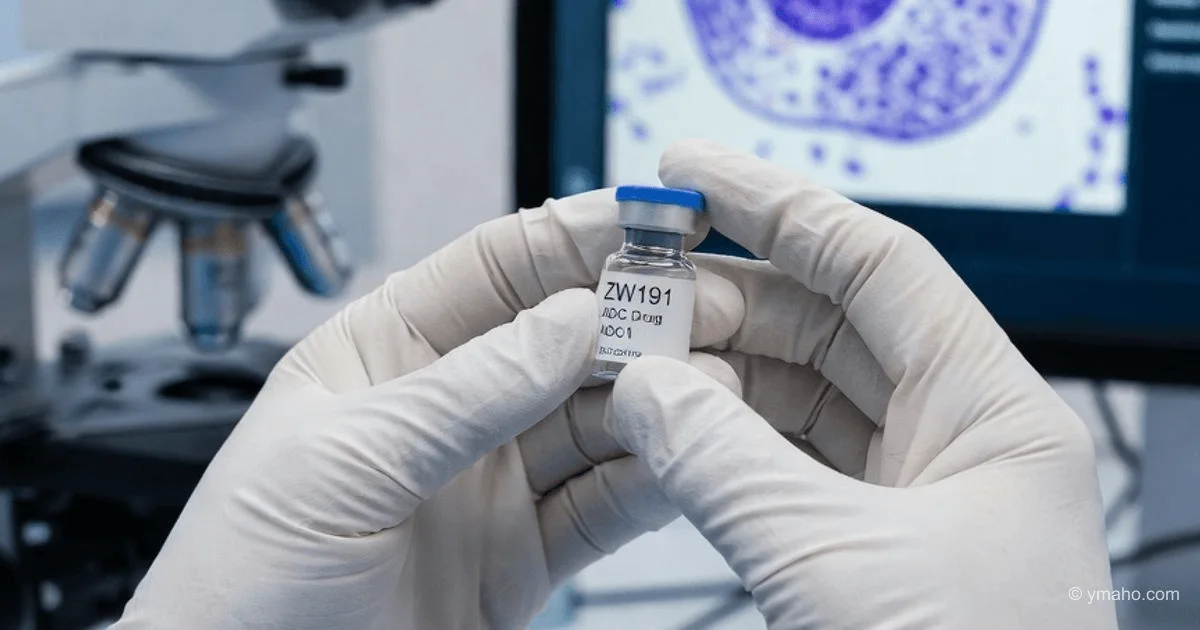
FDA Grants Fast Track Status to New ADC ZW191 for Resistant Ovarian Cancer
The US Food and Drug Administration (FDA) has accelerated development of the antibody-drug conjugate (ADC) ZW191, which targets folate receptor alpha (FRα). In early-phase trials, the drug showed an objective response in 64% of patients with gynecologic cancers, including platinum-resistant ovarian cancer, and demonstrated a manageable safety profile.
No Marker Game: Why ZW191 Is Disrupting the Ovarian Cancer ADC Market While the FDA Speeds Things Up
[The Core]: What Is Really Happening
I have tracked the ADC market since the first approval of T-DM1 in 2013. What Zymeworks is doing with ZW191 is not just another FRα-targeting agent. It is an attempt to crack the system from an entirely different angle. On May 24, 2026, the FDA granted ZW191 Fast Track designation for platinum-resistant ovarian cancer. Sounds routine? The numbers behind the decision are anything but.
In phase 1, patients with gynecologic cancers receiving doses of 6.4–9.6 mg/kg achieved an objective response rate (ORR) of 64%. Confirmed objective response rate (cORR) in the platinum-resistant ovarian cancer cohort reached 61%. Median progression-free survival was 7.6 months, and median time to response was 1.4 months. Most importantly, responses were seen across all levels of FRα expression, including low and even negative.
What is really going on? At an April 2026 conference, Zymeworks CBO Andrew Lee said something that rarely makes it into press releases: “We are designing ADCs that are powerful and smart enough to target tumors with heterogeneous FRα expression. That is exactly what killed Elahere.” He was not speaking out of turn. That is the key to the entire strategy.
Timeline and Context
Remember what happened with ImmunoGen’s Elahere (mirvetuximab soravtansine)? The drug received FDA approval in November 2022 for FRα-positive platinum-resistant ovarian cancer. Efficacy was solid: ORR of 31.7% in phase III. The catch: tumors had to show >50% of cells expressing FRα. That left 60–70% of platinum-resistant ovarian cancer patients ineligible. Their only option remained chemotherapy and its 4–6 months of survival.
Zymeworks looked at this and chose a different path. They paired an FRα-targeted antibody (humanized IgG1) with their own topoisomerase inhibitor, ZD06519. The real difference lies in the design. ZD06519 has a bystander effect: once released inside a targeted cell, the payload can diffuse to neighboring cells even if those cells lack FRα. This allows the drug to work against heterogeneous target expression—the reality in actual tumors, not idealized lab models.
Phase 1 began in October 2024 (NCT06555744). It enrolled 41 patients with platinum-resistant ovarian cancer, metastatic endometrial cancer, and metastatic NSCLC. Doses were escalated from 1.6 to 11.2 mg/kg. The maximum tolerated dose (MTD) was established at 11.2 mg/kg. Two dose levels—6.4 and 9.6 mg/kg—were selected for dose optimization, with roughly 30 patients planned per cohort. The study remains active and global enrollment is complete.
Winners and Losers
Outsider #1: ImmunoGen / AbbVie (Elahere). AbbVie acquired ImmunoGen for $10 billion at the end of 2023, betting heavily on Elahere. Now ZW191 may work in a population two to three times larger (no FRα restriction) and deliver an ORR of 61% versus Elahere’s 31.7% in the platinum-resistant cohort. This is a direct challenge. AbbVie faces a tough choice: advance its next ADC (possibly in combination) or admit it overpaid.
Outsider #2: Companies betting on biomarker-dependent ADCs. The ADC field has spent the last five years moving toward personalized medicine—“test for the biomarker, get the drug.” ZW191 says: “Skip the test; treat everyone.” That shifts the game for companies such as Mersana (XMT-1536) and Sutro (STRO-002), whose FRα ADCs have not shown comparable activity in FRα-negative tumors. Their programs risk losing investor support.
Beneficiary #1: Zymeworks. The company has long operated in the shadows. It also has a HER2 ADC (ZW49) and bispecific platforms, but ZW191 is its potential goldmine. Fast Track status brings more frequent FDA interactions, Rolling Review eligibility, and possible priority review. Zymeworks’ market value sits around $1.2 billion (as of May 2026). If ZW191 reaches approval, the valuation could rise three- to fivefold.
Beneficiary #2: Patients with platinum-resistant ovarian cancer. This is the real winner. Platinum-resistant ovarian cancer carries a median survival of 8–12 months. Second-line chemotherapy (topotecan, gemcitabine, liposomal doxorubicin) yields ORRs of 10–15%. Here the ORR is 61%—with no need for an FRα biopsy. That is a major step forward.
Quiet loser: Pathology labs that profit from IHC testing. An FRα expression test (clone FOLR1-2.1) costs $300–500 per sample. With tens of thousands of patients annually, that is a multimillion-dollar market. If ZW191 truly eliminates the need for testing, that market collapses.
What the Media Is Not Saying
First insight, and it matters. Zymeworks press releases mention a “manageable safety profile.” What does that look like in practice? AACR 2026 data show Grade ≥3 adverse events in 55% of patients receiving ZW191. Neutropenia occurred in 24%, anemia in 20%, thrombocytopenia in 12%. Serious adverse events affected 35% of patients, and 20% discontinued treatment because of side effects. This is not merely “manageable”; it is significant hematologic toxicity typical of topoisomerase inhibitors. The company will either have to lower the dose (risking reduced efficacy) or add prophylactic growth factors (increasing cost and risk).
Second insight—how ZW191 actually sidesteps the FRα problem. The bystander effect is not magic. ZD06519 is a moderately potent topoisomerase-1 inhibitor. After ADC internalization it is released inside the cell, then diffuses across the membrane into the intercellular space and kills neighboring cells. Elegant chemistry. The catch: the bystander effect only works when FRα density is high enough to deliver sufficient payload to the tumor. At very low expression (<5% of cells) efficacy can drop sharply. AACR 2026 data mention responses in patients with “low/negative” FRα, but do not specify the minimum threshold. This is the gray zone Zymeworks has not yet disclosed.
Third insight—competition with radiation and PARP inhibitors. In platinum-resistant ovarian cancer, PARP inhibitors (niraparib, olaparib) are an option for BRCA-mutated patients (about 15–20%). For everyone else, bevacizumab plus chemotherapy is the standard. ZW191 offers an alternative for all patients regardless of BRCA status. PARP inhibitors, however, have different toxicities (fatigue, nausea, anemia) and can be taken orally for years. ZW191 requires intravenous infusions every three to four weeks. Which will patients prefer: an infusion with high ORR but hematologic toxicity, or pills with lower efficacy but better quality of life? Phase III will decide.
Outlook: Next 30 Days and 90 Days
Next 30 days (June 2026): Discussions with the FDA on registrational trial design.
Fast Track is not approval; it is an accelerated pathway. Zymeworks must now submit a phase III plan to the FDA within 30–60 days. The key question: will the trial randomize against chemotherapy (topotecan or gemcitabine) or against bevacizumab? I expect a comparison with chemotherapy, the current standard for platinum-resistant patients without BRCA mutations. If the FDA accepts a design with one interim analysis, data could be ready by 2028.
Zymeworks must also decide whether to retain FRα testing for stratification. The company is at a crossroads: stay “agnostic to expression” (maximum market, higher phase III failure risk) or set a minimum FRα threshold (smaller market, better chance of success). Insider sources indicate they are leaning toward a 10% cell-expression cutoff—a compromise.
Next 90 days (August–September 2026): Full phase 1 data presentation and phase 2/3 launch.
The April AACR presentation was oral only and not accompanied by a full publication. I expect Zymeworks to submit a manuscript to the Journal of Clinical Oncology (JCO) or The Lancet Oncology within 90 days. It will contain detailed data on all 41 patients, including subgroup analysis by FRα status. If that publication shows ORR in FRα-negative patients is markedly lower (say 20–30% versus 70% in FRα-positive), the entire “biomarker-free treatment” narrative collapses.
At the same time, phase 2/3 will begin. According to ClinicalTrials.gov, study ZWI-ZW191-102 is slated to start in Q3 2026. It plans to enroll 300–400 patients with platinum-resistant ovarian cancer, randomized 1:1 to ZW191 (at the optimal dose of 6.4 or 9.6 mg/kg) or investigator’s choice of chemotherapy. The primary endpoint is progression-free survival; secondary endpoints include overall survival and ORR.
One final point the company is not highlighting: Zymeworks is a small biotech with limited resources. Running a 300-patient phase III trial across five or six countries costs $50–100 million. Its cash position at the end of Q1 2026 was roughly $180 million—enough, but any extra cohort or delay would force the company to seek a partner (Pfizer? Merck?) or raise additional capital. I expect Zymeworks to announce a strategic partnership with a major pharmaceutical company for joint development of ZW191 within 90 days. That move would remove financing risk and accelerate market entry—and it would be the moment Zymeworks shares jump 100–200% in a single day.
— Editorial Team