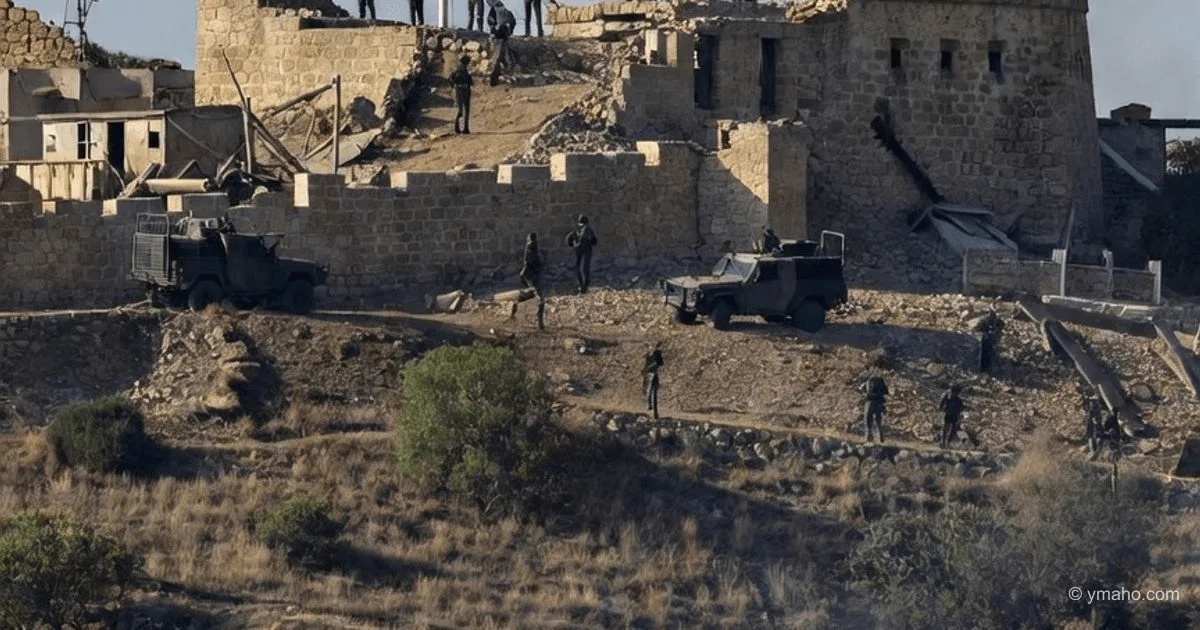
Israel Expands Ground Operations in Lebanon, Seizing Beaufort Fortress
Despite a formal ceasefire, Israeli forces have occupied a strategic fortress in southern Lebanon, marking the deepest incursion in 26 years. Hezbollah continues rocket attacks on northern Israel.
Analytical article: Citadel of Blood — Why Capturing Beaufort Shifts Energy Markets More Than Any Diplomacy
[The Core]: What Is Really Happening
You see the headlines: Israel has seized Beaufort Fortress in southern Lebanon, raising its flag over a citadel it last held a quarter-century ago. The official line is strategic necessity, protecting northern borders, and dismantling Hezbollah infrastructure. Benjamin Netanyahu called it a “dramatic turning point” in the campaign against the group. It sounds like a military briefing. But after 14 years in trading rooms, I can tell you: this is not just a battlefield win. It is a market signal that traders have not yet fully decoded.
The key point is this: the capture of Beaufort occurred despite the formal ceasefire in place since April 17. Moreover, it happened just days before a new round of direct talks between Lebanon and Israel in the USA. Israel struck at the very moment the diplomatic window was about to open. This is no coordination error. It is a deliberate message: for Israel, a military solution on the Lebanese front takes priority over diplomacy. That signal carries immediate consequences for global energy markets.
Why? Because escalation on the Lebanese front is not an isolated conflict. Hezbollah is an Iranian proxy. Every new blow to Hezbollah reduces the chance that Iran will agree to extend its ceasefire with the USA, let alone reopen the Strait of Hormuz. Iran has already stated that “Hezbollah must be included in any broad agreement.” While Israel bombs Lebanon, talks with Iran are dead. While talks are dead, the Strait of Hormuz stays closed. While the strait is closed, oil sits at $93–97 per barrel. The chain is direct, and the market is beginning to price it in.
There is also a subtler, less obvious mechanism. Capturing Beaufort is a psychological threshold. It is Israel’s deepest penetration into Lebanon since 2000. When the Israeli flag flies over a fortress built by Crusaders 900 years ago, it signals that Israel does not intend to stop at a buffer zone. It is prepared to go further. That means the conflict will be prolonged. A prolonged conflict keeps a $10–15 risk premium embedded in oil prices. The market has not yet fully priced this in.
Timeline and Context
Let us reconstruct how we reached this point and why the capture of Beaufort represents escalation rather than another local skirmish.
The conflict on the Lebanon-Israel border began on March 2, 2026, when Hezbollah fired rockets into northern Israel two days after the USA and Israel struck Iran. Fighting has continued without pause since then. On April 17, a ceasefire was announced under USA mediation. Yet all sides later acknowledged that the truce was only formal. Shelling continued. Israeli airstrikes did not stop. By the end of May, the death toll in Lebanon exceeded 3,400.
May 30, 2026, is the pivotal date. Israeli troops crossed the Litani River, which had served as an unspoken boundary, and seized Beaufort Fortress. The capture followed several days of intense fighting in neighboring villages where Israeli forces clashed with Hezbollah fighters. Israeli Defense Minister Israel Katz stated: “Forty-four years after the heroic battle for Beaufort, our troops have returned to the summit and raised the Israeli flag once more.”
On May 31, French Foreign Minister Jean-Noël Barrot requested an emergency UN Security Council meeting, declaring that “nothing can justify the continuation of Israeli military operations in Lebanon.” Military talks between Israel and Lebanon held at the Pentagon produced no results.
June 1–2, 2026, brought the response. Hezbollah announced 21 attacks in 24 hours against Israeli military targets. Israeli air defenses intercepted rockets fired from Lebanon toward Upper Galilee. A suspicious aerial object was shot down. Another Israeli soldier was killed—the 25th since early March.
Markets reacted immediately. On Monday, June 1, oil prices rose more than 2 percent: Brent climbed to $93.05 and WTI to $89.53. IG analyst Tony Sicamore warned that mines in the Strait of Hormuz could delay reopening even after any agreement.
Winners and Losers
Winners:
First and foremost—global oil companies, especially American and British majors (Exxon, Chevron, Shell, BP). Every escalation in the Middle East adds $3–5 of geopolitical premium per barrel. At current global consumption of roughly 100 million barrels per day, that transfers an extra $300–500 million daily from consumers to producers. Exxon and Chevron shares rose 2–3 percent on Monday on the Lebanon news.
Second—defense contractors. Lockheed Martin, Northrop Grumman, and RTX (formerly Raytheon) all benefit from any drawn-out conflict that requires replenishing munitions and replacing equipment. As Wedbush Securities notes, “geopolitical volatility reshapes market sentiment and boosts defense, energy sectors.” Lockheed Martin’s backlog is approaching record levels.
Third—investors holding long positions in oil futures and call options. Implied volatility on oil options has risen but remains below the March–April peaks. Those who went long after the late-May price drop are now in profit.
Losers:
First—European industrial companies and consumers. High oil prices hit Europeans already suffering from the energy crisis. Airlines (Air France-KLM, Lufthansa, Ryanair) are losing money on jet fuel. Chemical firms (BASF, Covestro) lose competitiveness.
Second—the Eastern Mediterranean tourism sector. Cyprus, Greece, Turkey, and Egypt all depend on visitors who now fear traveling to a region with active fighting. Hotels in Cyprus report a 15–20 percent rise in cancellations over the past week.
Third—investors in unhedged technology stocks. During geopolitical flare-ups, capital flows from “risky” tech names into “defensive” energy and defense sectors. The Nasdaq typically lags the Dow Jones and S&P 500 in such periods. Tech giants such as Apple and Tesla, with complex global supply chains, are especially vulnerable.
What the Media Are Not Saying
First—and this is the key insight missing from Reuters and BBC coverage—the capture of Beaufort is not only a military operation but a political one aimed at the domestic Israeli audience. Netanyahu, whose popularity has slipped in recent months amid economic woes and the ongoing conflict, is using battlefield successes to shore up his position. Seizing the fortress Israel held from 1982 to 2000 is an appeal to collective memory. “We have returned to Beaufort as different people. We have returned united, resolute, stronger than ever,” Netanyahu said. This is the language of political mobilization, not military dispatches.
Second: the USA is quietly supporting the escalation despite public calls for restraint. France requested an emergency UN Security Council session. Germany expressed “serious concern.” Yet the USA, Israel’s chief ally, has not condemned the capture of Beaufort. Moreover, the Jerusalem Post reported that Israel asked Washington for permission to strike Beirut—and expects a “favorable response.” This indicates the USA has little interest in a quick end to the fighting. High oil prices weaken competitors (Europe and China) and strengthen the USA’s position as a net energy exporter.
Third: Hezbollah shows no sign of backing down, and the market underestimates this. The group continues attacks on Israeli forces in southern Lebanon. On June 1, Hezbollah claimed 21 operations in 24 hours. On June 2, it said it had struck an Israeli Merkava tank and three Humvees near Al-Hamra. These are not random barrages. They are coordinated military actions. Hezbollah is demonstrating that it retains resources and will to fight on. The conflict will be long, regardless of who holds which fortress.
Outlook: Next 30 Days and 90 Days
30-Day Horizon (through early July 2026)
Oil will remain volatile with an upward bias. Brent is expected to trade in the $92–102 range, with a high probability of testing $100 within the next two weeks. Key triggers: developments on the Lebanese front (if Israel advances toward Nabatieh or Beirut) and any Iranian statements ending talks with the USA.
On specific assets, defense contractors should continue to rise. Lockheed Martin (LMT) and Northrop Grumman (NOC) could add another 3–5 percent in the next 30 days if escalation persists. Energy ETFs such as XLE (Energy Select Sector SPDR Fund) should also stay in accumulation.
European equity indices, especially the German DAX and French CAC 40, will face pressure. Rising energy costs hurt industry, and geopolitical uncertainty reduces risk appetite. I expect the DAX to fall 2–3 percent from current levels by the end of June.
90-Day Horizon (through early September 2026)
Three scenarios are possible.
Base case (55 percent probability): fighting in Lebanon continues in the current pattern—Israel expands its control zone in the south, Hezbollah responds with rockets. The Strait of Hormuz stays closed. Brent settles above $100 and reaches $105–110 by late summer. Europe enters recession; the euro falls to 1.02–1.03 against the dollar.
Escalation case (30 percent probability): Israel strikes Beirut and eliminates Hezbollah leaders. Iran enters the conflict directly through proxies in Syria and Iraq. The Strait of Hormuz is mined further. Brent spikes to $120–130. This triggers a global recession and a 10–15 percent drop in world equity markets.
De-escalation case (15 percent probability): under USA and UN pressure, Israel agrees to a ceasefire and withdraws from the Litani area. Hezbollah halts rocket fire. Talks with Iran resume. Oil falls to $80–85. Europe gets relief. I view this scenario as unlikely given Netanyahu’s political incentives to keep fighting.
Editorial Forecast
Based on current data, we expect Brent (BZ) prices to continue rising over the next 24–72 hours amid ongoing escalation in Lebanon and lack of progress in talks with Iran. The target range is $94.50–$97.00, with potential to test $98 on any fresh reports of Israeli advances. Confidence: moderate. Main risk: an unexpected USA diplomatic intervention demanding an immediate ceasefire, which could temporarily trim prices by $2–$3. Such intervention remains unlikely given Washington’s quiet support for Israel.
(Editorial opinion is not individual investment advice)
— Editorial Team