# Nature Communications: vgll3 Gene Discovered, Revealing the 'Price of Youth' Mechanism in Aging and Cancer
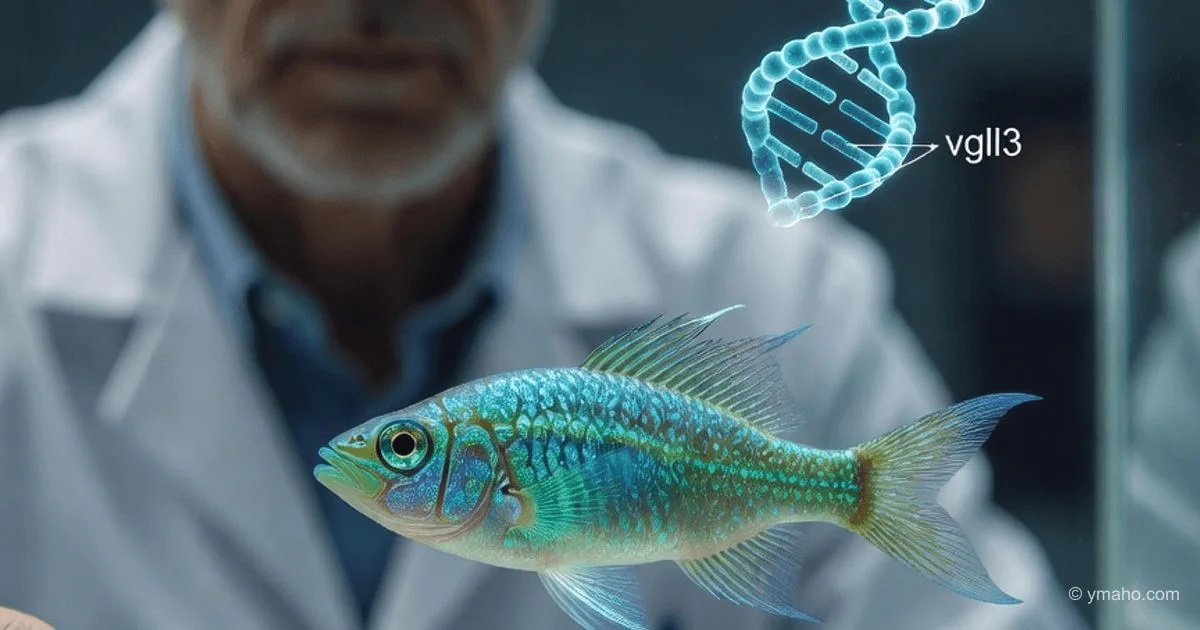
An international team of scientists working with killifish identified the vgll3 gene, which speeds up early growth and sexual maturity while simultaneously shortening lifespan and raising cancer risk. The findings, published in Nature Communications, offer experimental proof for the antagonistic pleiotropy theory and open new avenues for separating developmental processes from aging in humans.
Evolutionary Trade-off: Why the vgll3 Discovery Flips Aging Research on Its Head
[The Core]: What’s Really Happening
Headlines about vgll3 often read “early-growth gene accelerates aging and cancer.” It sounds like another routine evolutionary biology finding. But here’s what’s actually going on. Itamar Harel’s research group at the Hebrew University of Jerusalem has done something that fundamentally changes the rules in the longevity field. They delivered the first experimental proof of antagonistic pleiotropy in a vertebrate—an idea that had remained a compelling hypothesis for sixty years.
What the news leaves out. Harel’s team used the African turquoise killifish (Nothobranchius furzeri), a species that lives only four to six months yet ages much like humans. Using CRISPR, they toggled vgll3 on and off and observed a striking outcome: fish with active vgll3 grew faster and matured earlier, yet their lives were shorter and melanoma-like tumors appeared in their tissues. The same gene gives an organism a competitive edge in youth and kills it later in life.
There’s a deeper point most analysts miss. Vgll3 is not an “aging gene” in the usual sense of telomerase or sirtuins. It is a transcriptional cofactor that interacts with the Hippo signaling pathway, a master regulator of organ size and cancer development. In plain terms, vgll3 acts like an accelerator for cell division. In youth it drives growth; in old age it pushes already-mutated cells into uncontrolled division, forming tumors.
Timeline and Context
George Williams proposed the antagonistic pleiotropy theory back in 1957. The core idea: genes beneficial during reproductive years can become harmful afterward. Richard Dawkins sharpened the point in The Selfish Gene—we are essentially vehicles for gene replication, and genes have no stake in our longevity.
The sticking point was that for more than sixty years no one had pinned down a specific vertebrate gene and shown the direct causal chain: “this gene confers an early advantage, and the same individuals later die of cancer faster.” Work existed in fruit flies and nematodes, but nothing in vertebrates.
Then, between 2021 and 2022, Harel’s lab—one of the first to adopt killifish as an aging model—published a series of studies linking vgll3 to sexual maturation in salmon and humans. In 2023, clinical work connected high VGLL3 expression to poorer outcomes in serous ovarian adenocarcinoma; researchers at Yonsei University showed that VGLL3-positive patients lived significantly shorter lives and carried more tumor-associated macrophages.
On 2 June 2026, Nature Communications published the paper by Moses, Bergman, Harel et al. titled “An Antagonistically Pleiotropic Gene Regulates Vertebrate Growth, Maturity, and Lifespan.” Using CRISPR, they knocked out vgll3 in killifish and found longer-lived animals with fewer cancers—yet slower growth and delayed maturity. The trade-off had been demonstrated.
Winners and Losers
The clearest beneficiary is the entire longevity-research field. Until now, investors viewed anti-aging companies with skepticism: “You claim you can slow aging, but you lack biomarkers, proxy endpoints, and mechanistic clarity.” Now there is an experimentally validated target in a vertebrate, and that target is conserved in humans.
Companies positioned to benefit include Calico (Alphabet), Altos Labs, and Unity Biotechnology. These funds have already poured billions into senolytics and aging modulators. Harel’s discovery supplies them with a concrete molecular mechanism: vgll3 links cell proliferation, DNA repair, and immune aging.
Who loses? Any business built on denying evolutionary constraints—especially firms selling “youth elixirs” based on telomerase activation. If vgll3 represents the cost of rapid growth, interventions that accelerate cell division early in life may exact a cancer toll later. Harel’s work shows melanoma-like tumors in fish with active vgll3.
A quieter loser is the oncology-surgery and early-detection sector. If we learn to switch vgll3 off or block its pathway, we could reduce age-related cancers and the billions currently spent on chemotherapy, targeted therapies, and surgery. Pharmaceutical giants profiting from oncology are unlikely to celebrate.
What the Media Isn’t Saying
First insight, and it’s not obvious. Vgll3 is not only about cancer and aging; it also shapes sex differences in autoimmune disease. Work from 2020 showed VGLL3 as a key regulator of female immunity, with overexpression tied to lupus-like conditions and skin fibrosis. Women suffer autoimmune diseases three to four times more often than men, possibly because vgll3 is expressed more highly under estrogen control.
Therapeutic implications follow. Suppressing vgll3 to extend life could trigger immune dysfunction in women, raising infection rates or autoimmune flares. Harel told GlobeNewswire, “Nature does not prioritize longevity; it prioritizes reproduction.” Yet the deeper issue remains: separating early and late effects of vgll3 may be impossible because it is the same protein acting in the same cells. We cannot simply instruct vgll3 to “work in youth, turn off in old age.”
Second insight: the killifish model is brilliant yet limiting. Killifish live four to six months; humans live eighty years. Evolutionary pressure on vgll3 differs sharply. In killifish inhabiting temporary African pools, selection for rapid maturation is extreme—the pool may dry up in three months. The price of “early growth versus cancer” may therefore be very different in humans, whose reproductive window spans thirty to forty years. Simple extrapolation to human gerontology is risky.
Third insight: money and patents. The study was funded by the European Research Council and the Israel Science Foundation—no corporate grants. Big Pharma has stayed away. Patent space around vgll3 is already partly occupied for ovarian-cancer diagnostics; Yonsei University filed applications in 2023 to use VGLL3 as a prognostic marker. Therapeutic blockade of vgll3 remains untouched—too risky. Suppressing a gene involved in DNA repair and cell division could cause tissue aplasia, impaired wound healing, or neurodegeneration instead of cancer. Investors are still circling at a distance.
Outlook: Next 30 Days and 90 Days
Next 30 days (June 2026): Wave of replication studies.
Immediately after the Nature Communications paper, labs working with zebrafish (Danio rerio) and mice will rush to test Harel’s result. Zebrafish also carry vgll3. Within a month I expect at least three to four bioRxiv preprints attempting replication in other models. If two or more groups confirm the trade-off, a race will begin.
Additional activity: the Yonsei University group, already linked to ovarian-cancer findings, will rapidly reanalyze its biobanks to test whether vgll3 polymorphisms correlate with human lifespan. They have the data—The Cancer Genome Atlas contains both cancerous and healthy tissues with clinical outcomes. A link between specific vgll3 SNPs and longevity (or early cancer death) would be another nail in the coffin for skeptics.
Next 90 days (August–September 2026): Shift in aging-research direction.
First, Altos Labs or Calico will likely announce a mouse model with tissue-specific vgll3 knockout (for example, only in epithelium or only in hematopoietic stem cells). This sidesteps the “early growth versus late aging” problem by disabling the gene in adulthood rather than from birth.
Second, the European Medicines Agency may open discussions on whether long-term safety of any proliferation-modulating drugs (including certain senolytics) should be reassessed through an evolutionary trade-off lens. Existing approvals are unlikely to be withdrawn, but new anti-aging trials will probably require extended oncology surveillance protocols—five to seven years instead of the usual two to three.
Third, the most intriguing scenario is an attempt to create a vgll3 inhibitor. This will be a nightmare for medicinal chemists: vgll3 lacks enzymatic activity and works through protein–protein interactions with TEAD transcription factors. Blocking such interfaces with small molecules is extremely difficult. Success would command prices on the order of $500,000 per course, comparable to Zolgensma. Yet the potential payoff—a 20–30 % reduction in cancer incidence among people over seventy—would justify the investment.
Finally, Harel’s team has already stated that the next step is to try separating vgll3’s early and late effects. Success would deliver not merely an anti-aging drug but a new medical principle: evolutionary editing. We would stop fighting the downstream consequences of natural selection and begin rewriting rules laid down over millions of years. It sounds like science fiction—exactly how CRISPR sounded ten years ago.
— Editorial Team