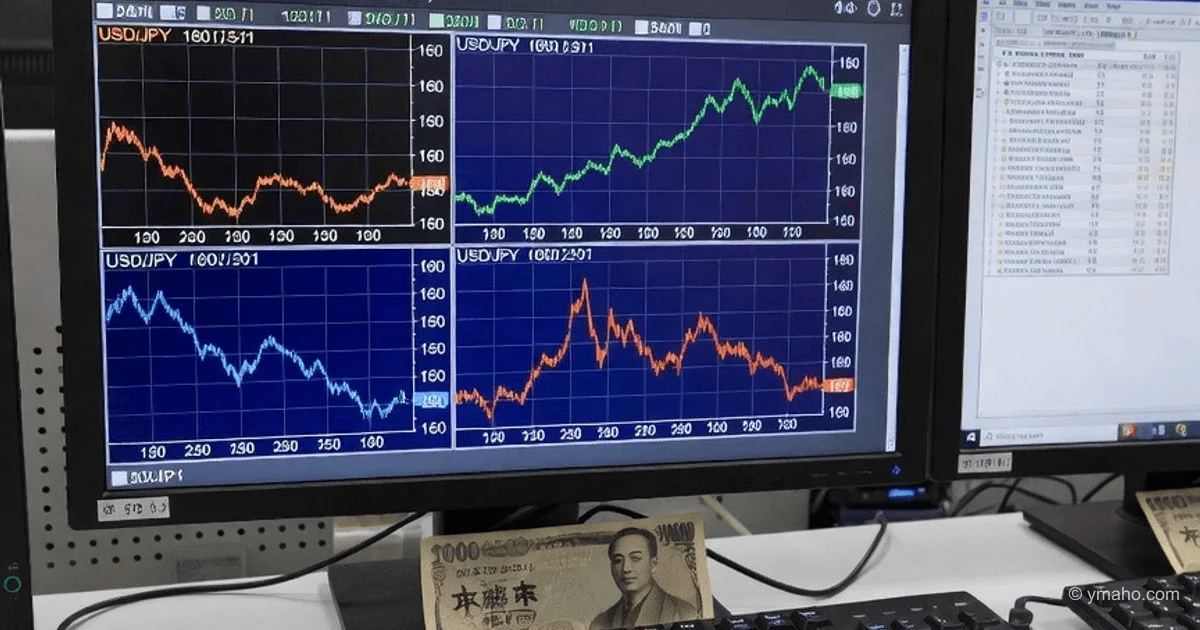
Japanese Yen Continues Weakening, Approaching the 160 Mark
Despite record interventions (around $74 billion), the yen keeps depreciating amid diverging monetary policies between the Bank of Japan and the Fed. USD/JPY is again trading near the psychological 160 level.
Analytical article: The Titanic That Ignores the Iceberg — Why ¥74 Billion in Interventions Failed to Save the Yen, and What Really Lies Behind the Weakness
[The Core]: What Is Actually Happening
You see the headlines: the yen continues weakening toward 160 despite record interventions of roughly $74 billion in April–May. USD/JPY is again trading near the psychological 160 level. The official line blames “diverging monetary policies” and a “strong dollar.” That is true, but only a small part of the story. I have traded currency derivatives for 12 years, and I can tell you the interventions are not working because the market long ago stopped believing Japan’s narrative.
The real issue is that the yen is falling even as Japanese rates rise — a paradox that breaks every classic currency-pricing model. Normally, when a central bank hikes rates, its currency strengthens. With the yen the opposite is happening: the 10-year yield on Japanese government bonds has climbed from 0.1 % in 2023 to 2.3 % today, yet the yen has weakened another 15 %. This is no typo. It signals that the market doubts Japan can normalize policy without wrecking its own debt market.
The key insight almost never discussed in mainstream media is this: yen-funded carry trades now represent a ticking bomb worth between $1 trillion and $4 trillion. Investors worldwide borrow yen at near-zero cost and invest in higher-yielding assets (U.S. Treasuries, equities, credit). As long as the yen weakens, the trade prints money. But if the yen starts strengthening — whether because the Bank of Japan hikes aggressively or global risk appetite evaporates — the trade reverses violently. Billions of dollars will be sold to unwind positions, triggering a sharp yen rally, a sell-off in U.S. Treasuries, and a global equity correction. This is the scenario the Bank for International Settlements already flagged as a “systemic risk” in 2024, and it has only become more likely.
Timeline and Context
Let’s walk through the timeline so you can see how Japan has spent billions with zero lasting result.
28 April 2026 — first strike. When USD/JPY broke 160, Japan’s Ministry of Finance and the Bank of Japan launched currency intervention — selling dollars and buying yen. It was the largest intervention in Japan’s history by volume. Between 28 April and 27 May 2026 the authorities spent 11.7 trillion yen (roughly $73.68 billion) defending the currency. An absolute record. The previous record, set in 2022, was about $65 billion for the entire year.
What happened after the intervention? USD/JPY dropped from 160 to 152 within days. Traders holding short yen positions took losses. It looked like victory. Yet within weeks the pair was back at 159, and by 3 June 2026 it was again trading near 160. The market fully reversed the intervention’s effect. Implied volatility on options has risen, and the options market now prices in a 52 % chance that the yen will fall back to 160 by the end of June.
Why did the intervention fail? The fundamentals never changed. The gap between the Fed’s policy rate (3.50–3.75 %) and the Bank of Japan’s rate (0.75 %) is still 300 basis points. That spread makes the carry trade extremely profitable. As long as it persists, anyone who sells yen on dips (i.e., buys dollars after an intervention) will make money — and traders are doing exactly that. In the first week of June alone, short yen positions climbed back to pre-intervention levels.
The next key date is 10–11 June, when the Bank of Japan holds its next policy meeting. Markets price a 60–70 % chance of a rate hike from 0.75 % to 1.00 %. Even that move is unlikely to stop the yen’s slide, because the gap with Fed rates will remain huge. Moreover, any hike raises the cost of servicing Japan’s colossal public debt (debt-to-GDP above 250 %), creating fresh risks.
Winners and Losers
Winners:
First — U.S. investors and corporations that hedged yen exposure in advance. If you are a U.S. company with yen revenues (Toyota or Sony selling cars in the United States, for example), a weak yen means fewer dollars on conversion. But if you bought options or forwards to sell yen ahead of time, you locked in the rate and protected profits. Those who did not hedge are losing.
Second — speculators holding short yen positions. Every time USD/JPY pulls back to 160 they sell yen (buy dollars); when the pair drops to 157–158 on intervention or intervention threats, they close with a profit. It is the perfect swing-trade range. The Japanese government has effectively given traders a “free option”: they know intervention will arrive at 160 and give them a better exit.
Third — Japanese exporters, especially large firms such as Toyota, Honda, Sony and Nintendo. A weak yen makes their goods cheaper for foreign buyers, boosting volumes and yen-denominated profits. Toyota shares are up 15 % year-to-date on the back of yen weakness. For the broader Japanese economy the weak yen is a double-edged sword, but for exporters it is pure gain.
Losers:
First — Japanese households and small businesses reliant on imports. Japan imports nearly 90 % of its energy. Crude oil trades in dollars. At 160 yen per dollar, each barrel costs 30–40 % more in yen terms than at 120. Petrol, heating and food prices (all energy-intensive) have surged. Real household incomes have fallen for four straight quarters. Consumer spending is shrinking, hitting the domestic economy.
Second — Japan’s budget and taxpayers. The $74 billion interventions are not free money. Japan sold foreign reserves, mostly U.S. Treasuries. Selling Treasuries either locks in losses or forgoes future interest income. Ultimately Japanese taxpayers foot the bill. That same $74 billion could have built schools, hospitals or cut taxes.
Third — holders of Japanese government bonds, including pension funds and insurers. When the Bank of Japan raises rates (and it will be forced to), prices of existing lower-yielding bonds fall. Pension funds required to hold large JGB allocations suffer losses. This puts millions of Japanese pensions at risk. If confidence in Japanese debt cracks, a panic comparable to Europe’s 2011 debt crisis could follow.
What the Media Are Not Saying
Here we enter territory even the Financial Times and Nikkei avoid.
First, and this is the central insight: Japan cannot win this fight because it is fighting itself. Interventions mean selling dollars and buying yen. Where does Japan get the dollars? By selling U.S. Treasuries. When Japan sells Treasuries, Treasury yields rise (demand falls). Higher U.S. yields widen the rate gap with Japan, making the yen even less attractive. Japan, trying to strengthen the yen, creates the conditions for further weakening. It is a vicious circle with no exit.
Second: the United States will not help Japan, despite Treasury Secretary Scott Bessent’s visit. Analysts expect Bessent, who is visiting Japan this week, to withhold approval for joint intervention. Why? A strong dollar helps the U.S. fight inflation (imports become cheaper), and a weak yen is Japan’s problem, not America’s. Behind the scenes the Trump administration is quietly encouraging Japanese interventions because they reduce demand for U.S. debt — which, paradoxically, could help lower Treasury yields if the Fed starts buying bonds. It is a complex geopolitical game, and Japan is the junior partner.
Third, and most dangerous: the yen carry trade can unwind at any moment, and when it does the consequences will be catastrophic. The Bank for International Settlements estimates yen-funded positions in the global financial system total between $1 trillion and $4 trillion. Most are not hedge funds but institutional investors — pension funds, insurers, banks — using derivatives that allow extreme leverage. A sudden 5–10 % yen rally would trigger automatic position closures via margin calls. That would set off a chain reaction: asset sales (equities, bonds, other currencies), falling prices, new margin calls, more selling. It would be 2008, but in the currency-and-debt dimension.
Outlook: Next 30 Days and 90 Days
30-Day Horizon (through early July 2026)
USD/JPY is likely to keep trading in the 155–162 range. The key level remains 160. A sustained break above 160 would open the door to 162–163. The probability of fresh intervention at 160 is very high — I put it at 70–80 %. Yet any intervention will again deliver only a temporary effect. I expect USD/JPY to fall to 155–157 after intervention, then climb back toward 160 within two to four weeks.
The Bank of Japan’s 10–11 June meeting is the pivotal event. A hike to 1.00 % (60–70 % probability) could give the yen short-term support, pushing it to 155–156. That strength would likely be sold, because the market knows one 25-basis-point move does not alter the fundamental picture. If rates stay unchanged (30–40 % probability), the yen could drop to 162–163 within days, triggering intervention.
90-Day Horizon (through early September 2026)
Three scenarios are possible.
Base case (55 % probability): USD/JPY consolidates between 152 and 165. The Bank of Japan raises rates to 1.00–1.25 % by summer’s end, but the Fed holds at 3.50–3.75 %. The spread stays wide, the yen keeps weakening, albeit more slowly. Japan conducts one or two more interventions of $30–50 billion each, but each successive round has less impact. The market grows accustomed to a “new normal” of 155–160.
Bearish for the yen (30 % probability): escalation in the Middle East pushes oil above $110. Japan, a net energy importer, suffers twice: the trade deficit widens and the yen weakens further. USD/JPY could reach 168–170. Interventions become even less effective as fundamentals (high import prices, rising deficits) overwhelm one-off support. This is a nightmare for Tokyo, yet it is growing more plausible.
Bullish for the yen (15 % probability): sudden ceasefire in the Middle East, oil falls to $70. The Fed signals rate cuts late in 2026. The rate gap narrows. Carry trades begin to unwind. USD/JPY could drop to 140–145 within two to three months. This would be ideal for Japan, but it remains unlikely given current conflict dynamics and Fed positioning.
Editorial Forecast
Based on current data we expect continued pressure on the yen over the next 24–72 hours. USD/JPY will probably test 160.00, where verbal intervention from Japanese authorities is highly likely. Technical indicators (RSI ~61, MACD in positive territory) point to ongoing upward momentum. Confidence: medium. Main risk: an unexpected Bank of Japan rate hike on 10–11 June (60–70 % probability) that could be telegraphed via leaks and trigger premature yen strength to 156–157 this week.
(Editorial opinion is not individual investment advice)
— Editorial Team