Nature Sensors: USC Chip for Edge Computing in Medicine Mimics Brain Synaptic Plasticity
A detailed publication in Nature Sensors describes the creation of a self-learning analog chip that implements an unsupervised learning mechanism, amplifying recurring signals and filtering out noise. The device can process physiological data (pulse, pressure) without digital conversion, which is revolutionary for wearable devices and remote health monitoring in field conditions.
Synaptic Plasticity Without Programs or Batteries: Why the USC Analog Chip Is an Architectural Manifesto, Not Just a Gadget
[The Core]: What Is Actually Happening
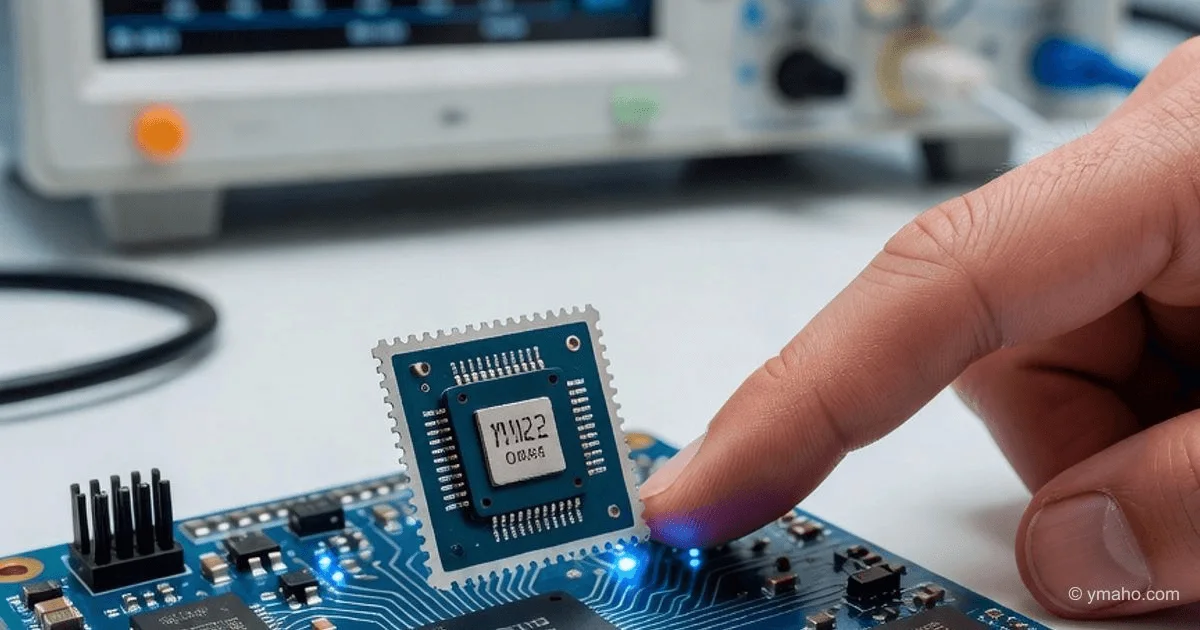
On June 2, 2026, the cover of the new issue of Nature Sensors featured an image that should unsettle every chip engineer in Silicon Valley. The team led by J. Joshua Yang from the University of Southern California did not merely “improve energy efficiency”—they built a system that breaks seven decades of digital dogma. Their coin-sized device senses, encodes, learns, and remembers, powered solely by the energy of the signals it processes: light, pressure, temperature.
What is actually happening, however, is hidden behind the term “self-learning.” This is not “AI on a chip” in the sense marketing departments have accustomed us to. It is the first hardware implementation of unsupervised learning on memristors that requires no lines of code, no analog-to-digital converters, and no battery. Postdoc Seung Ju Kim, the paper’s first author, puts it radically: “Memory is not updated by a software learning algorithm. Instead, it emerges from the temporal relationships between physical signals.”
The foundation consists of two types of memristors. The diffusive type (silver ions in silicon dioxide) acts like a neuron: the stronger the stimulus—brighter light or greater pressure—the faster it generates a spike. The drift type (hafnium oxide with tantalum-platinum electrodes) acts like a synapse: it accumulates weight changes on repeated coincidences and stores them indefinitely. By combining them with resistors and capacitors on a printed circuit board, the researchers created a circuit that performs what previously required a digital processor, memory, and constant power—using only the physics of ions.
Yang, an IEEE Fellow and director of the CONCRETE center funded by the US Air Force and Army, concludes: “The signal is not only a signal to be processed. It is also the source of energy that powers the system.”
Timeline and Context
The idea of “memristor computing” is already about 15 years old. The first laboratory samples appeared in the late 2000s, but all suffered from one flaw: they required external programming. You apply specially shaped pulses from an external microcontroller to the memristor—and it changes resistance. This is still a digital approach, just with a different type of memory. The work of Yang and Kim is fundamentally different: their memristors learn on their own from the temporal relationships between signals.
A key technological milestone often overlooked is the Yang lab’s work on high-temperature memristors, published in Nature in March 2026. They demonstrated devices operating at temperatures above 700 °C. Now they have combined that materials platform with the concept of self-powering. The chip can therefore not only operate without a battery but also function in environments that destroy ordinary electronics—inside reactors, on the surface of Venus, in wildfire zones.
In a simulation that served as proof-of-concept, the researchers deployed a network of such sensors in a wooded area of California to detect lightning—the main cause of fires. Lightning produces light (instantly) and sound (~340 m/s). The time gap between them encodes distance to the strike. The system stored this gap directly in the circuit—without GPS, without cellular networks, without a server. When both signals coincided in time accounting for the delay, the device “remembered” the pattern and strengthened it. Repeated coincident signals are amplified; unrelated ones gradually fade.
This is a direct hardware implementation of STDP (spike-timing-dependent plasticity)—the mechanism considered the basis of learning in the biological brain. No “model training on the ImageNet dataset.” Only physics.
Winners and Losers
Total Loser #1: ARM and the entire edge-processor ecosystem. Companies such as ARM, Qualcomm, and MediaTek built empires on the premise that every sensor must send its signal to a processor and the processor must execute an instruction. The USC chip executes no instructions. It has no registers, no program counter, no data bus. It has only the diffusive dynamics of silver ions—and that is all. When such devices reach volume production, the market for ultra-low-power microcontrollers for IoT could shrink by 60–70 %. Global data centers already consume 1–2 % of worldwide electricity in 2026, and that share doubles every four years. The USC chip offers an alternative: “intelligence without infrastructure” that does not send raw data to the cloud.
Loser #2: NVIDIA and the market for edge AI accelerators. Yes, NVIDIA profits from the data centers needed to train large models. But its Jetson platform for edge inference is still a digital monster. Jetson Orin consumes 15–25 watts. The USC chip consumes zero watts—it draws energy from the signal itself. Of course, its computational power cannot be compared with Jetson. Yet for 95 % of edge tasks (lightning detection, gait classification, real-time cardiac arrhythmia recognition) that power is unnecessary. What is needed is speed, energy independence, and low cost.
Beneficiary #1: Medical implants. Yang names smart glasses as the main consumer application. As an analyst, however, I look at implants. Existing neurostimulators for chronic pain still require an external unit and a battery that must be replaced every 3–5 years via surgery. The USC chip can be powered by biomechanical pressure from footsteps or body heat. An implant that learns and adapts without a battery or recharging is the holy grail of neuromodulation.
Beneficiary #2: US Department of Defense. It is no coincidence that funding flows through the US Air Force and Army via the CONCRETE Center. A sensor that can be dropped by drone behind enemy lines and listen, process, and remember for years without emitting a radio signal is intelligence gold. The California lightning scenario is merely a cover story. The real targets are seismic sensors for detecting underground nuclear tests and acoustic sensors for identifying military vehicles.
What the Media Are Not Saying
The first insight, and one that is not obvious even to many engineers: the USC device is not a “computer.” It is a classifier. It can distinguish lightning from fireworks by the time delay between light and sound. It can distinguish gait “A” from gait “B” by the pressure pattern on a piezoelectric element. But it cannot learn the multiplication table. It has no feedback, no conditional branches, no arbitrary computation. It is a specialized neural network “hard-wired” into the physics of the memristors. This is a fundamental limitation that no one will overcome in the foreseeable future, because analog computation is by definition not universal. So the current hype around “AI without a battery” is marketing. Real general-purpose AI requires digital logic. The analog circuit solves a narrow but critically important class of tasks.
The second insight concerns reproducibility and technological readiness. Memristors are devilishly temperamental devices. Their switching threshold drifts from cycle to cycle, they degrade over time due to oxygen-vacancy migration, and they are critically sensitive to temperature and humidity. A study published on arXiv in May 2026 assessed existing memristor systems for dynamic vision at technology readiness levels (TRL) 2–5—that is, from “technology concept” to “validation in a relevant environment.” Reaching TRL 7–8 (“system demonstrated in an operational environment” and “completed”) will take years. How long will the USC device operate in the field at –20 °C to +50 °C and 10 % to 95 % humidity? The Nature Sensors paper is silent on this. The CONCRETE Center is military-funded, and I am almost certain these tests are already under way, but the data will not appear publicly until a commercial version exists.
The third insight concerns competition with organic neuromorphic systems. In the same issue of Nature Sensors that carried the USC work, there is a paper by Zhong and colleagues on soft organic electrochemical neurons that operate at biological speeds. Organics can be implanted directly into the brain because they are soft and do not provoke inflammation. USC memristors are rigid; they suit peripheral sensors but not neural interfaces. The market will split. Which approach wins in the long run remains unclear.
The fourth insight explains why this appeared now and not five years ago. In April 2026, Nano-Micro Letters published a forward-looking article systematizing the concept of “in-sensor-memory computing” (ISMC) as a post-von-Neumann paradigm. The authors state explicitly that global efforts to create such an architecture are only beginning to coalesce. The USC device is not an isolated miracle but the first working example of what theorists wrote about in 2025–2026. The fact that Nature Sensors put this work on the cover signals that the journal’s editors see it not merely as a laboratory curiosity but as a paradigmatic shift.
Forecast: Next 30 Days and 90 Days
Next 30 days (June 2026): wave of patent filings and foundry negotiations.
USC Viterbi, as a research university, will certainly file patents on the “self-powered neuromorphic system with diffusive and drift memristors” architecture. I expect at least three to four patent applications with priority from the publication date (June 2, 2026). Moreover, Professor Yang already has a commercialization track record—more than 120 US patents are assigned to him. He is the founder of several startups. Now wearable-electronics manufacturers will join them. Garmin, Apple, and Oura Ring will all urgently request samples to evaluate the possibility of a fitness tracker that never needs charging.
At the same time, foundry negotiations will begin. The device is assembled on a printed circuit board from discrete memristors, resistors, and capacitors. To turn this into a commercial product, integration is required—the memristors must be embedded in a silicon chip atop standard CMOS logic (or instead of it). The forward-looking Nano-Micro Letters article states explicitly that moving ISMC into scalable commercialization requires global “industry–academia–research” collaboration. I expect USC to announce a partnership with TSMC, Intel Foundry Services, or a specialized memristor manufacturer such as Weebit Nano within 30 days.
Next 90 days (August–September 2026): publication of stability data and first engineering prototypes.
The key question that will determine the technology’s future is the long-term stability of diffusive memristors. Silver ions tend to agglomerate and migrate out of the active layer over time. I expect the USC team to publish additional data (possibly in Nature Electronics or Advanced Materials) within 90 days on device cycling over millions of switches and state retention at elevated temperatures (as is done for commercial RRAM). If the data show less than 10 % degradation after 10^6 cycles and 10 years of storage at 85 °C, that will be a green light for commercialization.
At the same time, design of a specialized integrated circuit (ASIC) with memristor blocks will begin. The first engineering samples could appear by the end of 2026 or early 2027. Their size will not be “coin-sized” but “microchip-sized”—less than 10 mm². They will consume nano- or even pico-joules per operation.
Finally, something the enthusiasts are not saying. Yang’s phrase that should give pause: “Energy is the key problem for the data center. Learn from the most efficient computer in the world—our brain.” It sounds elegant. But the brain runs on 20 watts and has 86 billion neurons. The USC chip has two memristors (one diffusive, one drift). Yes, the principle is scalable. Yet between “principle” and “a supercomputer consuming microwatts” lies a gulf that cannot be crossed in three years. Investors who now rush to buy shares in memristor startups may be sorely disappointed in the short term. The engineering problems of reliability, reproducibility, and scaling have not yet been solved. But the fact that the first step has been taken—and taken brilliantly—cannot be denied. For the first time in 70 years we have a working alternative to the von Neumann architecture for a narrow but critically important class of real-time tasks. And it does not require a battery.
— Editorial Team