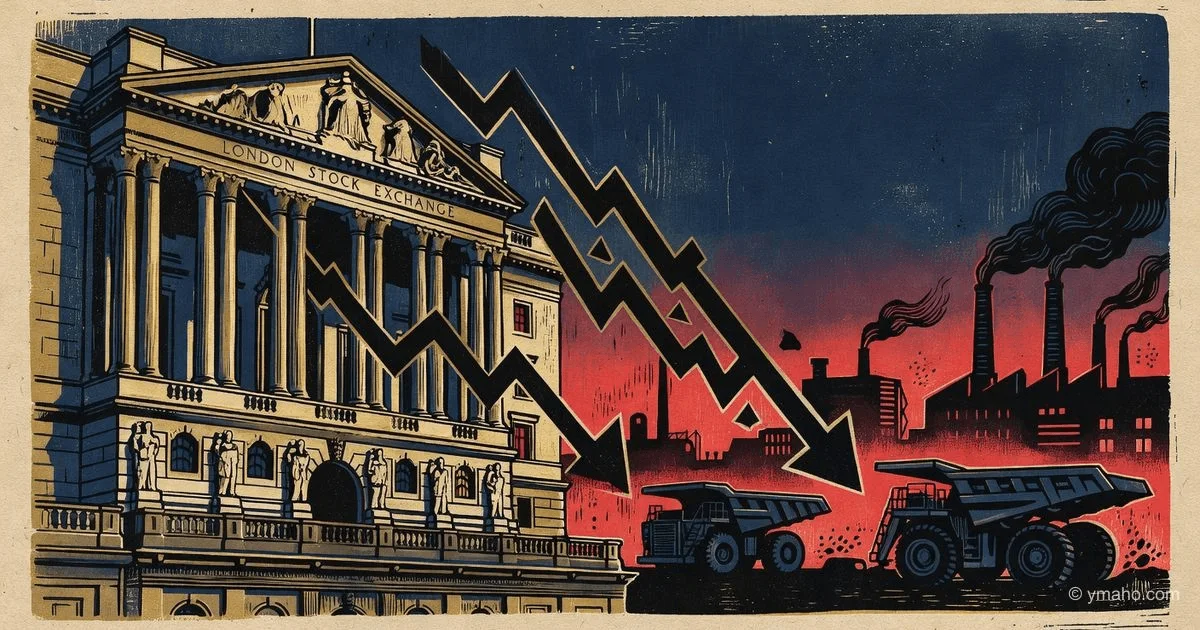
Commodity Sector Drags Down London Stock Exchange Indices
FTSE 100 falls as mining stocks decline. Investors lock in profits in the commodity sector amid signals of slowing demand from China and weak industrial data.
FTSE 100 Decline: Why the Mining Sector Crashed and the Market Missed the Big Picture
Analytical article — 1650 words
[The Core]: What Is Really Happening
London's FTSE 100 is showing a notable decline, and the formal reason is well-known: falling mining stocks amid signals of slowing demand from China. But behind this obvious story lies a much more complex and troubling picture.
The real insight is that the Chinese PMI, which everyone cites as the driver of the sell-off, actually shows not just a slowdown but a structural disconnect between production and demand. According to data published by China's National Bureau of Statistics on May 31, 2026, the manufacturing PMI stood at exactly 50.0% in May, down 0.3 percentage points from April.
But the key detail that is being overlooked: the new orders index (新订单指数) fell to 49.9% — indicating shrinking demand, while the production index remains at 51.2%. That is, factories are still running, but orders for their products are declining. This is a classic signal of excess inventory accumulation — what analytical reports call "passive inventory accumulation."
And here lies the most important thing that news headlines are silent about. The decline in mining stocks on the FTSE 100 is driven not so much by today's demand slowdown as by the realization that the Chinese government will no longer rescue the commodity sector with stimulus.
Why? Because the focus of Chinese policy has shifted. Note: high-tech manufacturing (高技术制造业) and equipment manufacturing (装备制造业) continue to grow — their PMIs stand at 52.9% and 52.1% respectively, higher than the May reading. The computer, electrical, and communications industries show strong activity. Beijing no longer intends to pump the construction sector and heavy industry with cheap credit as it did in past decades. China's new economy requires less iron ore, copper, and coking coal. And global mining companies listed on the LSE are only beginning to grasp the scale of this structural shift.
[Timeline and Context]
To understand the depth of the current decline, we need to look at the dynamics of Chinese PMIs and the reaction of commodity markets over recent weeks.
May 31, 2026: China's National Bureau of Statistics publishes May PMI data. The figures come in worse than expected: the consensus forecast was 50.2 points, the actual value 50.0 points. The new export orders index (新出口订单指数) fell by 1.7 percentage points, indicating weakening external demand.
June 3–4, 2026: The FTSE 100 opens lower, and mining stocks become the main driver of the decline. Against this backdrop, there is also a general deterioration in global risk appetite: the Middle East conflict (exchange of strikes between the US and Iran) continues to weigh on sentiment, the S&P 500 closed down 0.74%, the NASDAQ fell 0.89%, and Hong Kong's Hang Seng lost 1.39% during trading on June 4.
But there is a nuance that the market seems to ignore. The decline in the industrial metals sector occurs against the backdrop of commodity prices remaining historically high. The raw material purchase price index in Chinese statistics (主要原材料购进价格指数) stood at 60.5% in May — still a zone of very strong growth, albeit down from the April peak.
Why is this important? Because investors in mining companies are not looking at current copper or iron ore prices, but at demand dynamics. And the May data from China showed a worrying trend: the finished goods inventory index (产成品库存指数) rose by 1.8 percentage points to 49.3%. Orders are falling, warehouses are filling up. Producers are not yet cutting output, but if demand does not recover in June, production cuts will become inevitable — a direct blow to commodity demand.
Historical context is also important. The FTSE 100 briefly exceeded the 10,000-point mark in January 2026, seen as a historic achievement. At that time, the growth driver was precisely the commodity supercycle — high prices for oil, gold, copper. Now the index is trading significantly below those levels, and the current decline is not just a correction but possibly the beginning of a longer phase of reassessment of the commodity sector.
[Who Wins and Who Loses]
Winners:
Stocks of companies not tied to the commodity sector, especially in aviation and tourism. As noted in analysis after the January FTSE 100 decline, International Consolidated Airlines Group (IAG) could benefit from lower fuel prices if oil continues to fall. The more commodity giants fall, the more attractive these "defensive" sectors appear.
Chinese high-tech manufacturers. For them, lower commodity prices mean lower production costs. China's computer and electrical equipment industries, whose PMI stands at 52.9% and continues to grow, will get a double bonus: strong export demand and cheaper materials.
Funds shorting the mining sector. Since the release of weak Chinese PMI data in late May, these positions have been yielding significant profits. Given that the S&P/ASX 300 Metals & Mining Index has already fallen 3.27%, short positions on Rio Tinto, Glencore, and Anglo American look particularly attractive.
Losers:
Mining companies listed on the LSE. These are the obvious losers. Anglo American and Glencore lost 1.9% and 1.3% respectively in recent trading. Rio Tinto, despite high copper prices due to the Oyu Tolgoi project, is also under pressure from general sector pessimism. These companies depend on Chinese demand more than anyone else.
Suppliers of mining equipment. If mining companies start cutting capital expenditure in anticipation of lower demand, manufacturers of excavators, crushers, and transport systems will be the first hit. This effect will be delayed (6-9 months), but it is inevitable.
Economies dependent on commodity exports (Australia, Chile, Peru, South Africa). Falling commodity prices and reduced export volumes to China will directly hit their trade balances and national currency exchange rates. The South African index has already shown negative dynamics, and this is just the beginning.
[What the Media Are Not Saying]
The first and most important omission concerns the oil factor. Everyone talks about the mining sector but almost ignores energy. Meanwhile, as noted in analytical materials, the US administration's decision to allow Venezuelan oil market access led to Brent falling to nearly $60 per barrel in January 2026. This has exerted and continues to exert enormous pressure on BP and Shell shares.
Why is this being ignored? Because the oil shock from Venezuela overshadowed a more fundamental problem: Chinese demand for commodities is declining not due to cyclical factors but due to a structural transformation of the economy.
The second omission concerns China's domestic politics. Media write about an "economic slowdown" but do not clarify that this slowdown is a conscious policy of Beijing. China no longer wants to be the "world's factory" consuming ever more iron ore and coal. The country is moving toward high-tech manufacturing, services, and domestic consumption. As noted in official comments on the statistics, high-tech manufacturing has been expanding for 16 consecutive months. Each percentage point of GDP growth in this new model requires significantly less raw material than before.
And finally, the third omission: almost no one talks about the risks for copper producers. Yes, copper remains in deficit due to limited supply, and prices hold up. But the Chinese PMI shows a slowdown in electronics and electrical equipment production — which are precisely the main consumers of copper. Analysts point out that the "computers, communications, and electronics" segments remain strong, but growth rates are slowing. If the slowdown continues, copper prices could follow iron ore and coal.
[Forecast: Next 30 Days and 90 Days]
Next 30 days (until early July 2026):
I expect continued pressure on the FTSE 100 mining sector, especially companies with a high share of iron ore in revenue. The key date is the release of China's June industrial production data (expected in mid-July). If these data confirm a slowdown, we could see a new wave of declines.
However, it is not all one-sided. In June, the dividend season begins for many British companies, including mining giants. This could provide temporary support for stocks as investors buy shares to capture dividends. But after the ex-dividend dates, pressure will likely return.
Technical level to watch: the FTSE 100 index around 10,300–10,400 points — this is the zone where support is likely to be found. If this level is broken, the next target is 10,200.
Next 90 days (until early September 2026):
Here, the key factor will be not China but Fed and ECB policy. If interest rates remain high (and the current consensus suggests this), global economic growth will slow, hitting commodity demand. Mining companies could face a double blow: falling commodity prices and a strengthening dollar (in which commodity prices are denominated).
On the other hand, if de-escalation begins in the Middle East and the Chinese government announces new economic stimulus, the mining sector could recover. But I assess the probability of this scenario as low (20-25%), given the structural reorientation of the Chinese economy.
My base case forecast: the FTSE 100 will end the third quarter in the range of 10,200–10,500 points, implying a continuation of current levels with a potential further decline of 2-3% from current values. The mining sector will continue to underperform the market, while defensive sectors (utilities, consumer staples) will show relative strength.
Key upside risk: an unexpected announcement by China of a large infrastructure package to stimulate the economy. Although this contradicts Beijing's current policy line, in the event of a sharp slowdown in GDP growth (below 4.5%), such measures could be adopted. Watch for statements from China's State Council in July-August.
Editorial Forecast
Asset: FTSE 100 mining stocks (Rio Tinto, Glencore, Anglo American). Direction: Continued downward movement over the next 48-72 hours amid persistent pressure from weak Chinese PMI data and profit-taking after the recent rise.
Key levels: Rio Tinto (LSE: RIO) — current price around 4,850 pence, nearest support at 4,800 pence, resistance at 4,950 pence. Glencore (LSE: GLEN) — support at 420 pence, resistance at 440 pence. FTSE 100 index — support at 10,300 points.
Confidence level: Medium (60%). China data is already priced in, but there is a risk of further negative reaction at upcoming bond auctions and new statistical releases.
Main risk to the forecast: An unexpected announcement by the Chinese government of new economic stimulus measures, especially in the infrastructure sector, which could trigger a sharp reversal in mining stocks. Watch for the release of China's May new loan data (expected June 10-12) — if the figures come in above forecasts, it could catalyze a 3-5% one-day recovery in the sector.
This forecast is an analytical opinion of the editorial board and does not constitute an investment recommendation. All decisions to buy or sell assets are made at your own risk.
— Editorial Team