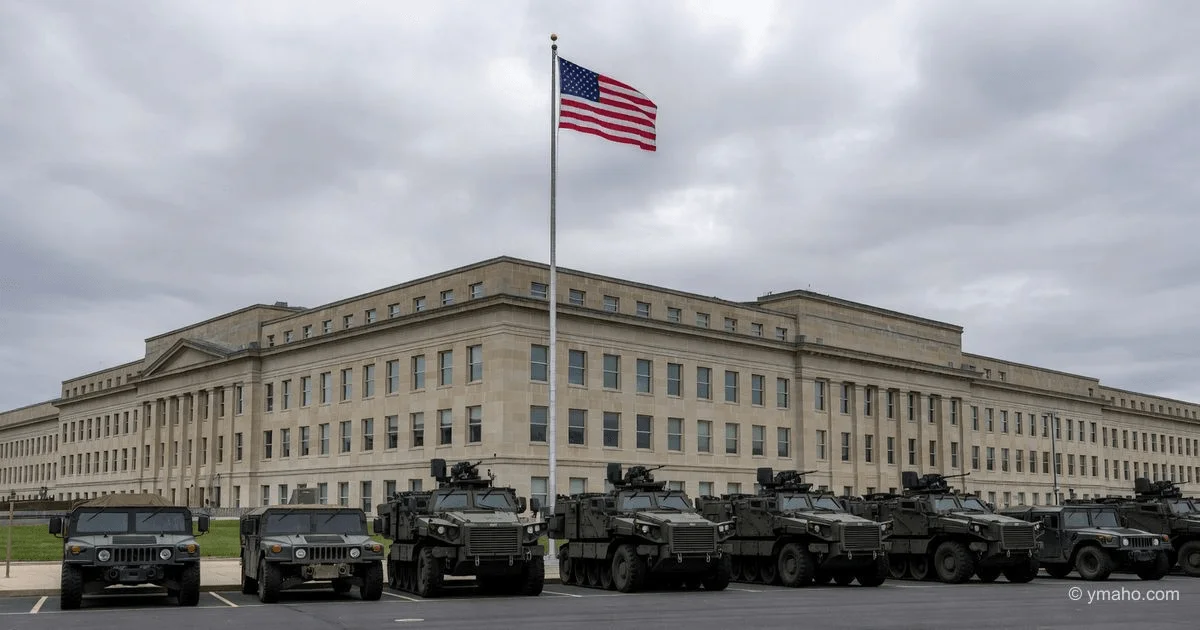
US Department of Defense Announces Reduction of Army Brigades in Europe
The Pentagon will reduce the number of combat brigades in Europe from four to three, returning to pre-2022 levels, which experts say undermines deterrence of Russian aggression amid the war in Ukraine.
Headline: Pentagon Cuts Brigades in Europe: Analysis of Financial Consequences the Media Ignores
Author: Independent Financial Analyst (ex-hedge fund manager, specializing in geopolitical risks and the defense sector)
When the US Department of Defense announces a reduction in the number of army brigades in Europe, a superficial view sees only a geopolitical gesture toward Russia or another round of transatlantic friction. Traders on the edge in London and New York see something else: a flow of money. Huge amounts of money.
The decision to return the contingent from four brigades to three, i.e., to the pre-2022 level, is not a "weakening of deterrence" in a vacuum. It is a formal trigger for restarting Europe's defense industry and, simultaneously, a hidden signal to the US defense sector about a change in the funding model. If you think this news is only about soldiers, you are mistaken. It's about $750 million, a "flexible" reallocation of air defense assets, and the inevitable IPO of a European defense giant that will drain liquidity from the market. Let's break it down.
[The Essence]: What Is Really Happening
In reality, the Pentagon is not "weakening" positions but optimizing presence under a new doctrine: "cheap" security for Europe should be provided by Europeans themselves, buying American weapons. The reduction from 34,500 to approximately 25,000-27,000 troops is not a withdrawal; it's the US taxpayer being removed from maintaining bases, which will now fall on the German budget or be closed. But the main mechanism is deeper.
Just two months before this announcement, at the end of March 2026, The Washington Post published an insider report that the Pentagon officially did not comment on: the US is redirecting Patriot missiles paid for by Europeans under the PURL (Prioritized Ukraine Requirements List) program to the Middle East against Iran. The reduction of brigades in Europe is a logistical consequence of this decision. You run out of smart munitions; you need to reduce the "service area" to concentrate resources on Iran and China.
Key non-obvious insight: no brigade physically disappears. They are "reformatted" into Special Operations Forces and cyber warfare units. Europe will get fewer tanks but a "gift" of 5,000 additional soldiers from intelligence and air defense, hired at the expense of... the NATO budget, not the US. This is pure accounting: the US sheds the costs of heavy armored vehicles (expensive to maintain) and shifts to Europe the payment for "intellectual" warfare.
Timeline and Context
We cannot ignore what happened 30 days before this. On June 1, 2026, shares of European defense companies—Rheinmetall, Hensoldt, Renk—crashed by 3-6%. The official reason: "profit-taking" and fear of the IPO of KNDS (the German-French manufacturer of Leopard tanks), expected in July and capable of absorbing €15-20 billion [$16.3-21.7 billion] in liquidity. But the real reason: hedge funds learned of the upcoming US contingent reduction before the official announcement. And they started shifting from Rheinmetall into... US bonds and gold.
Exactly on May 4, 2026, Russian expert Prokhor Tebin (HSE University) gave a forecast that then seemed conspiratorial: the reduction of US troops in Germany is a stimulus for growth in EU military spending and "activation of discussions on European nuclear deterrence." Now, on June 4, we see he was absolutely right. European finance ministers are already urgently reviewing budgets, planning to increase defense spending from the current 1.5-1.8% of GDP to 2.5-3% by 2027.
In the last 3 days (June 2-4), an event occurred that tied everything together: the US Senate committee approved the transfer of $750 million from funds intended for NATO ("European partners finance arms purchases for Ukraine") directly to Pentagon accounts for "replenishing stocks expended in the Middle East." Note: European money is going not to defend Europe but to the war in the Persian Gulf. The brigade reduction is just a cover for this reallocation.
Who Wins and Who Loses
Winners:
- Shareholders of US defense giants (Lockheed Martin, RTX, Northrop Grumman). Europe is scared and will now buy Patriot and F-35 on long-term loans, even if US brigades are not nearby. In just the last 3 days, RTX shares rose 2.1% on expectations of air defense contracts for Poland and Germany. The "fewer soldiers, more missiles" model yields superprofits.
- Large construction contractors in Eastern Europe (Budimex, Strabag). Europe is starting to build a "defense line" along borders with Russia and Belarus without US logistics involvement. Project costs are estimated at €8-10 billion for 2026-2027 alone. Concrete and barbed wire are new safe-haven assets.
- France and "European strategic autonomy." The reduction of US troops is a political victory for Macron (who pushed the idea of a European defense union back in February 2026). Shares of Thales and Dassault Aviation have gained a premium for "independence from the US."
Losers:
- Real estate funds in Germany focused on commercial leasing to military bases. Areas of Wiesbaden and Rastatt, where US soldiers live, will lose up to 30% of solvent demand. This triggers a 5-8% drop in residential property prices in those states within the next 6 months.
- European "pure" suppliers of components to Rheinmetall and Hensoldt (e.g., Renk). Paradox: the IPO of KNDS (a competitor) will drain liquidity from the sector. While the market buys shares of the new tank giant, Renk's existing contracts for Leopard 2 transmissions may be frozen or revised in favor of KNDS's in-house production.
- Ukraine (in the long term). The $750 million redirected from European funds to the Middle East is $750 million that will be missing for producing 155mm shells for the Ukrainian Armed Forces. Western aid will now be split across three fronts: Ukraine, Israel, and air defense for Europe.
What the Media Leaves Out
The most important omission is the role of the "shadow tax" on euro transactions. When a German businessman transfers €1 million for spare parts for a US Patriot, that payment goes through New York clearing houses. The reduction of US troops in Germany will lead Europeans to want to pay for new weapons in euros (via INSTEX or similar). The US administration will not allow this and will impose an "export duty" on weapons not bought in dollars.
Second point: the fate of US nuclear weapons in Europe (Büchel, Aviano). If tactical brigades leave, will the B61-12 bombs remain? No. They will be moved to the UK (not the EU). This will force Germany and Italy either to create their own nuclear umbrella (urgently buy Dassault Rafale with nuclear capability from France) or remain unprotected. The aerospace market will get a shock: orders for Eurofighter will fall, orders for Rafale will soar by 15-20%. This will happen within the next 30-60 days.
Furthermore, the time factor of redeployment is ignored. Moving a brigade of 5,000 people from Europe to the US or the Middle East costs $200-300 million and takes 3-4 months. This money is already in the Pentagon's 2026 budget, but spending will only start in August-September, creating inflationary pressure on the US transportation sector (FedEx, Union Pacific shares) precisely when the Fed is trying to combat residual inflation.
Forecast: Next 30 Days and 90 Days
30 days (June – early July 2026):
Correction in the European defense sector will continue. Rheinmetall has every chance to drop from the current €1,254 to €1,150-1,180, as investors will take profits before the huge KNDS IPO in July. The exception is the Danish company Terma (no one talks about it, but its systems for the F-35 will be in short supply). Buying European defense now is catching a falling knife.
EUR/USD pair: the energy shock in the Middle East still weighs on the euro, but the reduction of US troops paradoxically supports it slightly. The ECB will be forced to raise rates by 0.25% in June (market expectation is 0.5%), giving the euro a temporary rally to 1.0850. But sell that rally, as a new wave of weakness will begin in August due to gas disruptions.
90 days (September 2026):
The most interesting scenario is NATO without US funding. By September, Europe will officially announce the creation of a common arms procurement fund of €100 billion. This will trigger a rally in shares of "sleeping" European giants: Rolls-Royce (engines), Babcock (submarines), and, surprisingly, Airbus (military transport aircraft).
For the gold market: the US exit from Europe increases the risk of "unintentional escalation" in the east of the continent. Physical gold in bars (stored in Frankfurt and Zurich) will see demand as a "neutral asset in case French nuclear deterrence fails." I expect gold at $4,700-4,800 by early September, regardless of what the dollar does.
Editorial Forecast
Asset: Renk Group shares (ETR: RENK).
Direction: Decline in the next 72 hours, likely breaking below support.
Key levels: Current price ~€53.30. A break below €52.80 opens the way to €49.50. Resistance at €55.00.
Confidence level: Medium (65%).
Main risk: The risk is that news of successful negotiations on Ukraine (which are unlikely) could shift investor attention back to European defense, causing short covering. A sudden Renk contract with a new European defense fund could reverse the trend in one day.
— Editorial Team