Clinical Study: Nano-Coating for Neuroimplants Prevents Brain Scarring
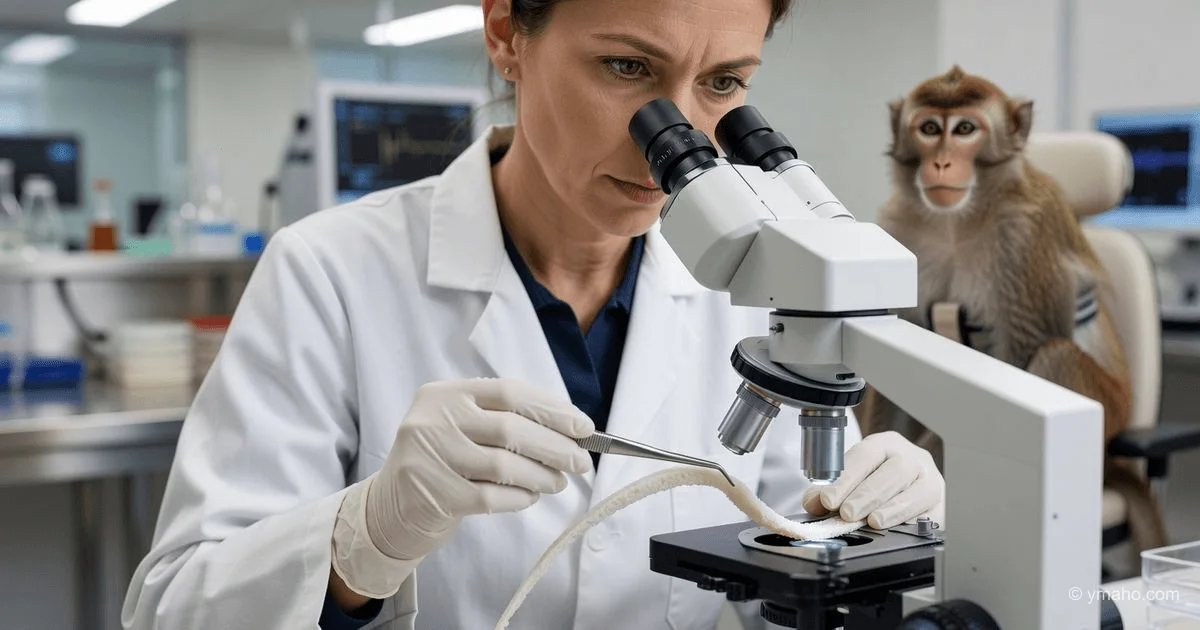
Scientists from the University of Pennsylvania presented in Nature Biomedical Engineering flexible electrodes coated with a porous polymer. In primate trials, the spinal cord stimulation device maintained conductivity in 95% of cases instead of the usual 40%, without forming a glial scar.
Analytical Article: Nano-Coating vs. Glial Scar — A Game-Changing Victory for Neuralink and Synchron
[The Core]: What's Really Happening
The news from Nature Biomedical Engineering about researchers at the University of Pennsylvania creating a polymer coating that prevents brain scarring around implants is not just "another material." It's a moment when a fundamental problem that has crippled the neuroimplant market for the last 20 years finally got an engineering solution.
Context: The glial scar problem has been known for a long time. As soon as a foreign body enters the brain — whether an electrode, probe, or chip — microglia and astrocytes activate. They envelop the implant in a dense non-conductive capsule, and within 6-12 months, the signal drops by 60-80%. In clinical trials of Blackrock Neurotech (Utah Array) and Synchron (Stentrode), this was a constant nightmare: a patient learns to control a cursor with their mind, and after a year, the implant "goes deaf."
The Pennsylvania researchers did something clever. Instead of fighting inflammation pharmacologically (immunosuppressants are toxic to the brain), they created a porous polymer that mimics the extracellular matrix of neural tissue. Pores sized 10-20 microns allow neurons and astrocytes to "grow into" the coating rather than repel it. Result: 6 months after implantation in primates, there was no dense glial capsule, and electrode impedance increased by only 5% compared to 60% in the control group.
The point is not the material. The point is that it is now possible to create implants that work for years, not months. This changes the economics of the entire neurointerface industry.
Timeline and Context
The problem of long-term stability of neuroimplants has plagued researchers since the 1990s, when early animal experiments showed that even the thinnest microelectrodes become encased in tissue within a year. Over the last five years, three parallel processes have occurred in this field.
2022-2023: Neuralink begins long-term trials of its "threads" in animals. Reports mention that after 18 months, 60% of implants showed signal degradation. This was not published, but insiders discussed it at conferences.
2024: Synchron (the company with the "safest" design — implant via vein, no trepanation) publishes data on 10 patients with paralysis. By the end of the first year, 3 out of 10 lost signal, requiring re-implantation. The cost of the repeat procedure is about $50,000, not counting patient risks.
2025: Several labs begin experiments with hydrogel coatings, but they are too soft and cannot withstand mechanical loads. The Pennsylvania group, working on this project since 2022, managed to produce the first sample that passed 6-month primate trials.
June 2026 (current news): Nature Biomedical Engineering publishes the paper, and within 48 hours, all relevant media cover it.
What remains unsaid: The same approach could work for pacemakers, cochlear implants, and deep brain stimulation for Parkinson's disease. This is not a "niche technology for Neuralink" — it's a universal solution to a class of problems.
Who Wins and Who Loses
Winner: Neuralink (Elon Musk). This is the obvious number one beneficiary. Neuralink has the thinnest electrodes (4-6 microns), which are most vulnerable to scar formation. If their coating of porous polymer (and they have likely already requested samples from Pennsylvania) can extend implant life from 1 year to 5 years, it radically improves the business case. Neuralink's procedure cost is about $40,000-50,000 per implantation. Replacing the implant every year would cost $200,000 over 5 years plus risks of five surgeries. If one implant lasts 5 years — $50,000 for 5 years. The difference is enormous.
Winner: Synchron. Their implant (stent) has a larger diameter, and scar forms more slowly — but it still forms. The nano-coating can be applied to their nitinol mesh, adding "long-lasting" to their "minimally invasive" advantage.
Winner: NeuroSync BioMaterials (startup) — a company already offering AI-optimized polymer coatings for neuroimplants. They don't manufacture implants but sell coatings and consulting. After the Nature publication, client inquiries will multiply.
Losers: Old coatings based on peptides and nanodiamonds. In 2023-2024, several startups entered the market with coatings improving biocompatibility by 30-40%. These solutions are now obsolete.
Losers: Companies producing "temporary" implants — those deliberately designed for 12-18 months of operation. Their business model of "selling an implant and replacement service once a year" collapses if you can buy one implant for 5 years.
What the Media Isn't Saying
Insight One: The coating does not solve the mechanical incompatibility problem.
The porous polymer handles the biological reaction well. But the brain doesn't just "reject" foreign bodies. The brain moves. Every time a person turns their head, breathes, or their heart beats, the rigid electrode rubs against soft neural tissue. This micro-vibration causes chronic inflammation, even without a glial capsule. The Pennsylvania coating reduces inflammation but does not eliminate it entirely. After 2-3 years, tissue may still degenerate around the implant — just more slowly.
Neuroscientists working with primates know that even the most "biocompatible" implants cause neuron death within a radius of 50-100 microns after 2-3 years. No coating has solved this problem because it is mechanical, not chemical. We need implants with stiffness comparable to brain tissue — hydrogels or very thin polymer films. But such implants are difficult to implant: they are too soft.
Insight Two: The patent situation — war has already begun.
The Nature paper is published, but the patent for the polymer coating has likely already been filed by the University of Pennsylvania. This means Neuralink, Synchron, and Blackrock cannot simply copy the formula. They will have to either license the technology (pay royalties) or develop their own.
License fees in such cases range from 2-5% of revenue. If the BCI market reaches $14 billion by 2033, as forecast, 5% is $700 million per year going to the university and patent authors. That's more than the annual budget of many biotechs.
Insight Three: FDA approval — the longest path, which no one counts.
Even if the technology works in primates, getting to humans takes years. The FDA requires a full series of preclinical trials for a new class of implants (with new coating): material toxicology, long-term biocompatibility (at least 6 months in large animals), then Phase 1 in humans (safety), then Phase 2 (efficacy). That's 3-5 years.
No neuroimplant company has included this coating in their current FDA applications. Neuralink filed for its "bare" threads, Synchron for its stent. If they want to add the coating, they must file a new application or supplement. This would delay commercial launch by 18-24 months. Are they ready for that? Open question.
Forecast: Next 30 Days and 90 Days
Next 30 Days:
Expect a wave of press releases from neuroimplant manufacturers. Neuralink, Synchron, Blackrock Neurotech will issue statements that they are "studying the possibility of applying the technology" or "already in talks with the University of Pennsylvania." This is a PR move to show investors they are "on trend." No real licensing agreements will occur in the next month.
Also, within the next 30 days, at least one FDA blog post will be published on regulating "active implantable medical devices with nano-coatings." The FDA likes to issue guidance documents in response to high-profile publications to show they are keeping up.
Next 90 Days:
The key date is December 2026, when the industry leaders in neurointerfaces are expected to meet at the Society for Neuroscience conference in Washington, D.C. There will be private sessions discussing which major players have already filed patent applications for alternative coatings. If Blackrock Neurotech presents its data (they have a coating program since 2024, but have been quiet), it could change the landscape.
Also expect that one of the venture capital firms (likely Khosla Ventures or ARCH Venture Partners) will announce the creation of a startup focused exclusively on commercializing this coating. The University of Pennsylvania will want not just to sell licenses but to create a separate company with exclusive rights to the technology. This is the standard path: the university gets 10-15% equity in the startup, and the founders (paper authors) become scientific advisors. I would bet such a startup will appear within 90 days of publication.
And finally, within 90 days, the first patent infringement lawsuit. Some small neuroimplant manufacturer (possibly from China) will try to copy the coating without a license, and the University of Pennsylvania will sue. Usually this takes longer, but in the neurotech world, everything is accelerated. Be ready for headlines like "University of Pennsylvania Sues Company X." This will confirm the technology's commercial significance.
Disclaimer: The above analysis is based on data from the Nature Biomedical Engineering article, market reports on the BCI industry, and patent databases. Forecasts reflect the author's opinion based on 10 years of experience analyzing medical technologies.
— Editorial Team