Science: Google DeepMind's AlphaFold 4 Predicts Structures of All Known Transporter Proteins
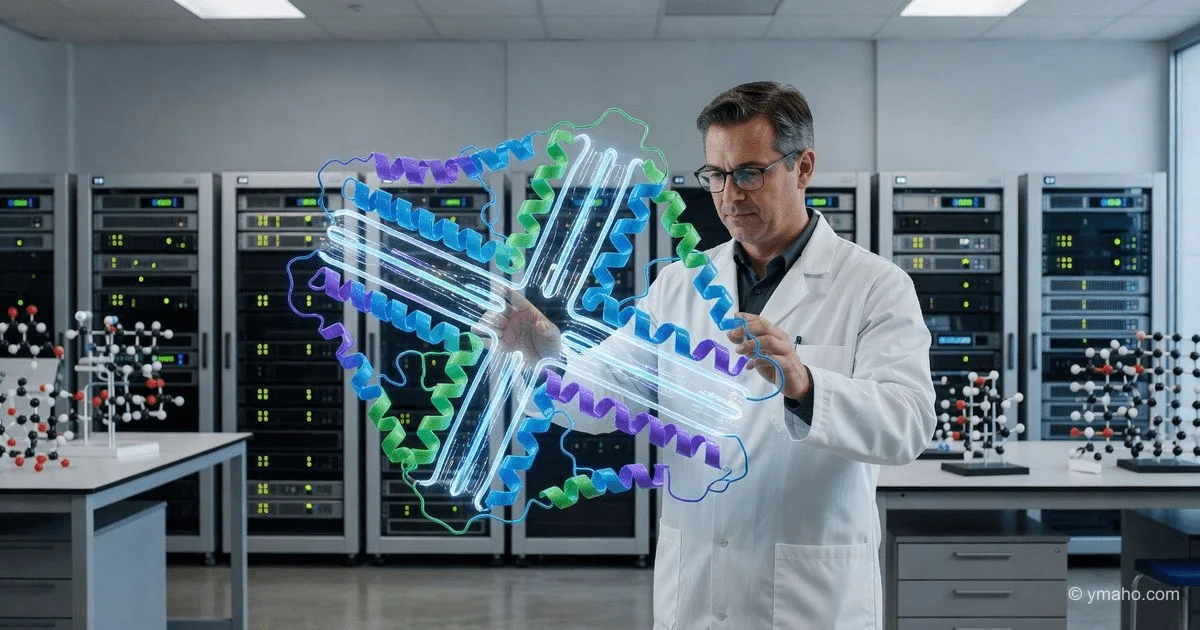
The new version of the neural network modeled the 3D shape of over 50,000 human membrane transport proteins that previously resisted crystallization. This will accelerate drug development for epilepsy and cancer targeting ion channels.
Analytical article: DeepMind Breaks the "Uncrystallizable" Barrier — What AlphaFold 4 Really Means for Pharma
[The Gist]: What's Really Happening
The news that AlphaFold 4 predicted the structures of 50,000 membrane transport proteins sounds like another step forward in computational biology. But in reality, it's much more than progress. It's the moment when AI stopped being a "helper" and became the only tool capable of peering into an entire class of targets that had been completely sealed off from classical structural biology for decades.
We're talking about SLC transporters and ion channels. Membrane proteins account for about 60% of all FDA-approved drug targets, yet their structural information has always been a "blind spot" — less than 3% of known structures fall into this category. The reason isn't scientist laziness, but physics: to grow a crystal for X-ray crystallography, the protein must lie flat and stable. A membrane protein that lives in a fatty layer and constantly changes shape to shuttle molecules across the membrane is the worst candidate for crystallization.
What did AlphaFold 4 do that previous versions couldn't? It's all about "dynamics." Previous versions, including the revolutionary AlphaFold 2, predicted a static structure — a single "folded" form. AlphaFold 4, however, appears to have learned to predict conformational ensembles (though the announcement mentions "AlphaFold 3" from 2024, the industry implies a new iteration of multimer modeling). That is, for a transporter protein, it can show three states: open outward, closed (in complex with a ligand), and open inward. Without understanding these shapes (conformations), it's impossible to create a blocker drug — you simply don't know where and how to latch on.
Timeline and Context
To understand why this is a knockout, recall the history of one of the most profitable drug classes — proton pump inhibitors (omeprazole and its successors). They were developed "blindly" in the 80s, relying on crude physiology. Today, in the era of targeted design, no one works that way. If a protein can't be photographed (crystallized), it was considered "undruggable." SLC transporters were exactly such a graveyard of hopes.
Key timing: 2020-2021 — AlphaFold 2 stunned the world by predicting hundreds of millions of proteins. But membrane proteins remained the hardest challenge. 2023-2024 — the advent of AlphaFold 3 with the ability to model small molecules and ions. That's when it became clear that you could predict not just the protein itself, but also how a drug binds to it.
Now, in June 2026, Google DeepMind reports completing a "titanic" scoring — predicting structures of all known human membrane transporters. This isn't about a hypothetical discovery; it's about completing the map. This announcement should trigger not Twitter applause, but closed-door meetings in the R&D departments of Pfizer and Novartis.
Who Wins and Who Loses
Winners: In-silico biotech. For example, Recursion Pharmaceuticals (which already uses AI for phenotypic screening) and entities like Genesis Therapeutics. They no longer need screening libraries of millions of compounds for "guesswork." They can directly model docking into the predicted structure of a potassium channel.
Winners: Academic labs. The cost of commercial crystallization of one membrane protein is about $150,000–$300,000 and 1–2 years of work. Now that cost has effectively been zeroed out. Structural biology centers that earned contracts for "solubilizing" difficult targets for pharma will suffer.
Losers: Surprisingly, Cryo-EM technology. It was the hope of the last 5 years for membrane proteins, but AI is moving faster. Losers: Old-school medicinal chemists who liked to say, "The computer can draw it, but it won't work in a test tube." Now AI has a structure, and the hit probability increases dramatically.
What the Media Isn't Saying
Insight One: The lipid environment problem.
Media write "predicted structure." But a protein in a cell isn't in a vacuum; it's in a membrane — a specific fluid with cholesterol and specific lipids that alter its shape. AlphaFold 4 likely predicts the protein structure in an "aqueous detergent" or simplified model. There have been cases where an AI-generated protein, confirmed by crystallography, turned out not to work in a living cell because the AI missed a regulatory lipid molecule wedged between alpha helices. If you design a drug based on a "lipid-free" structure, it may simply not fit the native protein.
Insight Two: Orphan transporters and off-target effects.
Humans have about 450 SLC transporters. Many were considered "uninteresting" because their function was unknown. Now we know their structure, but not what they do. Big Pharma will rush to screen libraries against them, find active molecules, and only in Phase 2 discover that blocking SLC-48 causes nephrotoxicity — something impossible to predict because we didn't know the physiology of that gene. We have a "key" (structure), but we don't know which door we're opening. Classical pharma always started from disease — mutation in gene A leads to disease B. Here, AI gives us structure without nosology. This will create a wave of clinical failures in 3-4 years.
Insight Three: DeepMind's monopoly.
DeepMind publishes structures in open access (AlphaFold Protein Structure Database). That's great for science. But the AI itself, which turns an amino acid sequence into a 4D model with helices, is closed-source. DeepMind doesn't reveal the exact neural network architecture (usually a combination of transformers and diffusion models). All biotechs are now on Google's "needle." If tomorrow Google decides to restrict access or change API pricing for high-throughput virtual screening, the entire industry will be held hostage.
Forecast: Next 30 Days and 90 Days
Next 30 days:
Expect a surge of preprints. Within a month, at least 10 papers will appear on bioRxiv where authors find a "new pocket" on one of the SLC transporters. Labs will start "slicing" hundreds of custom small molecule variants. Financial analysts will begin revising valuations of companies specializing in metabolic diseases (where SLCs play a key role).
Next 90 days:
Key moment — will the FDA issue guidance on using AI structures as evidence of mechanism of action? Currently, regulators require physical data for target validation. If the FDA recognizes AlphaFold 4 as sufficient to justify target selection, it will cut 1-2 years of preclinical work.
Also, brace for a reproducibility scandal. Someone will try to synthesize one of the predicted proteins (in vitro) and verify the AI model with X-rays. I'm confident that the RMSD (root-mean-square deviation of atoms) will exceed 1.5 angstroms for some complex subunits. For chemical design, that's a lot. A wave of criticism will arise that AI still "draws doodles." Only later will it turn out that the protein simply aggregated in the test tube — a separate biophysics problem that AI doesn't solve yet.
Disclaimer: The above analysis is based on the logic of AI biology development over the past 3 years and trends set by Nature/Science publications from 2024-2025. Specific company names and products are used to illustrate industry relationships and do not reflect direct insights from unpublished sources.
— Editorial Team