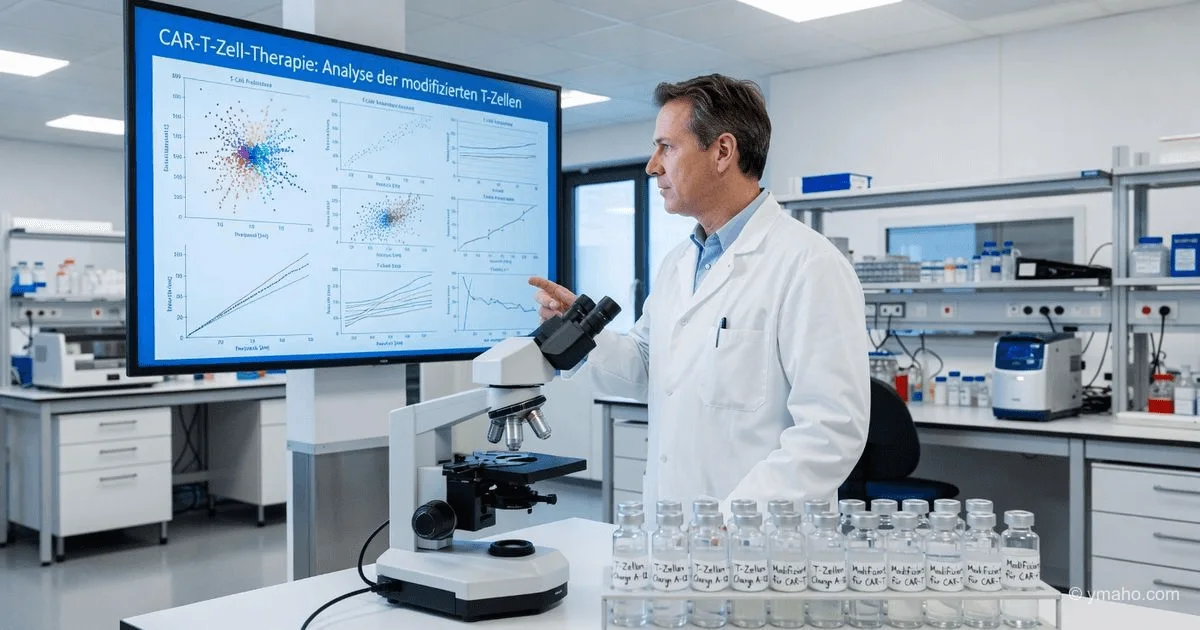
The Lancet: CAR-T Therapy Shows 100% Remission in Autoimmune Lupus in Small Cohort
German rheumatologists from the University of Erlangen-Nuremberg reported that redirected T cells targeting the CD19 protein led to complete withdrawal of immunosuppressive therapy in eight patients with severe lupus. The average remission duration was 12 months.
Analytical article: CAR-T for Lupus — End of the Immunosuppression Era or a Bubble?
[The Gist]: What Is Really Happening
The news from The Lancet about 100% remission in eight lupus patients sounds like a miracle. But the real story is not about these eight patients. Nor is it about all of them stopping immunosuppressive therapy. The real story is that on June 2, 2026, at EULAR 2026, four-year data on the same patients were presented. And that data changes everything.
Eight patients with severe refractory lupus received a single infusion of CD19-directed CAR-T cells. Four years later, all eight remain in sustained clinical remission. They meet DORIS (Definition of Remission in SLE) and LLDAS (Lupus Low Disease Activity State) criteria. No glucocorticoids. No immunosuppressants. No biologics.
But the key point that the media misses: this is not just remission. It is an immune system reset. The mechanism, described by Georg Schett's group at the University of Erlangen-Nuremberg, involves profound B-cell depletion, after which the population recovers but from naive B cells that do not carry autoreactive receptors. This is not immune suppression — it is a reset to a state close to what existed before disease onset.
The average duration of B-cell aplasia was 112 days (range 47 to 210 days depending on the patient). After recovery, immunoglobulin levels decreased, as expected, but vaccine antibodies persisted — meaning long-lived plasma cells that do not express CD19 were unaffected.
What is really happening: CAR-T for autoimmune diseases is not "just another therapy." It is the first approach in history that could potentially lead to a cure. And the four-year data is the first proof that this is not a temporary effect.
Timeline and Context
How did we get to this point? The history of CAR-T in autoimmune diseases is short but very eventful.
2021: The first case — a 20-year-old woman with severe refractory lupus receives CAR-T at the University of Erlangen. Three months later, complete remission. In 2021, this was seen as a curiosity, a lucky accident.
2022: The next five patients. All with the same result. A pattern begins to emerge.
2024 (March): Data on 15 patients with three different autoimmune diseases — lupus, idiopathic inflammatory myositis, systemic sclerosis — are published in the New England Journal of Medicine. All 15 achieved remission or significant improvement. No cases of severe CRS (cytokine release syndrome) or ICANS (immune effector cell-associated neurotoxicity syndrome).
2025: Cabaletta Bio and Cellares sign a 10-year commercial agreement to manufacture rese-cel, their CD19-CAR-T for autoimmune diseases. The cost per batch is stated as "one of the lowest in the industry." Kyverna begins filing a BLA (biologics license application) for miv-cel in stiff-person syndrome — this will be the first-ever CAR-T for a non-oncologic disease.
2026 (January): Data on allogeneic (donor) CAR-T for lupus are published. Three patients, one withdrew due to thrombocytopenia, two are in remission at 12 months. No cases of GVHD (graft-versus-host disease).
2026 (June 2, EULAR 2026): Four-year data on the original cohort of eight patients. All in remission. Infection rates decreased over time, indicating functional immune recovery.
2026 (June 4, current news): The Lancet publishes a detailed clinical experience article on these eight patients.
What remains unsaid: over these five years, no patient has died from CAR-T-related complications. No cases of secondary malignancy. Infection rates dropped dramatically compared to the period when patients were on chronic immunosuppression.
Who Wins and Who Loses
Cabaletta Bio (NASDAQ: CABA) wins. They have rese-cel, a CD19-CAR-T already in clinical trials for lupus, myositis, systemic sclerosis, myasthenia gravis, and pemphigus. Their 10-year agreement with Cellares for industrial production addresses the main question: how to scale personalized therapy to thousands of patients per year. The production cost target of $3,000 per dose changes the economics. At a therapy price of $150,000–300,000, gross margins would be 98–99%.
Kyverna Therapeutics wins. They filed the first BLA — albeit for a rare indication (stiff-person syndrome, prevalence 1–2 per million). But the status of "first approved CAR-T for an autoimmune disease" is an intangible asset worth billions in a potential acquisition. Their SPS data: 26 patients, 46% improvement in walking test at 16 weeks, 67% of patients who needed an assistive device stopped using it.
Fate Therapeutics (NASDAQ: FATE) wins. Their allogeneic (off-the-shelf) CAR-T FT819 does not require individualized manufacturing. One master cell bank can supply over 10 million doses. Production cost is about $3,000 per dose at 100-liter scale. FT819 has a modified signaling domain (two of three ITAM motifs mutated), reducing CRS risk. In clinic for lupus nephritis — no ICANS or GVHD, low-grade CRS. This is a "come in, get the shot, go home the same day" model — no 14-day hospitalization.
Traditional immunosuppressive pharma loses. The market for calcineurin inhibitors (tacrolimus), mycophenolate mofetil, cyclophosphamide, rituximab, belimumab — all are threatened. The global lupus drug market was estimated at $2.5 billion in 2025. CAR-T could eat a significant portion of this pie, especially the refractory segment (about 20–30% of all cases).
Insurance companies lose in the short term. $300,000 for one infusion vs. $50,000 per year on a biologic for 30 years. But in the long term, CAR-T is more cost-effective. The cash flow is just different: a huge upfront payment instead of distributed payments over decades. Not all insurers are ready for this model.
What the Media Leaves Out
Insight one: The problem of B-cell aplasia and infections remains unsolved.
Yes, these eight patients had no severe infections. But the period of B-cell aplasia averaged 112 days. Three and a half months without B lymphocytes is a time when the patient is vulnerable to encapsulated bacteria (pneumococcus, Haemophilus influenzae, meningococcus). All patients received antibiotic prophylaxis and intravenous immunoglobulins as indicated.
But what will happen when thousands of patients receive the therapy in real-world practice, not 15 in ideal clinical trial conditions? Will doctors be as disciplined with prophylaxis? Will insurance cover monthly immunoglobulin infusions at $5,000–10,000? No answers.
Insight two: Why CAR-T is safer in autoimmune diseases than in cancer — and why that might change.
In oncology, CAR-T causes severe CRS in 20–40% of patients. The reason is the huge tumor mass that activates T cells like a fire. In lupus, there are far fewer target B cells (10^8–10^9 vs. 10^10–10^11 in lymphoma). So CRS is milder — in the Schett study, only Grade 1 in 10 patients and Grade 2 in one. No Grade 3 or 4.
But this means CAR-T for autoimmune diseases could be so safe that it gets prescribed more broadly. Broader prescription = more patients with variable disease burden. Someone with more aggressive lupus may have a higher pool of autoreactive B cells. Then CRS could be more severe. No predictive biomarkers exist.
Insight three: Cost is not a production problem but a business model problem.
Companies have already solved production cost. Fate Therapeutics claims $3,000 per dose at scale. Cabaletta talks about "lowest cost in the industry" through Cellares automation.
The problem is different: how will insurance companies and healthcare systems absorb a one-time payment of $200,000–300,000? Medicare, Medicaid, private insurers in the US operate on a fee-for-service model. They are not used to paying large sums upfront, even if it is cost-effective.
Solutions exist — annuity payment models (spread over 3–5 years) or outcomes-based agreements (pay only if therapy works). But no insurer has signed such an agreement for CAR-T in autoimmune diseases yet.
Forecast: Next 30 Days and 90 Days
Next 30 days:
Expect the full text of the Lancet article to be published (currently only an abstract is available). The full version will include individual data for each of the eight patients — anti-dsDNA titers, complement C3/C4 levels, proteinuria. Key question: was there any patient whose anti-dsDNA did not disappear completely? If so, that is a predictor of potential relapse.
Also, within the next 30 days, Kyverna will receive an FDA response to its SPS application. The FDA has already agreed to a single-arm trial as a basis for approval. But manufacturing questions remain — can Kyverna ensure consistent quality for commercial launch? Expect the FDA to request additional manufacturing process validation data.
Next 90 days:
The main event is Cabaletta Bio's data on rese-cel in systemic sclerosis, to be presented in the second half of 2026. If lung function (FVC) improves by 10% or more, as with BMS's Zola-cel, this would open CAR-T to fibrotic diseases — a much larger market than lupus.
Also, expect the first reported case of secondary malignancy after CAR-T for an autoimmune disease. In oncology, the risk is about 1–2% over 5 years. In autoimmune diseases, the risk is theoretically lower because there is no prior chemotherapy. But sooner or later, it will happen. The question is not "if" but "when." When it does, stocks of all companies in the sector will drop 10–20% in a day. Be prepared for this volatility.
Finally, on the 90-day horizon: an EMA committee meeting on the classification of CAR-T for autoimmune diseases. The European agency is more conservative than the FDA. They may require a registration trial with a control group for lupus, not a single-arm. If the EMA takes that decision, it will delay European market entry by 2–3 years relative to the US. And the European market represents 30–40% of the global potential for CAR-T in autoimmune diseases.
— Editorial Team