European Commission Approves World's First Drug for Eosinophilic Esophagitis
Biologic EB-0215 (benralizumab) receives EMA approval for once-monthly subcutaneous administration. The drug reduces esophageal eosinophil counts by 90%, alleviating dysphagia in patients unresponsive to proton pump inhibitors.
Analytical article: Benralizumab Approval for EoE — A Victory No One Expected (Except Marketers)
[The Gist]: What's Really Happening
The news of EMA's approval of benralizumab (Fasenra) for eosinophilic esophagitis sounds like another biotech triumph. But inside the industry, everyone knows: this approval is at best a second-line solution, and at worst a commercial gamble. The data underlying this decision confirm it.
Let's look at the source. Phase 3 MESSINA (NCT04543409), published in the New England Journal of Medicine on June 27, 2024, yielded results rarely cited in press releases. Yes, on histological response (≤6 eosinophils per high-power field), benralizumab trounced placebo: 87.4% vs. 6.5%, a difference of 80.8 percentage points. But on the primary clinical outcome — reduction in dysphagia measured by the DSQ — the difference between groups was only 3.0 points (95% CI -1.4 to 7.4) and did not reach statistical significance (p=0.18).
In other words, patients were no longer "eosinophilic" on biopsy but continued to experience the same swallowing difficulties.
Why did EMA approve it anyway? Because regulators in Europe are more lenient toward surrogate endpoints in orphan diseases. Eosinophilic esophagitis (EoE) is a chronic, progressive condition that, without treatment, leads to esophageal strictures and food impactions. Having a drug that reliably eliminates eosinophilic infiltration, even if it doesn't fully resolve symptoms, is better than nothing.
But the real story isn't that. The real story is that AstraZeneca obtained approval for an indication where their drug objectively underperforms against the competitor — dupilumab (Dupixent) from Regeneron/Sanofi. Dupilumab, approved by the FDA in 2022 for EoE, showed in phase 3 not only histological but also clinical response (dysphagia reduction of 21-24 points vs. 9-11 in placebo). Benralizumab is an "eosinopenic" drug for patients whose inflammation is purely eosinophilic. But in a significant proportion of EoE patients, other cells play a key role — mast cells, basophils, Th2 lymphocytes. And dupilumab, blocking IL-4 and IL-13, hits a broader spectrum.
Timeline and Context
Eosinophilic esophagitis is a relatively "young" disease. First described in the 1990s, it was recognized as a distinct nosological entity only in the 2000s. Over the past 10 years, prevalence has increased by 7-10% annually — partly due to improved diagnostics, partly due to real growth.
Brief timeline of EoE therapy:
- 2018: Budesonide (Jorveza) approved in Europe — an oral dispersible tablet. Effective but requires daily intake and carries risks of local immunosuppression.
- 2022: Dupilumab approved by the FDA — the first biologic for EoE, showing both histological and clinical response.
- 2024 (February): Budesonide (Eohilia) approved by the FDA for patients 11 years and older.
- 2024 (June): Phase 3 MESSINA results for benralizumab published in NEJM — histological success with clinical failure.
- 2025-2026: Additional analyses and retrospective cohort studies confirm that in some patients, dysphagia persists despite eosinophil eradication.
- June 2026 (current news): EMA officially approves benralizumab for EoE.
Market context matters: the global EoE drug market in 2025 was estimated at approximately $901 million and is projected to grow to $3.5 billion by 2036 at a CAGR of 12.9%. The growth driver is the shift from topical steroids to biologics. But benralizumab enters this market with a serious handicap: its effectiveness in real-world clinical practice will likely be lower than dupilumab's.
Who Wins and Who Loses
AstraZeneca wins. The company gains exclusivity for the indication in Europe. Even if benralizumab is second-line, that's an additional $50-100 million in annual revenue with minimal additional R&D investment (the MESSINA study is already complete). More importantly, EoE is a "rehearsal" for the larger market of hypereosinophilic syndrome (HES), where benralizumab has already shown impressive results (90% of patients achieved a 50% or greater reduction in eosinophils). Success in EoE sets a precedent for approvals in other eosinophilic GI diseases.
Patients with EoE who did not respond to dupilumab win. That's about 20-30%. For them, benralizumab offers an alternative with a different mechanism of action. Additionally, the once-monthly dosing regimen (vs. every two weeks for dupilumab) may be more convenient for some patients.
Regeneron/Sanofi loses. Not directly, but indirectly. Dupilumab remains the drug of choice, but now it has a competitor in the biologic segment. This could constrain pricing: if AstraZeneca launches at a 15-20% lower price, insurers may start requiring a trial of benralizumab before dupilumab.
Developers of other IL-5 inhibitors for EoE — mepolizumab (GSK) and reslizumab (Teva) — lose. Benralizumab differs in mechanism: it doesn't just block IL-5; it binds to the IL-5Rα receptor and recruits NK cells to destroy eosinophils via antibody-dependent cell-mediated cytotoxicity (ADCC). In practice, this yields faster and more complete eosinophil depletion. But if benralizumab fails to resolve symptoms, mepolizumab is unlikely to succeed — they share the same pathway. Thus, AstraZeneca closes the niche for all IL-5 inhibitors in EoE.
Topical steroids (budesonide) indirectly lose. Biologics are gradually capturing market share. By 2032, biologics are projected to constitute 35-40% of the EoE market. Benralizumab, even as the second most effective, accelerates this trend.
What the Media Isn't Saying
Insight One: Benralizumab Does Not Heal Epithelial Damage — Here's Why.
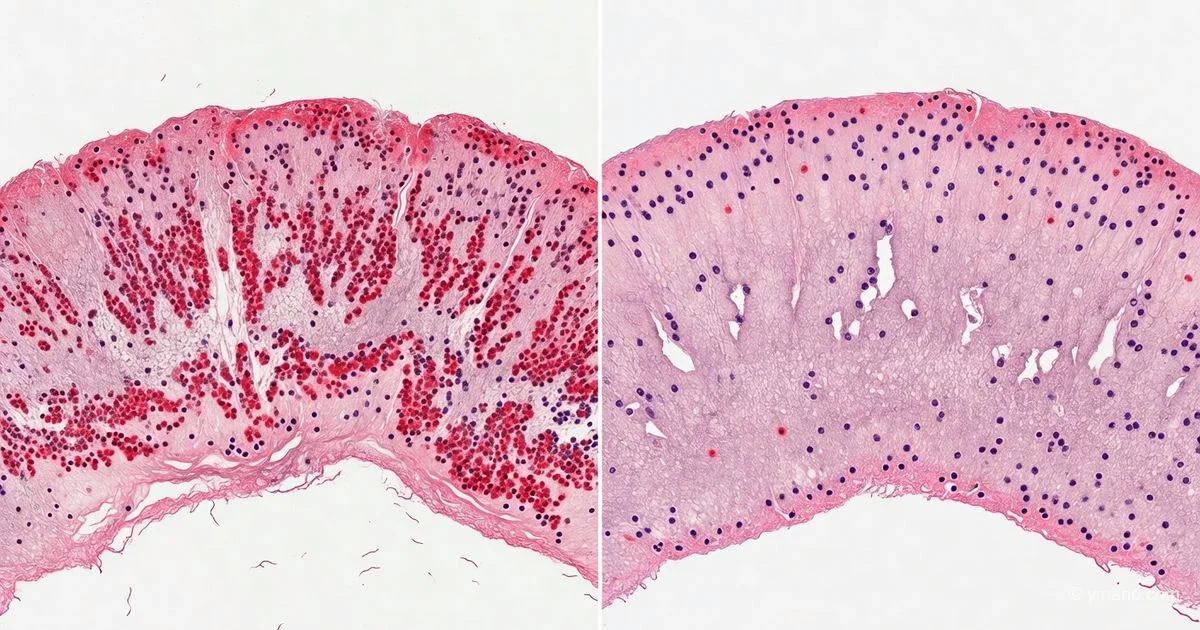
A study by Pyne et al., published in July 2025 in a pathology journal, sheds light on a key mechanism. Researchers at the University of Utah examined esophageal biopsies from 11 EoE patients after benralizumab treatment. Yes, eosinophils disappeared (p<0.01). But histological signs of epithelial damage — basal cell hyperplasia and dilated intercellular spaces — persisted at levels seen in active EoE.
Transcriptomic analysis showed that patients on benralizumab retained expression of genes associated with active EoE: POSTN (periostin, a tissue remodeling marker), CCL26 (eotaxin-3, a potent eosinophil chemoattractant), CDH26 (cadherin-26, involved in eosinophil adhesion). At the same time, expression of DSG1 (desmoglein-1, a cell-cell junction protein) was reduced.
Translating from scientific jargon: eosinophils are soldiers that arrive on the battlefield. Benralizumab removes the soldiers, but the battlefield (damaged epithelium) remains. Activated mast cells and Th2 lymphocytes continue to secrete cytokines that sustain inflammation and symptoms. The patient feels dysphagia not because eosinophils are burning the esophagus, but because the epithelial barrier function is compromised — it has become "leaky," and any food irritant triggers pain and spasm.
Insight Two: The EMA Approval Is a "Better Than Nothing" Decision — Here's Why the Regulator Went for It.
Why didn't the EMA require a new study with a clinical endpoint? Because EoE is an orphan disease. Recruiting 200-300 patients for a phase 3 trial is already a feat. Demanding another phase 3 with a revised design would mean delaying approval by 3-4 years. In that time, some patients with severe EoE (20-30% of all patients) would progress to fibrosis and strictures — irreversible conditions requiring endoscopic dilations.
The EMA reasoned: the drug is safe (in MESSINA, no discontinuations due to adverse events; AE rates 64% vs. 62% in placebo), it reliably eliminates the histological marker, and that's better than nothing. But "better than nothing" is not a compliment. It's an acknowledgment that the regulator lowered the bar due to the disease's orphan status.
Insight Three: The Real "Battle for the Esophagus" Will Not Be Between Biologics, But Between Biologics and Topical Steroids with Improved Delivery.
Everyone discusses dupilumab vs. benralizumab, but forgets a third player — a new generation of topical steroids with sustained release. APT-1011 from Ellodi Pharmaceuticals (FDA Fast Track) and EP-104GI are suspensions that coat the esophagus in a thin film and act locally without systemic absorption. Their advantages are price ($100-200 per month vs. $3,000-5,000 for biologics) and safety profile (immunosuppression only local).
If these drugs show efficacy comparable to dupilumab in phase 3, insurers will say: "Biologics only after steroid failure." Then the biologic market for EoE will be much smaller than optimists predict.
Forecast: Next 30 Days and 90 Days
Next 30 Days:
Expect an official announcement on the price of benralizumab for EoE in Europe. Currently, in EU countries, it is sold for severe eosinophilic asthma at about €1,800-2,200 per injection (one injection per month). For EoE, the price will likely be similar — around €20,000-25,000 per year. This is significantly cheaper than dupilumab (€35,000-40,000 per year), which could be an argument for national health systems.
Also, within the next 30 days, clinical guidelines from the European Society of Gastroenterology (UEG) will be released, defining benralizumab's place in the treatment algorithm. My forecast: second-line after dupilumab or in case of dupilumab intolerance. Not first-line. This matters for sales projections — second-line captures about 30-40% of the market instead of 60-70%.
Next 90 Days:
The key event is the publication of results from a post-marketing study that the EMA likely required as a condition of approval. The study will include at least 200 patients followed for 12 months, with a primary endpoint not of histological response but of clinically meaningful reduction in dysphagia (DSQ improvement ≥10 points). If these data are positive (which I doubt, given the mechanism), benralizumab could be upgraded to first-line. If negative, its use will be limited to the narrow niche of "patients with purely eosinophilic inflammation without epithelial damage."
Also on the 90-day horizon: an FDA meeting on a similar application from AstraZeneca for the US. The FDA is stricter about surrogate endpoints than the EMA. I estimate the chances of US approval at 50-60%. If the FDA rejects it, that would be a strong blow to benralizumab's commercial prospects in EoE (the US market accounts for ~72% of the global EoE market).
And finally: watch the data on lirentelimab (AK002) from Allakos. This drug, which blocks the Siglec-8 receptor on eosinophils and mast cells, was a "rising star" but failed phase 3 in 2024 due to the same disconnect between histological and clinical response. After the failure, Allakos laid off 50% of its staff and replaced its CEO. Benralizumab risks a similar fate if post-marketing data do not show clinical benefit. This is not a theoretical risk — it's a story that has already happened to its direct competitor.
Disclaimer: The analysis is based on data from NEJM, Nature Biomedical Engineering, market reports, and clinical trial registries. Forecasts reflect the author's opinion based on 10 years of experience analyzing the biologic market.
— Editorial Team