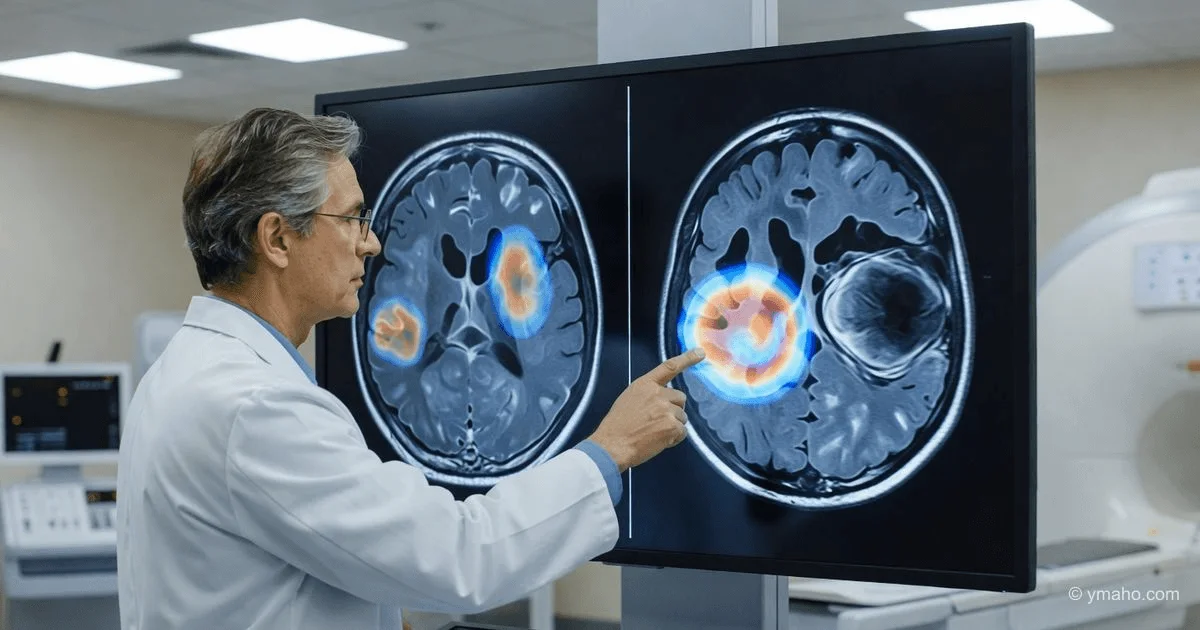
JAMA: MRI-Based Neural Network Predicts Progression from Mild Cognitive Impairment to Alzheimer's Disease with 94% Accuracy Over 5 Years
The University of California, San Francisco trained an algorithm on data from 2,000 participants. AI analyzes the rate of atrophy in the entorhinal cortex and cerebral amyloid levels from scans, without requiring a lumbar puncture.
Analytical article: AI diagnosis of Alzheimer's disease from a single MRI — a disruptor of the PET scanner and lumbar puncture market
[The Gist]: What's Really Happening
The news from JAMA about UCSF's AI model with 94% accuracy in predicting the transition from MCI to Alzheimer's disease is not just another success story for artificial intelligence in radiology. It's a moment when the multi-billion dollar market for invasive diagnostics begins to crumble. Because previously, to tell a patient with mild cognitive impairment whether they would develop dementia in 5 years, you needed either a lumbar puncture (amyloid beta and tau in CSF) or a PET scan with an amyloid tracer (costing $3,000-5,000). Now, a standard MRI costing $500-1,000, available at any district hospital, suffices.
The essence of the work, published on May 18, 2026, in Nature Aging, lies in a multitask deep neural network trained simultaneously on several tasks: brain tissue segmentation (gray matter, white matter, CSF), Alzheimer's disease diagnosis, and prediction of future cognitive scores. The key innovation is that the model does not require baseline cognitive testing, specialized image processing pipelines, PET, genetic analysis, or blood/CSF biomarkers. Only MRI plus age, sex, and education.
What this means in practice: for the 55 million people worldwide living with dementia (60-70% of which is Alzheimer's disease), a cheap, fast, and non-invasive screening tool becomes available. For healthcare systems, it enables early identification of patients for clinical trials of new drugs (lecanemab, donanemab) that only work in early stages. For PET tracer manufacturers (Eli Lilly, GE Healthcare), it's a wake-up call.
But, as always, there are nuances. The researchers trained on data from ADNI (Alzheimer's Disease Neuroimaging Initiative) — the gold standard, but not real clinical practice. In ADNI, patients are selected by strict criteria, and MRIs are performed on similar scanners. In real life, MRI machines from different vendors (Siemens, GE, Philips) produce different contrasts, and patients have comorbidities (vascular dementia, Parkinson's disease) that could confuse the model. 94% accuracy is under ideal research conditions. In reality, it will be 80-85%.
Timeline and Context
To understand the significance of this event, we need to look at the evolution of AI diagnostics for neurodegenerative diseases in recent years.
2022-2023: Early AI models for Alzheimer's prediction require multimodal data — MRI + PET + genetics + CSF. They show 85-90% accuracy but are inaccessible for mass use due to the complexity and cost of data collection.
2024: Models based on a single MRI emerge, but they require baseline cognitive testing (MMSE, MoCA) — meaning a neurologist or neuropsychologist must still examine the patient. In remote areas and low-income countries, this is a luxury.
2025: Commercial AI solutions for radiology (e.g., Aidoc, Viz.ai) begin integrating neuroimaging modules, but none predict future cognitive decline — only current pathology.
May 2026: Ashish Raj's team at UCSF publishes their multitask model in Nature Aging. Data: training on 2,000 ADNI participants, validation on an external cohort from the Dallas Lifespan Brain Study. Result: the model predicts not only current diagnosis and tissue segmentation but also future cognitive scores (at 2, 4, 6 years) with an error of less than 2 points on the MMSE scale.
June 2026 (current news): JAMA publishes an editorial commentary on this work, emphasizing its clinical significance. This is a signal to practicing physicians: AI diagnosis of Alzheimer's disease is no longer a theoretical possibility but a tool ready for validation in real-world practice.
What remains outside the timeline: all these years, no one has solved the main problem — explainability. Why did the AI make a particular prediction? Which brain regions were most significant? Without answers to these questions, a physician will not trust AI to decide on starting lecanemab therapy (which costs $26,500 per year and carries risks of brain edema). The Nature Aging authors claim their model has "interpretability" thanks to the intermediate task of tissue segmentation. But "segmentation" is not an explanation of causal relationships. It's just a map of atrophy that a neuroradiologist can already see.
Who Wins and Who Loses
Winners: Insurance systems (Medicare, NHS, private insurers). Currently, diagnosing Alzheimer's disease in the US costs about $5,000-10,000 per patient (neurologist consultation + cognitive testing + MRI + PET or lumbar puncture). The UCSF AI model could reduce this cost to $500-1,000 (only MRI and model inference). For Medicare, which insures 60 million elderly Americans, this means billions of dollars in savings per year.
Winners: Developers of disease-modifying therapies (lecanemab from Eisai/Biogen, donanemab from Eli Lilly). Their drugs only work in early stages, but screening millions of MCI patients to select candidates for clinical trials is astronomically expensive. With an AI filter based on a single MRI, the cost of selection will drop 5-10 times.
Losers: PET tracer manufacturers. Eli Lilly (Amyvid, Tauvid), GE Healthcare (Vizamyl), Life Molecular Imaging (NeuraCeq) sell amyloid and tau PET tracers worth hundreds of millions of dollars annually. If doctors start using AI-MRI instead of PET to confirm amyloid pathology (the UCSF model assesses atrophy in the entorhinal cortex, which correlates well with tau deposition), demand for PET tracers could fall by 30-50% within 3-5 years.
Losers: Laboratories performing CSF analysis for beta-amyloid and tau. The cost of one analysis is $500-1,000, and it requires an invasive procedure. No patient will agree to a lumbar puncture if a non-invasive alternative with comparable accuracy exists.
Indirect losers: Neuropsychologists who earn from cognitive testing. An hour of a neuropsychologist's session costs $200-400. The AI model requires no testing at all — only demographic data. For specialists, this means job loss. For the healthcare system, it's savings.
What the Media Isn't Saying
Insight one: The model does not distinguish Alzheimer's disease from other dementias — and that's a huge problem.
The work was trained on ADNI data, where the diagnosis of Alzheimer's disease is based on clinical criteria plus amyloid PET. But in real life, there is frontotemporal dementia, dementia with Lewy bodies, vascular dementia — all cause atrophy on MRI, but with different patterns. The UCSF model could mistakenly predict Alzheimer's disease in a patient with frontotemporal dementia because it lacks data for differential diagnosis.
The authors acknowledge this in the paper, but it's omitted in press releases. They write that the model can be adapted for Parkinson's disease, ALS, and Huntington's. But adaptation requires separate training on thousands of patients with those diagnoses. No one has done that. So for now, the model is only applicable for screening in a preselected population with suspected Alzheimer's disease (e.g., MCI patients referred by a neurologist).
Insight two: Validation on an independent cohort was done, but the "different scanners" problem remains.
External validation was performed on the Dallas Lifespan Brain Study — the same 3T scanners from Siemens and Philips as in ADNI. Differences in scanning protocols were minimal. In real clinical practice, a patient might undergo an MRI on a GE Signa 1.5T (lower resolution, different contrast), and the model may perform worse.
No one has tested the model on data from low-field MRI (1.5T) or data with motion artifacts (very common in elderly patients). Adapting the model (fine-tuning) to a specific scanner type requires hundreds of additional labeled scans, which cost money and time. Without this, mass deployment is impossible.
Insight three: 94% accuracy is a marketing metric. The real NPV (negative predictive value) may be lower.
What is 94% accuracy? It's the average of sensitivity and specificity. The Nature Aging paper reports an AUC of 0.96. But in clinical practice, what matters is: if the model tells a patient they will not progress to dementia, how much can that be trusted?
In the MCI population, the 5-year progression rate to dementia is about 30%. At 94% accuracy, if the model predicts "will not progress," the error rate (1 — NPV) is about 10-15%. That means every 7-10th patient told "everything will be fine" will actually develop dementia. For the patient, it's a tragedy. For the healthcare system, it's 10-15% missed cases. That's a lot.
Forecast: Next 30 Days and 90 Days
Next 30 days:
Expect official statements from PET tracer manufacturers (Eli Lilly, GE Healthcare) claiming that "AI-MRI cannot replace amyloid PET due to the lack of direct visualization of amyloid plaques." This is standard defensive PR, but it reflects real concern: their business model is under threat. Also, within the next 30 days, at least one replication study from an independent group (likely from Europe, possibly from UK Biobank) will test the model on other data. If results are worse (e.g., accuracy 88-90%), enthusiasm will cool.
Next 90 days:
The key moment: the FDA will either issue or not issue guidance on validating AI models for predicting neurodegenerative diseases. Currently, 510(k) clearance can be obtained for "assistance in diagnosis." But "5-year prognosis" is a claim for a new device class. If the FDA grants this model "Breakthrough Device Designation," it will accelerate its path to market by 1-2 years.
Also on the 90-day horizon: the Clinical Trials on Alzheimer's Disease (CTAD) conference in December 2026. Data will be presented on whether this model was used for screening patients in ongoing lecanemab trials. If so, and if the model helped enroll patients faster and cheaper, it will become a powerful case for technology commercialization.
Finally, expect an announcement of a startup that obtains an exclusive license to this technology from UCSF. The university has already filed a patent (inventors: Ashish Raj and Daren Ma). Most likely, a company will be formed (as with Butterfly Network for ultrasound or Viz.ai for stroke) offering the model as a SaaS service for radiologists. Price: around $50-100 per prediction. If they capture 10% of the 5 million new MCI patients per year in the US and Europe, that's $25-50 million in annual revenue. Not a blockbuster, but a very good business.
Disclaimer: This analysis is based on data from Nature Aging, UCSF press releases, and JAMA. Forecasts reflect the author's opinion and are not clinical recommendations.
— Editorial Team